Dunsley Hall. Built in 1900 for Frederick Haigh Pyman, a man dedicated to the sea
Built: 1900 Owner: Wood and Stone Developments Ltd Country house hotel
There is a certain mystery about Dunsley Hall. This late Victorian building is prominently situated in the small hamlet of Newholm-cum-Dunsley, a few miles outside Whitby. It offers distant sea views which made it an idyllic spot for Frederick Haigh Pyman to build his holiday home back in 1900. Its location at the heart of the village rather flew in the face of his contemporaries who were much happier hiding away from prying country folk. Today, it sits blissfully beside a handful of cottages, a former chapel and the odd farmstead, altogether the perfect rural setting.
To understand why he chose Dunsley we must first look at his family background. Frederick Haigh Pyman (1858-1932) was the seventh child of George Pyman (1822-1900) of Sandsend, a small fishing village close to Whitby.
George Pyman (1822-1900) (The Pyman Story)
At the age of ten George Pyman joined the family fishing boat and immediately developed a competency for the sea. By the time he was 21 he was captain but had far greater ambitions. He married Elizabeth English (1821-1893) in 1843 at Whitby Parish Church but realised that money could be made elsewhere. He uprooted his young family to West Hartlepool in 1850 and started a new career as a ship-chandler going into partnership with Thomas Scurr and later setting up a business with his brother-in-law, Francis English.
Pyman and Scurr later became ship brokers and coal fitters for the Weardale Coal Company and operated several collier briggs. After Thomas Scurr died in 1861 George continued to run the company which became George Pyman & Co. He moved into steamships and accumulated significant wealth allowing him to diversify into timber, farming and coal mining. However, it was the intricate web that George developed in shipping that provided his biggest assets. He became the largest steam-ship owner in the north east, was elected a Poor Law Guardian for West Hartlepool in 1861, an Improvement Commissioner in 1868, and became a Justice for the Peace for Durham in 1872. He was even appointed Vice-Consul for Belgium in 1879.
With two daughters and seven sons it was not surprising that his offspring would use his fortune to set up similar ventures around the country. George retired to Raithwaite Hall at Sandsend in 1882 and died in 1900. He left a substantial fortune of £135,000 as well as Raithwaite Hall, Moss Brow House and significant agricultural land around Whitby and Sandsend.
Frederick Haigh Pyman, his sixth son, was born in West Hartlepool in 1856. He was typical of George’s sons and, along with his brother Francis, set up Pyman Brothers in London in 1882 and later the London & Northern Steamship Company.
Frederick Haigh Pyman (1856-1932) ( Pyman Story)
In 1885 he married Blanche Gray (1862-1896), the daughter of William Gray, a family friend and extremely successful shipbuilder from West Hartlepool. Between them they had ten children and it is likely that Blanche died during the birth of Blanche Gray Pyman in 1896. Three years later Frederick married Edith Mary Browning and would go on to have another three children. They chose to live in Enfield and later at 82 Fitzjohns Avenue in Hampstead.
While spending most of his year attending to business in London Frederick was eager to own a holiday home. In 1900 he chose a plot of family-owned land at Dunsley which stretched almost to Raithwaite Hall at Sandsend. It is not without possibility that Dunsley hall was built on part of the original Home Farm estate. Indeed, early maps suggest an older property stood on the site with the most likely use being a farmstead.
The architect is unknown but it is likely that the original property was smaller than appears today. The modest house was built of stone with two stories and an attic in Y-shaped fashion. The rear of the property stood higher while the unassuming main entrance was at the side of the property where a date stone is still visible above the door. Without doubt the masterpiece of the house would have been its unsymmetrical north prospect with then unobstructed views of the sea. Its three bays, containing the family rooms, led onto a small terrace with descending steps into the formal gardens.
The family rooms had north facing sea views towards Sandsend (The Pyman Story)
Throughout the house was oak panelling hand-crafted by ships’ carpenters. According to legend the same craftsmen who worked here went on to do the interiors for the Titanic².
Without doubt the pinnacle of today’s house is the lounge. This may have originally been the drawing room or even used as a library. However, its grandeur suggests that this was once a room designed to impress and would have been used for entertaining.
Two features exist that make it one of the most remarkable rooms.
The first is a stained glass window depicting a classic seascape – obviously commissioned by a sea-faring person – and providing privacy from the village lane outside. The second is an inglenook fireplace, quite magnificent, with green tiles and marble surround. It is encased with carved oak and crowned with the Pyman coat-of-arms awarded to Frederick’s father.
The original stained-glass window with maritime scene (House and Heritage)The Victorian fireplace with family coat-of-arms above (House and Heritage)
The coat-of-arms appears almost Arabesque suggesting connections with far-off exotic places. However, according to a family descendent, who uses a later version of the family crest for the Pyman Pâté company it is rather glorified:-
“It was first matriculated in the 1880s for my great-great-great Grandfather George Pyman. The most striking feature of the coat of arms is the ‘savage affrontee proper garlanded about the loins and temples holding in the dexter hand a scroll’. During the nineteenth century the College of Arms seems to have been the habit of granting savages to those with business in foreign part – hence also the crescent and the stars. That George Pyman mainly did his business in Europe and around the British coast seems to be taking this somewhat to excess. It has met with slightly ribald comment from the family over the years.”³
Frederick Pyman was an enterprising man all but forgotten today. We can determine that he was particularly fond of singing, and a vocalist of no mean ability. He was a J.P., would become a Chairman of the London Chamber of Shipping, Commodore of the Whitby Regatta, a President of the Whitby Yacht Club (he kept his yacht ‘Stalwart’ at Whitby), and of Whitby United Football Club. In his later he years he, along with his brother Walter Herbert Septimus Pyman (1858-1931), was responsible for the reconstruction of the Pyman Institute at Sandsend, built on the site of their father’s birthplace.¹.
Frederick named one of his new ships for the London & Northern Steamship Company after Dunsley Hall. The steamship Dunsley was built in 1913 but had a short life. It was travelling from Liverpool to Boston when it was torpedoed off the south coast of Ireland in 1915. Newspapers report that it was hit by U-24, the same submarine that had already sunk the White Star liner SS Arabic. Pyman’s boat managed to stay afloat and rescue a number of the liner’s passengers. Two crewman from Dunsley were killed but we can assume that the rest of the crew and the Arabic survivors were transferred to safety before the ship plummeted to the depths.⁴
The steamship Dunsley named after Pyman’s holiday home (Hartlepool Ships & Shipping)
Frederick Pyman’s year followed a fairly predictable pattern. The winter would be spent attending to business at Mountgrove, his London town house, at Fitzjohns Avenue. During the summer he would relocate the family to his much-loved Dunsley Hall.
It was here, in the summer of 1932, aged 74, that he was taken seriously ill and died. He left £270,132 and properties to his family. Most interesting was that he put aside £2,000 to be distributed amongst his servants and employees.⁵
Frederick Haigh Pyman at Dunsley with eight of his children (The Pyman Story)
On his death the Dunsley Hall estate passed to a consortium of his eldest children. The most likely summer resident was Captain Frederick Creswell Pyman (1889-1966), the managing director of William Gray and Co Ltd, the West Hartlepool shipbuilders. He lived with his wife and children at Oval Grange in West Hartlepool and served with the 2nd Battalion of the Yorkshire Regiment in World War One.
In 1944 the whole of the Dunsley Hall estate was put up for sale by the executors. It comprised 728 acres and described Dunsley Hall as “a modern residence with luxurious and up-to-date equipment placed in a sunny and sheltered position with Mulgrave Woods to the North and commanding views over Sandsend and Whitby”.
The sale also included six farms, including Home Farm.
“The principal feature of the estate (apart from the beauty of its situation) is the excellence of the farm buildings. The late owner was not so much concerned with rental as with contented tenants and pride in a particularly well ordered estate, and the substantial comfortable and spacious character of the various steadings reflects this attitude to a remarkable degree, and entirely removes the usual anxieties of a Purchaser as to heavy repair and future capital expenditure”.⁶
In the end the estate was purchased privately by Frederick Pyman’s children with only a handful of outlying lots offered for sale.
Frederick Creswell Pyman shown with his first cousin
According to authors Peter Hogg and Harold Appleyard in their book The Pyman Story the family owned Dunsley Hall and its farms until 1949. Legatees, led by Frederick Creswell Pyman, eventually sold the estate to a wealthy Leeds businessman called Joshua Raynor.
Dunsley Hall Country House Hotel, pictured in 2016 (House and Heritage)
Dunsley Hall became isolated from the rest of its estate but survived under several different owners. During the seventies and eighties it appeared to have suffered from an identity crisis. The house was obviously expensive to maintain and the building was sub-divided into flats for a time. A number of changes of use were proposed. In 1978 it was granted planning permission to convert the main building into a school while, in the same year, was refused consent for conversion into a country club. Not to be deterred the owners applied for change of use from flats to a hotel. Once again this application was rejected by the North Yorkshire Moors National Park⁷.
North and east facing elevations of the 1900 house (House and Heritage)
Dunsley Hall’s recovery came in 1995 when it was acquired by William and Carol Ward. Their persistence with planners resulted in the house becoming the Dunsley Hall Country House Hotel with significant, but sympathetic changes, to the interiors and the creation of a new bedroom block.
The business flourished for many years but suffered in the nadir of the economic recession. The year 2014 is regarded as the one where financial hardship finally hit the hospitality industry. It must have been a catastrophic day when the hotel was forced to call in administrators and all the hard work lost.
Happily, but not without irony, the house was bought by Wood and Stone Developments in 2015. With challenges overcome by others the hotel once again appears to be thriving with plans for further refurbishment afoot.
Dunsley Hall seen from the road. The house is at the centre of the village (House and Heritage)
Other children of Frederick Haigh Pyman:-
Frederick had thirteen children across two marriages. Apart from Frederick Creswell Pyman the most notable were his eldest son William Haigh Pyman (1887-1983) who became a director of Pyman Brothers. Margaret Joyce Pyman (1891-1986) married John Campbell Boot, the son of Sir Jesse Boot of Nottingham, in 1914. They would later become Lord and Lady Trent. Lieutenant Alan Pyman (1895-1915) was killed by a bullet while serving with the 3rd Yorkshire Regiment at Givenchy in France.
References:- ¹Yorkshire Post and Leeds Intelligencer (18 Jul 1932) ²Yorkshire Post (4 Mar 2009) ³Pyman Pâtés (http://pymanpates.co.uk/home/pyman-family-crest/) ⁴Stevens Point Daily Journal, Wisconsin (20 Aug 1915) ⁵Yorkshire Post and Leeds Intelligencer (17 Oct 1932) ⁶Yorkshire Post and Leeds Intelligencer (18 Jul 1944) ⁷Planning applications to the North Yorkshire Moors National Park
Further Reading:- ‘The Pyman Story – Fleet and Family History’ by Peter Hogg and Harold Appleyard (2000)
Stone; coarse ashlar of carboniferous limestone from Kniveton and dressings of Ashover Grit from Stanton Moor. Roof: flat and slate. An irregular house of massive appearance in the neo-Tudor genre. There was a 150ft tower in army barracks style, a second smaller campanile, mullioned and transomed windows and a spacious palm house loggia. The Derbyshire Country House (Maxwell Craven and Michael Stanley)
There is usually limited information available when writing about a demolished house. However, with Osmaston Manor it was different. This house threw up different challenges. When researching the house and its people the amount of material proved almost overwhelming. The outcome was one of the longest pieces I have written but as the story took shape the eventual outcome was inevitable.
If Osmaston Manor had survived it would now be considered one of Derbyshire’s finest houses. Alas, for this country house, it suffered highs and lows, the result of ‘boom and bust’ circumstances, which in turn created a love-hate relationship for its owners.
Osmaston Manor, now demolished (Lost Heritage)
Francis Wright (1806-1873) Osmaston Manor was built for Francis Wright (1806-1873) who inherited the estate from his mother’s family (she was a daughter of Francis Marcus Beresford of Compton House, Ashbourne and Osmaston). The Osmaston estate had originally belonged to the Meynell family of Bradley.
The Wright family were Nottingham bankers but made their fortune from iron and coal production. Francis Wright was the head of the Butterley Iron and Coal Company from 1830 until 1873. When he became senior partner the company was valued at £30,000 and to underline its success its assets amounted to £436,000 by 1858¹ He was also connected to Codnor Park and several other large collieries in Derbyshire.
According to the Sheffield Independent he might have been termed a Christian in the broadest sense of the term. He was a supporter of the Church Missionary Society, the Church Colonial Aid Society and the British and Foreign Bible Society for Promoting Christianity amongst the Jews. In his time he would build a new church, new schools and properties at Osmaston and become a benefactor of the Derbyshire Royal Infirmary². His biggest achievement was his involvement in the foundation of the Trent College, a public boarding school for boys in Long Eaton.
Wright had married his cousin Selina (1806-1888), the daughter of Sir Henry FitzHerbert of Tissington Hall, in 1830. They made their home at Lenton Hall in Nottinghamshire but saw the land at Osmaston as their future.
Early portrait of Francis Wright (1806-1873)
Looking to build a new home worthy of his position Wright appointed Henry Isaac Stevens (1806-1873) of Derby to oversee the work. The architect was a brave choice as Stevens’ previous work had mainly been church designs but it would become his greatest commission. The house was built by Messrs. Ford and Co of Derby and was completed in 1849 in Victorian Tudor style with more than a passing resemblance to Tissington Hall.
Osmaston Manor had 70 rooms, a bake-house, wash-house as well as a brew-house. It had a subterranean railway, hot-air central heating and a central tunnel carried smoke from the house to a communal garden chimney, 150 feet high in Italianate style¹. The house was 330 feet long and a height of 192 feet. The terraces covered 4 acres of ground.
It was set within 3,500 acres of parkland with lakes and trees. Sir Joseph Paxton is believed to have advised on the layout of the park.
A later portrait of Francis Wright (A Tale of Social Downward Mobility)
Francis Wright would live at Osmaston Manor until his death from bronchitis, aged 66, in 1873. He left 5 sons and 5 daughters – the oldest of which was John Wright of Eldensley House² who inherited his father’s estates. Another son, Francis Beresford Wright, lived at Aldercar Hall.
While Osmaston Manor enjoyed the trappings of success under Francis Wright the same could not be said under the guardianship of John Wright.
The terrace at Osmaston Manor (Lost Heritage)
John Wright (Osmaston) (1831-1901) John Wright (1831-1901) had been married twice. He married Emily Sophia Plumptre in 1853 and, following her death, was wedded to Florence Mary Rice in 1861. In his lifetime he would become Deputy Lieutenant of Derbyshire and Justice of the Peace for Staffordshire and Derbyshire.
Wright was eager to build upon his father’s legacy and just six months after his death had negotiated the purchase of the Old Dalby Estate in Lincolnshire for £19,100. The sale included Old Dalby Hall with its beautiful grounds and gardens and 343 acres of land. A month later he offered the property for lease ‘on the border of the great Vale of Belvoir, within easy access to all the meets of the Quorn and Belvoir Hunt’.³
The following year, in 1874, he was entangled in a legal battle concerning the purchase of Dearham Colliery in County Durham. Wright believed he had bought the colliery through an intermediary for £90,000 only to find that the purchase had actually cost just £60,000. The aggrieved Wright initiated criminal proceedings against a Mr Henry Osborne O’Hagan (who had bought the colliery), Mr Isaac Armstrong, Mr James Saunders, the Cumberland Union Banking Company, the London and Provincial Bank and the London and Liverpool Financial Association, all of whom he believed implicated in the fraud. In the end only O’Hagan and Saunders were tried at the Central Criminal Court where the jury returned a verdict of not guilty.
It was a harsh lesson for John Wright and, with large estates to support, suggests the family wealth was not what it was. Something needed to be done and the first signs of change came when John Wright rejected his patronymic and changed his name to John Osmaston in 1876. He stated that there were several magistrates of the same name in Derbyshire⁴ but it is more likely he had a long term plan.
In 1883 it was announced in a London newspaper that the estates of the late Francis Wright at Osmaston, Shirley and Ednaston, in Derbyshire, and at Langar and Barnston, in Nottinghamshire, were to be sold at auction⁵. Victorian property owners had begun to realise that there was a natural decline in property values if they were not carefully attended to. To ensure that wealth remained for future generations many ‘impoverished’ landowners resorted to the Settled Estates Act which effectively set them free of unwanted and unsustainable properties. Income raised from the sale could then be used for them to live in relative comfort for the rest of their lives.
1883 auction notice for Osmaston Manor
The Osmaston Manor Estate, comprising 3,400 acres, with a rent roll of £6,000 per annum, failed to sell at the August auction. The main problem was Osmaston Manor which was thought to be out of proportion to the value of the property and could not be kept up in adequate style on less than at least twice the rental of the Derbyshire and Nottingham estates put together⁶.
Despite its failure to sell at auction there were interested parties willing to take on the financial burden of Osmaston Manor.
In November 1883 it was reported that the estate had been bought by Sir Samuel Wilson (1832-1895) who had made his fortune by sheep farming in Australia. On returning to England he had leased Hughenden Manor from Lord Beaconsfield and his vast fortune was more than enough to cover the upkeep of Osmaston Manor.
Wilson was understood to have paid £206,000 for the Osmaston Manor Estate, including the entire contents of the house, with the exception of the pictures. This was thought to be a low price for such fine estate with many experts stating it was worth at least £25,000 more than that⁷. At the time of the sale it was estimated that Francis Wright and John Osmaston had spent close on £250,000 to build and upgrade the house and grounds.
However, Sir Samuel Wilson was to be frustrated and the potential sale didn’t receive the necessary consent or ratification. The likelihood was that the sale didn’t meet the necessary formalities specified in Lord Cairns’ Settled Estates Act, under the enabling powers of which alone the property could only be sold.
The smoke room (Ashbourne News Telegraph)
No sooner had the sale fallen through when, just twelve hours later, Sir Andrew Barclay Walker stepped in to buy Osmaston Manor. The deal was completed in January 1884 with the Liverpool businessman paying £206,500 for the mansion, including the furniture and contents, excepting the pictures⁸.
Before John Osmaston could sever his ties he had the final task of disposing of the entire collection of valuable paintings from Osmaston Manor.
From the Derby Mercury 1884 (BNA)
The collection, enriched with bronzes and statutory, had been brought together by Francis Wright and his son and was said to have cost £150,000. The auction took place at the Lecture Hall at Wardwick, Derby, in March 1884. Commentators of the day questioned why so extensive a collection had not been sent to the rooms of Christie, Manson and Co in London.
The auction catalogue claimed that two well-known works were included in the sale. These were the ‘Monna Lizza’ by Leonardo da Vinci, and ‘The Magdalen’, by Murillo, purchased direct from the Queen of Spain.
Also included were ‘The Annunciation’ by P.P. Rubens; ‘The Fight for the Standard’, the engraved work by R. Ansdell, R.A.; ‘A River Scene’ by Constable, R.A.; three grand works by J.M.W. Turner⁹.
The Derbyshire Times and Chesterfield Herald gave a word of caution:
“Old masters are dubious things to buy from an auctioneer unless he knows something about art. It is difficult, above all things, to estimate the real value of works by the old masters. Experienced picture-buyers sometimes fall into pit-falls ruinously expensive, victimized by false work which has the irresistible charm of plenty of brown varnish employed by scientific swindlers, who, by their clever counterfeits obtain rashly artificial prices.”
On the day of the auction John Osmaston answered his critics by stating he had offered the pictures in Derby because he thought many of his friends in the country would be glad of an opportunity of purchasing some of them. Mr Huggins, the auctioneer, said that one of the conditions of the sale was that he could not guarantee the authenticity of any of the lots and that considerable doubt was cast upon their genuineness¹º.
In the end the bidders were unconvinced. Proceeds from the entire auction raised a paltry £7,000 – ‘The Magdalen’ sold for 1,900 guineas and the ‘Monna Lizza’ scraped a mere 50 guineas!
So ended John Osmaston’s shorts and ill-fated tenure at Osmaston Manor. We can only speculate as to his character and business acumen but evidence suggests he spent far more than he could afford and the only solution was to dispose of the estates.
John Osmaston, lighter in pocket, was now free to move to another country house, Hawkhurst Court, Billingshurst, in West Sussex. In time he would become a J.P. for Sussex and would remain there until his death, aged 70, in 1901. At the time of his death his estate was sworn at £2,826¹¹. By sharp contrast his father, Francis Wright, had left personal estate worth £700,000. His mother, Selina Wright, would live in the Dower House at Yeldersley Hall and died in 1889.
The imposing Osmaston Manor (Lost Heritage)
Andrew Barclay Walker (1824-1893) Andrew Barclay Walker was the second son of Peter Walker of Auchingflower who had been the head of the Fort Brewery in Ayr. His father had removed to Liverpool and after completing his education at Ayr Academy and the Liverpool Institute Andrew Walker was taken into partnership in his father’s brewing business.
In the course of his early career it is told that, at one time, becoming aware that foreign brandy would probably become scarce wowing to the failure of crops, he at once applied himself to buying up all the brandy that he could get control of. His anticipations proved accurate and he made a sum of money¹³.
In 1853 he had married Eliza, the daughter of John Reid, of Limekilns, Fifeshire.
Walker had served as a magistrate for Ayrshire and sometime afterwards was made a magistrate for the county of Lancashire. His chief residence was at Gateacre Grange, Liverpool, and joining the municipality had risen to the position of alderman.
Gateacre Grange, Liverpool (Liverpool City Group)
He had first been elected Lord Mayor in 1873, and the day after his appointment he had announced his intention of presenting the city with an art gallery at a cost of £20,000. For many years he had been in the habit of gathering numbers of poor men and women about him to enjoy a Christmas treat, which he provided for them in Toxteth.
A highlight of his career was a visit by the Duke of Edinburgh to lay the foundation stone at the Walker Art Gallery. As it was approaching its completion in 1876 the council thought it right that Walker be re-elected as Lord Mayor. To celebrate he presented the council with a handsome jewelled badge to be worn by future mayors on state occasions.
Walker had spent a number of years cruising with Lady Walker who had been suffering a lingering illness. She died in 1882, leaving behind her six sons and two daughters, the eldest being Peter Carlaw Walker (1854-1915).
Sir Andrew Barclay Walker (1824-1893)
By the time Andrew Walker purchased Osmaston Manor he was the head of Peter Walker and Sons and a very wealthy man†. It was understood he owned half the public houses in Liverpool. His main brewery was at Warrington with a second one added at Burton-on-Trent. Walker was also the proprietor of coal mines in South Wales.
In the same year the Liverpool Corporation built an extension to the art gallery, and Walker generously covered the cost of £12,000.
In 1885 he was awarded a baronetcy and would become known as Baronet Walker of Gateacre in the County of Lancaster. He was also appointed Deputy Leiutenant of the same county.
A reporter from the Liverpool Mercury visited Osmaston Manor in June 1887 and described the house and the popularity of its new owner:-
‘The entrance hall is a spacious and pleasant chamber, as are the principal rooms, but the smoke room is evidently much appreciated. Though its appointments are good, and its panelled ceiling of timber very fine, it has an essentially cosy appearance. Like the rest of the house, it is lit with the electric light. I found Mr Richard Keene, the well-known photographer of Derby, taking a variety of views of the mansion and its surroundings. For many years Sir Andrew Walker had known Sir Henry Wilmot, by whose advice, rumour has it, he bought Osmaston Manor. Be that it may, ever since that never to be forgotten garden party, to which the whole county was invited for Sir Andrew by Lady Wilmot, the popularity of its owner has gone on increasing with all classes. Only at the last county ball at Derby the guests were equally astonished and delighted at the sumptuousness of the supper and the excellence of the wines, and it only accidentally oozed out that the supper was the generous gift of Sir Andrew. He is a munificent subscriber, I heard, to all charitable and religious agencies for good, but withal he gives with discretion. He is a familiar presence at county gatherings, and with the middles classes and poor he has made his name a household world no less than with the county gentry’.
In October 1887 he married for a second time. His bride was Maude, the second daughter of Mr Haughton Charles Okeover, a family of very old standing and who had held the lordship of Okeover for over 700 years. Maude had served Queen Victoria in the capacity of Maid of Honour and was rewarded with several wedding presents including a beautiful diamond, ruby and pearl brooch, with a piece of hair and a photograph of her majesty in a silver frame.
Sir Andrew Walker made a number of improvements at Osmaston Manor. Kelly’s Directory 1891 described it as ‘a noble mansion, of dark blue limestone, with dressings of gritstone, situated on an eminence commanding extensive views of the picturesque scenery around, and is surrounded by large and well-kept pleasure grounds covering an area of about 35 acres ; considerable improvements have been made within the last few years, and in 1887 a billiard room was added : there are four lakes with islands within a short distance of the manor frequented by flocks of wild fowl.’
Sir Andrew Barclay Walker Warrington Museum & Art Gallery (The Public Catalogue Foundation)
Sir Andrew Walker was a private man but an extremely generous one. He had contributed £1,000 towards the rebuilding of Derbyshire Royal Infirmary, of which he served as president in 1886. He also sat on the committees of the Derbyshire Agricultural Society and Derby Charity Organisation Society as well as becoming vice-president of Derbyshire County Cricket Club. He was also vice-president of the Derbyshire Natural History and Archaeology Society, a patron of the Derby Burns’ Club, and a director of Francis Wright’s Trent College.
While Sir Andrew was a popular and kindly landlord his stay at Osmaston Manor was relatively short. He had suffered ill-health and even his wedding to Maude Okeover had to be delayed several months while he recuperated on his yacht and a visit to Scotland¹².
During early 1892 he was confined to his room at Gateacre Grange for several weeks with a severe illness. It was a sickness he would never recover from and he died in February leaving estate worth £2,876,781¹⁴.
Walker left the Osmaston estate, together with its contents,as well as the Belle Vue estates and adjoining property at Little Woolton, near Liverpool, to his eldest son, Peter Carlaw Walker¹⁴.
Gateacre Grange was left to another son, William Hall Walker, and another property, The Knoll, at Barton-under-Needlewood, to John Reid Walker¹⁴.
In 1895 Lady Maude Walker would marry Lort Phillips, of Lawrenny Park, Pembrokeshire, Master of the Pembroke Hounds.
Osmaston Manor (Lost Heritage)
Sir Peter Carlaw Walker (1854-1915) Sir Peter Carlaw Walker, 2nd Baronet, was just 38-years-old when he inherited Osmaston Manor. With the huge burden of maintaining his father’s popularity he wasted no time taking on Sir Andrew’s affairs.
As the head of the Walker and Sons he looked to expand its portfolio of public houses. In 1894 he formed a property company for the purpose of opening new sites and to carry on the business of brewers, maltsters, ale, beer, porter and corn merchants¹⁵.
Sir Peter Carlaw Walker (1854-1915)
Unlike his father he had been educated at home, proceeding to neither public school nor university. Instead he had developed a prowess at sport. Big game fell to his rifle in Norway, Ceylon, Assam, Colorado, Wyoming and British Columbia. He was also a keen sailor, being a member of the Royal Yacht Squadron at Cowes and spending six months in the south seas sailing around in a 30-ton coasting schooner. Walker was a strong supporter of the National Hunt and later appointed the trainer, Johnny Latham, to oversee his jumpers.
Caricature of Sir Peter Carlaw Walker from Vanity Fair
His business interests would be divided between Derbyshire and Lancashire. He was a Deputy Leiutenant and Justice of the Peace for Derbyshire, and a Deputy Lieutenant for Lancashire, of which county he was also High Sheriff in 1896-7. Although a staunch unionist he had little time for politics, nor indeed public life in general. He would be remembered as a generous landowner and country gentleman, an ardent follower of the hounds, a consistent patron of the turf, and perhaps above all as a keen officer in the auxiliary forces seeing out 35 years of service in the Lancashire Yeomanry and Derbyshire Yeomanry. He would reach the rank of Colonel in 1906 before handing over to Lord Henry Bentick, in 1912.
He was President of Derbyshire Royal Infirmary in 1903 and presented the institution with a complete Finsen light apparatus for the treatment of Lupus. He also invited the inmates of the Liverpool Seamen’s Orphanage to Osmaston Manor every year.
Outdoor entertaining at Osmaston Manor (Ipernity)
One of Peter Walker’s most interesting innovations at Osmaston Manor was a selection of Wyoming elk, which he purchased during one of his expeditions to the ‘Wild West’.
In 1895 Peter Walker gave away his stepmother at her wedding to Lort Phillips which took place at St. Peter’s Church in Eaton Square.
There was no doubt that the bond between Walker and his stepmother was close. Where similar relationships had failed it was through Maude Okeover that Peter Walker met his future wife. This turned out to be Ethel Blanche Okeover, his stepmother’s younger sister (d.1935), and the new Lady Walker of Osmaston Manor.
The wedding took place at Okeover Church in May 1899. Peter Walker’ was 44-years-old and his best man was Mr Nugent Howard of Broughton Hall at Malpas. It was an elaborate affair with the couple leaving Ashbourne by train for London en route to Paris, where their honeymoon was spent
Ethel Blanche Okeover, the step-daughter-in-law to her own sister, proved to be an able marriage partner. She became actively involved with the Derbyshire Children’s Hospital and was vice-president of the Derbyshire Red Cross Society. She also owned a number of National Hunt horses and raced under the name of Mr Shirley Park, taking the title from a neighbouring Walker estate.
In 1900 the couple celebrated the birth of a daughter, Enid Walker (1900-1988), who would marry Count Cosmo Diodono de Bosdari in 1928 but it would end in divorce in 1949. She later remarried to Bernard H. Lofts-Constable in 1958.
The courtyard at Osmaston Manor (A Tale of Downward Social Mobility)
Despite his liking for privacy Peter Walker opened the gardens at Osmaston Manor to the general public for the first time in the summer of 1900. It was the start of an annual event that lasted many years with entry charges donated to worthy causes. The occasion was always a highlight of the calendar with specially arranged daytrips from Nottingham and Derby.
In November 1902 Sir Peter and Lady Walker celebrated the birth of their son and heir.
Ian Peter Andrew Monro Walker (1902-1982) was christened at Osmaston Church with the Countess of Kingston acting as godmother¹⁷. While Ian Walker enjoyed a charmed childhood his life would change dramatically in 1915.
His father had been suffering from internal ailments for some time before entering a London nursing home in September 1915. The baronet underwent an operation and recovered sufficiently to be moved to Osmaston Manor. However, once settled in his own bed he suffered a relapse and died aged 61. On his death he left unsettled estate of £255,096 with net personlty £174,612.
At the age of 13 Ian Monro Walker inherited the Osmaston Manor estate along with the death duties associated with it.
The front hall at Osmaston Manor (A Tale of Downward Social Mobility)
Ian Peter Andrew Monro Walker (1902-1982) Ian Walker fell into his father’s mould with a love for the outdoors. Under the watchful eye of his mother he shouldered the responsibilities as the 3rd Baronet at Osmaston Manor.
He marked his coming of age with the purchase of the Glen Avon deer forest in Banffshire from the Duke of Richmond and Gordon. The estate comprised 40,000.acres producing about 90 stags a season as well as grouse, shooting and fishing¹⁸
His biggest contribution to Osmaston Manor was the creation of a polo ground within the grounds along with a riding school built for the purpose of housing polo ponies. The annual polo weeks would prove to be one of Derbyshire’s principal summer attractions. He became a prominent breeder of polo ponies and Ayrshire cattle.
While enjoying his sporting pursuits the young baronet showed expertise running estate affairs. In 1931, aged 29, he formed a new unlimited company, the Shirley Park Estate Company, ‘to acquire, manage certain estates in Derbyshire, and to purchase certain chief rents, to construct, improve, and alter roads, railways, watercourses, parks and streets’¹⁹
This measure of turning the estate into a company was designed to ease the burden of heavy taxation and one that the Duke of Devonshire and Duke of Bedford had already adopted.
Sir Ian Walker (National Portrait Gallery)
The following year Ian Walker bought Beresford Dale for £15,500, not for the Shirley Park Estate Company, but out of his personal wealth. The Dale, one of Derbyshire’s beauty spots, was well known for its excellent fishing and came with 576 acres.
In 1935, the person who had protected his childhood from the pressure of baronetcy died. Lady Ethel Blanche Walker died at Osmaston Manor after a short illness.
By now it was evident that Osmaston Manor and its estates were becoming a millstone. It was a problem shared with many large houses and, in 1937, the Derby Daily Telegraph lamented the loss of country houses and praised the county’s remaining properties:-
“It is fortunate that very few Derbyshire estates have shared the tragic fate of Drakelow Hall, its glories consigned to the housebreaker and timber merchant. Keddleston Hall, Osmaston Manor, Foremarke Hall, and, of course, Chatsworth and Haddon, remain unsullied by modern changes²º”
For one of these houses the future was not certain at all.
Sir Ian Walker (National Portrait Gallery)
Sir Ian Walker married Dorothy Elizabeth Heber-Percy (1913-2005) of Guy’s Cliffe, Warwick, in June 1938. She was the granddaughter of Lord Algernon Malcolm Arthur Percy, the second son of the 6th Duke of Nortumberland, and a former chairman of Warwickshire County Council. The best man was Ralph Curzon²¹.
Despite the pressures of running a large country estate Sir Ian Walker remained a popular landlord. He had built new cottages and a village hall in Osmaston with traditional thatched roof and half-timbered style.
The wedding of Sir Ian Walker and Dorothy Heber-Percy 1938 (Leamington Spa Courier)
The outbreak of World War Two saw Osmaston Manor handed over to the Red Cross to attend wounded soldiers. It also coincided with the birth of the couple’s first child, Elizabeth Anne Walker, born in 1940. She would be joined by Jane Katherine Walker (1942-2012) and Captain Sir Peter Ralph Leopold Walker (1947-2003). King Leopold of Belguim was one of Peter’s godparents explaining the use of his name for the future 4th Baronet.
In 1942 Sir Ian Walker purchased the estates of Slains, including the picturesque village of Collieston and the historic Old Slains Castle. The estate, bordering on the rugged Aberdeenshire coast, extended to 8,000 acres, and included 54 farms and crofts²².
As second-in command of the Derbyshire Yeomanry he saw active service throughout the North African campaign and eventually took over as commanding officer in 1944. The following year he was awarded the D.S.O. ‘for distinguished service’ in Italy.
Lost forever. Osmaston Manor seen in its glory days (John Bain)
The end of the war highlighted the many problems facing many landowners. In 1946 Sir Ian Walker announced his intention to leave Osmaston Manor and take up residence at Okeover Hall which had recently come into his possession. He told the Derby Daily Telegraph that the decision was “entirely due to heavy taxation.”
A string of would-be purchasers looked around Osmaston Manor but the house was not officially on the market. The most viable plan was to convert the manor into a girls’ school while retaining the estate. However, his departure depended on essential repairs being completed at Okeover Hall. In 1947 the Shirley Park Estate Company auctioned Yeldersley Hall further reducing their assets.
Okeover Hall. The family seat of the Walker-Okeovers (Gareth Hughes)
The move away was a prolonged affair with Sir Ian Walker still associated with Osmaston Manor. According to Giles Worsley in ‘England’s Lost Houses’ (2002) Sir Ian Walker didn’t actually inherit the Okeover estate until 1955 and didn’t actually move there until 1962. This is perfectly viable and explains his decision to obtain a Royal licence to change the family name to Walker-Okeover in 1956. The title befitted his role as Lord-Lieutenant of Derbyshire which he had assumed in 1951
However, with the future of Osmaston Manor seemingly doomed, he continued to develop his property portfolio elsewhere. In 1948 he had set up a new company, along with Lady Dorothy, called The Walker Scottish Estates Co, based at the House of Glenmuick in Ballatar, with the purpose of running estates in Aberdeen and Angus²³.
By this time Osmaston Manor was a problem that would not go away. With little in terms of maintenance the house was left to decay and the inevitable occurred in 1965 when the Walker-Okeovers made the irrevocable decision to demolish the house. It was raised to the ground but not before the neo-Tudor main staircase was transferred to Wootton Lodge in Staffordshire²⁴
The Winter Garden at Osmaston Manor shortly before demolition
Sir Ian Walker-Okeover died in 1982, aged 79, and Lady Dorothy died in 2005 reaching the grand old age of 91.
The terraces and staircases still survive (Stones Events)
The Osmaston Estate is still owned by the Walker-Okeover family as well as the House of Glenmuick, Ballatar, in Aberdeenshire. It is managed by Sir Andrew Peter Monro Walker-Okeover, 5th Bt (b.1978), and Lady Philippa Walker-Okeover.
The foundations of Osmaston Manor still exist and the grassed terraces, ponds, stone steps and balustrades have been restored. Today it is called Osmaston Park and serves as a wedding venue where elaborate marquees stand on the site of Henry Stevens’ now forgotten masterpiece.
A wedding marquee stands on the site of Osmaston Manor (Stones Events)
By coincidence the original plans for Osmaston Manor have recently been discovered by Mark Smith of Derbyshire Records Office:-
“It happens this way in archives sometimes. One minute, you are moving a roll of plans from one shelf to another, and carefully keeping a record of its new location; the next, you are rediscovering some long-lost treasure.
“It was in 1978 that we acquired collection D1849, the archives of the Osmaston Estate. The collection includes rent books, tenancy papers, some plans and photographs, and family papers of the Walker family, which acquired Osmaston Manor after the death of Francis Wright (1806-1873). A list for the collection was circulated soon afterwards. However, entry D1849/14 on that list, (“Osmaston Manor plans”) had no descriptive details, and our internal record to say which shelf held the plans said only ‘number not used’.”
The plans are in a poor condition and conservation work will be needed.
Previously thought lost. The original plans for Osmaston Manor (Derbyshire Records Office)
References: ¹Bygone Derbyshire
²Sheffield Independent (25 Feb 1873)/Morning Post (25 Feb 1873)
³Morning Post (12 Sep 1873)
⁴Derby Mercury (13 Sep 1876)
⁵Derby Mercury (30 May 1883)
⁶Manchester Courier and Lancashire General Advertiser (21 Nov 1883)
⁷Derby Mercury (28 Nov 1883)
⁸Sheffield Independent (24 Jan 1884)
⁹Derby Mercury (13 Feb 1884)
¹ºDerby Mercury (19 Mar 1884)
¹¹Sheffield Daily Telegraph (14 Feb 1902)
¹²Sheffield Independent (12 Oct 1887)
¹³Lancaster Gazette (1 Mar 1893)
¹⁴Leeds Mercury (29 Mar 1893)
¹⁵Liverpool Mercury (30 Jul 1894)
¹⁶Lichfield Mercury (2 Jun 1899)
¹⁷Derby Daily Telegraph (19 Feb 1903)
¹⁸Nottingham Evening Post (30 Aug 1923)
¹⁹Derby Daily Telegraph (28 May 1931)
²ºDerby Daily Telegraph (10 Feb 1937)
²¹Derby Daily Telegraph (28 Jun 1938)
²²Aberdeen Journal (11 Apr 1942)
²³Dundee Courier (30 Oct 1948)
²⁴The Derbyshire Country House (Maxwell Craven & Michael Stanley)
†Peter Walker & Son
The original brewery was started by Peter Walker, father of Andrew Walker, at the Fort Brewery in Ayr. Through investors the business expanded to Warrington and Burton on Trent. Andrew Walker took over the business in 1890 and is credited with pioneering many production, distribution and management systems that are still in place within the industry. The group had a chain of pubs around Liverpool and the north west. The company merged with Cairns Brewery in 1921 and the Tetley’s Brewery of Leeds in 1960, to form Tetley Walker.
In 1961 Tetley Walker merged with Ind Coope of Burton and Ansells of Birmingham to become Allied Breweries. This later became Allied Lyons in 1978 following a merger with J Lyons and Co. The business merged with Carlsberg in 1992 to become Carlsberg-Tetley and is now known as Carlsberg UK.
Fawsley Hall, Northamptonshire. Saved from destruction (Fawsley Hall)
Built: C16 with later additions in 1732 and 1867-68
Architects:
Richard Knightley, Francis Smith, Thomas Cundy and Anthony Salvin Owner: Hand Picked Hotels Country house hotel and spa
Grade II* listed
It is of coursed, square ironstone, with limestone dressings. Surviving from the house constructed by Richard Knightley , or representing additions of only a little later, is a five-bay hall, a south-facing parlour with two-storeyed oriel, the kitchen and bakehouse west of the parlour, and the long range known as the brewhouse (but perhaps originally lodgings) which runs parallel with the hall range, from the bakehouse to the north. The fourth, north side of the inner court is closed by a range dated 1732 and attributed to Francis Smith of Warwick (d 1738) but altered by Thomas Cundy (d 1825) in 1815 and then extended by Anthony Salvin in 1867-8 into a three-storey range. (Historic England)
The land around Fawsley Hall has belonged to the Knightley family since the early 16th century. The family entertained Elizabeth I and were supporters of Oliver Cromwell.
Fawsley Hall comprises builds from several periods. Parts of Sir Edmund Knightley’s 16th century house were added to in 1732 when the north wing, attributed to Francis Smith, was built. This was remodelled by Thomas Cundy in 1815 and again by Anthony Salvin at the same time as building the south-east wing of 1867-68. It stands within 2,000 acres of gardens and landscape partly designed by Capability Brown in the 1760s.
Fawsley Hall pictured in 1908 (Hand Picked Hotels)
Fawsley Hall was last lived in by Lady Louisa Mary Knightley until her death in 1913. She is remember for befriending John Cary Merrick, ‘The Elephant Man’, and provided him with a cottage on the estate for the only three holidays he ever had.
With the house empty the last Knightley Baronet died in 1938 and the estate was inherited by a nephew, the sixth Viscount Gage of Firle Park, Lewes, in Sussex.
The house was requisitioned in World War Two and suffered terribly at the hands of the military – “the worst wreckers of country houses since Cromwell,” says Simon Jenkins.
By 1949 the house was in poor condition with lead stripped from its roof and with crumbling ceilings. Soon the Great Hall would lose its roof and The Northampton Mercury reported its woeful neglect:
“Its 70-odd rooms echo hollowly as one walks, for the Hall has been empty since troops billeted there left in 1944. Notices on doors still bear witness to the last occupants – ‘Common Room’, ‘Sergeant’s Only’, ‘Company Office’.
“Many thousands of pounds would be needed for repairs. The paintings and furniture were sold and what was once a home became a shell.”
Lord Gage never lived at Fawsley Hall but in 1948 he formed a joinery firm that two years later merged with the Over Timber Company of Byfield which moved its workshops into the crumbling house. A sawmill was later built in the grounds behind the house.
A reporter from the Northampton Mercury made a return visit to the house:
“I walked around the echoing halls and passages and found them piled high with shavings and stacked with timber.
“Where Cromwell, Pym, Hampden and Haselrigge once conversed as they dined, the falsetto scream of a circular saw awoke the echoes. The tall mirrors of the ballroom, the carved tracery above the great mullioned windows, looked down on wood, wood, and more wood being turned into crates, gates, fencing, feeding troughs, and pig huts.
“Near the foot of the great staircase, with dust gathering in the toothless gaps of the sweeping bannisters, someone was operating a ‘four-cutter’ – one of the most modern of machines that cuts and planes four sides of a plank simultaneously.
Fawsley Hall being used as a carpentry workshop in the 1950s (British Newspaper Archive)
“In front of the great stone fireplace in the long banqueting hall, encrusted with coats of arms whose quarterings tell the story of the marriages of the Knightley’s through the centuries, workmen sat warming themselves in their lunch-hour. Around the walls stretches the oak panelling which Lord Gage decided to leave as it had stood so long.”
When Pevsner visited in 1972 the house was woefully derelict. The Saunders family bought the house and converted it into a hotel and reinstated the missing roof. Simon Jenkins called it ‘a happy restoration’.
Fawsley Hall, now a luxury hotel (Daily Mail)
After passing into the hands of entrepreneur Simon Lowe and Indian conglomerate, the Poonawalla Group, it was put up for sale for £15million in 2013. It was acquired for an undisclosed sum by Hand Picked Hotels a few months later. The hotel underwent a £4.5 million restoration in 2014-2015.
Fawsley Hall, Northamptonshire (Five Star Hotels)
Fawsley Hall Hotel and Spa Fawsley, Daventry, Northamptonshire, NN11 3BA
A group of history students in Australia claim to have uncovered evidence that the Duchess of Cambridge’s family once had links to a forgotten stately home near Leeds.
Olive Lupton
Art historian Michael Reed, of Hallam College in Melbourne, and his students discovered that the Duchess’s great-grandmother, Olive Lupton, was born and grew up on the Potternewton Hall Estate near Leeds.
The story is not exactly new as there were reports of her Yorkshire connection as far back as 2006. Her great-grandfather, Noel Middleton, married Olive Lupton, the daughter of Francis Martineau Lupton, one of a number of the Lupton family who were influential in Leeds throughout much of the 19th century and up until the mid-20th-century. The Lupton family have been described as ‘Landed Gentry; a business and political dynasty.’
More interesting is the Duchess of Cambridge’s connection with Potternewton Hall – long gone – but once one of several country houses in the area – Potternewton Park Mansion, Newton Lodge and Scott Hall.
Potternewton Hall stood on land once owned by the Earl of Mexborough. In the early 1700s the Barker family bought a large parcel of land and around 1720 built the three-storey country house. From 1860 the family had split their estate and sold Potternewton Hall along with 13 acres to Frank Lupton, a wool merchant and mill owner, and the father of politician Francis Martineau Lupton. The Lupton family had been landowners since the 18th century and Frank’s brother, Arthur Lupton, a wool merchant in the family firm, owned the adjacent Newton Hall Estate. Arthur had nurtured ideas for subdivisions on his adjoining estates since the 1850’s and in 1870 decided to sell Newton Hall to Frank and his other brother, Darnton Lupton. Darnton had lived at Potternewton Hall from the 1830’s and had been Mayor of Leeds in 1844.
By the end of the 19th-century the Luptons did not live at Potternewton Hall. The house was now lived in by the Nussey family who are likely to have taken out a long lease and remained there until 1933.
In 1910, the New Briggate Development Company bought half the shares in the Lupton-owned estates and after World War One, with the demand for housing increasing, came the realisation they were sitting on a potential cash windfall.
By 1927 the estates had been sold to United Newspapers who were investing in new markets. The sale of land, and a hefty profit, was obviously their motive because, in 1933, Potternewton Hall was being advertised for sale as “valuable building land”. The Yorkshire Post was already reporting that the Newton Hall Estate was “the largest private building enterprise in Leeds”.
Potternewton Hall was bought by Max Rabinovitch, a wholesale jeweller, of Nassau Place, in Chapeltown. The house and 13 acres had clearly been bought for redevelopment. Just over twelve months later Potternewton Hall and 5 acres at the front was sold for a hefty loss to Pickard and Co, a Leeds building contractor, who confirmed they would demolish the house and build on the land.
By 1935 both Potternewton Hall and Newton Hall had vanished and the land further sub-divided. At the outbreak of World War Two a new housing development, Riviera Gardens, flat-roofed white painted houses, had replaced the house and surrounding gardens.
Following the demolition of Potternewton Hall a York antiques dealer, G.F. Greenwood, offered for sale old panelling from Potternewton Hall. Much of this is lost but some was bought by Lt Col Gowans and reassembled at Sutton Park, Sutton-on-the-Forest, as a morning room
Sutton Park, Yorkshire
While Leeds may not have played a major part in the Duchess of Cambridge’s life she does have a strong connection. Michael Middleton, her father, spent his first two years (until the age of two) living at Moortown in Leeds.
Olive’s cousin, Baroness von Schunck (née Kate Lupton), also spent her early years with Olive’s family at Potternewton Hall. In fact, Baroness von Schunck’s daughter, Baroness Airedale, lived on the nearby estate – Gledhow Hall – which was once painted by J.M.W. Turner.
Beechwood, Yorkshire
Undoubtedly, the Lupton’s were a very distinguished family. Olive Middleton’s two uncles were both Lord Mayors of Leeds – Sir Charles Lupton in 1915 and his brother Hugh Lupton in 1926. Her cousin, Miss Elinor Lupton, was Lady Mayoress in 1943 in her own right. Apart from Potternewton Hall and Newton Hall, the Lupton’s owned a large number of grand houses in the area. These included Beechwood, in Roundhay, Mount Pleasant in Harehills and The Acacia on Oakwood Garden. Beechwood was a Georgian mansion on a large farming estate. It was purchased by Frank Lupton, Olive Middleton’s grandfather, in 1860 and eventually became the Lupton family seat. It stayed in the family until 1998. Much of the Beechwood farming land had been sold by the 1950’s to create a large council estate.
Built: 1864 – 1871
Architect: Anthony Salvin Owner: Warner Leisure Hotels Country house hotel and spa
Grade I listed
Elizabeth revival style with irregular facades. Rockfaced ashlar. Ashlar dressings. Slate roofs, some with decorative iron cresting. Chamfered plinth, first floor band, string course, moulded cornice. Panelled parapets with pierced decoration and strapwork. (Historic England)
My immediate impression when I saw Thoresby Hall was that it was not what I expected to see. Nor was it where I expected it to be. The house appears as if from nowhere and my first reaction is that I have seen it before. I know this isn’t the case.
In the cold of an autumn afternoon the spectre of the house is chilling and mysterious. The house seductively pulls you towards it as the November sun sets behind. Absorbing the east front you sense that something is not quite right. The image is spectacular but clumsy. There are masses of gables, dormers, turrets, towering chimneys and corner belvederes with iron finials. Three towers decorate the front – one at each end with the centre tower taking in the the main entrance and crowned by a three-tier clock turret. An elaborate bellcote takes centre stage with lofty views across the Nottinghamshire countryside. Look closer and you realise that Thoresby Hall is not well-ordered. Each tower is composed differently but architect Anthony Salvin managed to make it a work of art.
Thorseby Hall is one of those forgotten country houses. Deprived of the recognition associated with houses of a similar scale it has faded into obscurity. This was once one of the richest seams of country estates.
The Dukeries was named after the glut of Dukes who lived in and around Sherwood Forest. Clumber House, Rufford Abbey, Kiveton Hall and Worksop Manor have all been lost. Only Welbeck Abbey and Thoresby remain.
In the 1880s, the 3rd Earl Manvers decided to rebuild Thorseby Hall with income from his Derbyshire coal mines. He would spend a staggering £171,000 to build a grandiose Victorian house that accommodated 46 indoor servants and over 50 outdoor ones.
Despite military requisition in the Second World War Thoresby survived as a fully-staffed country house until the death of the 6th, and last, Earl Manvers in 1955.
While his widow lived on until 1984 the family’s long association was reaching its end.
The National Coal Board, wanting to mine under the house, purchased Thoresby with a view to prevent future compensation claims. The family retained ownership of all fixtures and fittings as a safeguard just in case the house should be demolished. In the end the mining never happened. The Coal Board opened the house to the public for several years but eventually decided that country house ownership wasn’t for them.
Thoresby Hall then descended into a decade of uncertainty.
In 1989 the house was purchased by an Australian property development company for conversion into a 5-star hotel. The Manvers reclaimed their contents and the house fell empty while it awaited its transition.
In the end the enterprise failed and the property was repossessed. A year later another property company attempted to convert it into a luxury hotel while keeping the state rooms open to the public but bankruptcy brought this to an abrupt end.
Thoresby Hall was now at its lowest point. Decay set in as the untended roofs started to leak and dry rot threatened the resplendent interiors.
The ultimate humiliation was when the National Trust declined to take over the property and English Heritage put the once noble house on its ‘at risk’ register.
Rescue would come in 1998 when Warner Holidays bought Thoresby Hall spending vast amounts of money to restore it to its former splendour. In a salute to the past the hotel would open a year later with Lady Rozelle Raynes, daughter of Countess Manvers, officially opening it.
The downside to all this is that Thoresby Hall is now overlooked as a country house.
Its future is secure and and appreciates the thousands of paying guests but it remains unappreciated by heritage devotees. Visitors to Thoresby are met with modern extensions and car parks with the full brilliance of Salvin’s house lost somewhere behind.
Thoresby Hall Hotel & Spa, Thoresby Park, Nr. Ollerton, Nottinghamshire, NG22 9WH
Built: Late 13th century with later additions in at least three stages Owner: Ashdale Hotels Country house hotel
Grade I listed
Late C13 origins. Later additions and alterations in at least 3 stages including C15 tower and refurbishing of interior c1760 attributed to John Carr. Further restorations and rebuilding c1960 for Donald Hart and c1980 for Carmelite Friars. Dressed magnesian limestone with concrete additions and concealed Welsh slate and lead roof. Approximately H-shaped on plan. 2 storeys and basement, 5 bays arranged 2:2:5:2:2 with bays 2 and 4 breaking forward. (Historic England)
The approach to Hazlewood Castle meanders away from the busy A64, which runs between Leeds and York, and suddenly you emerge in a state of stillness. The building is not a castle in the traditional sense but is a succession of intelligent later additions. The front approach is typical country house but is heightened by battlements. The turret towers provide the evidence that this has been a cared-for building under successive owners.
A visit off-season, when visitors are few, makes it the proverbial haunted house with chilling stone dominance, ornamental fireplaces, gloomy panelled interiors and creaking floorboards. St Leonard’s Chapel stands serenely alongside to remind us of the castle’s religious pedigrees.
The story of Hazlewood Castle is one of a house rather than a castle. The Vavasour family lived here for 900 years with its earliest roots in Norman times. The Doomsday Book of 1086 gave it a mention and the devoutly Catholic Vavasours added priest holes in the turret tower and an underground passage to nearby Crossroads Farm. This was an attempt to protect practising priests – and certain death – from Henry VIII’s stand against the Roman Catholic church.
In common with many country houses at the start of the twentieth century Hazlewood Castle suffered with declining estate income. The family mortgaged heavily to generate cash and ended up with debts of £12,000. This resulted with Sir William Vavasour selling the castle in 1908. He moved his family to the Awatere Valley in New Zealand where they founded vineyards and a long tradition of wine making.
Hazlewood Castle was bought by Edward Simpson, a solicitor, who remained there until 1953. During his tenure he added a front terrace and new entrance to the Great Hall (a medieval window was discovered here). Electricity was introduced in 1950-51. Between 1939 and 1953 part of the house was requisitioned by the Ministry of Health as a maternity hospital. Despite its remote location it proved popular with the ladies of Leeds and York who loved its rural surroundings. It is estimated that there were around 5,000 births over fourteen years. Simpson’s wife took an interest in the hospital but, on her death in 1951, an adjustment was needed on the existing lease which expired in 1953. A purchase was rejected by the health authority and the hospital closed its doors in June 1953.
Richard Fawcett, a wealthy local farmer, bought the castle in 1953 and is featured, with his wife, proudly showing Hazlewood Castle off to Country Life readers in two articles that appeared in December 1957. Fawcett’s stay lasted just five years and in 1958 the house was up for sale again.
The purchaser this time was Donald Hart who had ambitions for Hazlewood Castle to become a retreat and pilgrimage centre. He later arranged with the Bishop of Leeds for it to become just that but it would be 1971 before it opened. To avoid gift taxes the estate was bought by the Carmelite Friars but Hart was allowed to remain until his death the following year.
The retreat closed in 1996 and was sold to Brian and Andrea Walker who converted it into a luxury hotel. After extensive conversion it opened the following October with celebrity chef John Benson-Smith highlighting the importance of fine cuisine to its guests. It soon became a major wedding and conference venue but, according to Living North Magazine, it ‘wasn’t an unqualified success, with the heavy emphasis on quality cuisine deflecting from the castle’s other myriad charms’.
It was these charms that Ashdale Hotels, who purchased Hazlewood Castle in 2008, were keen to play upon. Publicity for the hotel tells tales of hauntings and spectral figures. There are even black cats looming out of dark corners. Throughout the hotel guests are reminded of its past with discreetly placed notices that would not look amiss in a National Trust property. It now contains 21 bedroom suites, 6 function rooms and the Great Hall holds 150 people.
Hazlewood Castle Paradise Lane, Hazlewood, Nr Leeds & York, North Yorkshire, LS24 9NJ
Goddards, Tadcaster Road, York. Built for Noel Terry. Seen from the front in the twilight of an autumn day
Built: 1926-1927
Architect: Walter Henry Brierley Owner: National Trust Town house
Grade I listed
Red brick in English bond, with black header diaper patterns, ashlar doorcase and oriel window and moulded brick plinth and dressings. Hipped, pitched and gabled roofs are tiled with brick corbelled kneelers and banks of tall octagonal stacks of moulded brick. Lead lined timber guttering on iron clamps, and rainwater goods of lead with clamps embossed with initials NTK, date 1927 and lion crest. Windows are framed in timber with wooden pegs. Terrace retaining wall of red brick in English bond with bands, strings and coping of moulded brick. Surface is stone paved, inlaid with cobbles in strips and panels. (Historic England)
Goddards is a house made from chocolate. Not in the literal sense. It was built in 1927 from wealth amassed from the manufacture of chocolate. However, Goddards might never have existed had it not been for a series of family tragedies.
This story really begins in 1767 when Robert Berry opened a shop close to Bootham Bar in York. This gentleman made a living selling cough lozenges, candied peel and sweets. He would later be joined by William Bayldon and the business renamed as Bayldon and Berry confectionery.
Joseph Terry (1793-1850), a farmer’s son, moved to York as a young apothecary apprentice and eventually started his own chemist shop in Walmgate selling spices, vinegar, medicines and perfumes and bloodletting by leeches. In 1823 he married Harriet Atkinson, sister-in-law of Robert Berry. This family connection provided the ambitious Joseph with a new opportunity. When William Baylden left the business the ambitious Joseph Terry became Berry’s new business partner. He sold his chemist shop and, for the next two years, gained experience selling cakes, candied peel, marmalade and medicated lozenges. In 1824 the business moved to a new shop in St Helen’s Square. Robert Berry died, a year later in 1825, and was succeeded by his son, George, with the shop now known as Terry and Berry.
This new partnership lasted just three years when George Berry left the business. Terry, the sole owner, and trading as Joseph Terry and Company, retained the existing peels, lozenges and pharmaceutical products, and added bakery, boiled sweets and comfits to the growing product range. The advancement of the railway meant that his products were being transported across the country and sold in 75 towns in the north, midlands and in London. By 1840 the business had become Joseph Terry & Sons.
Sir Joseph Terry (1828-1898). Painted when Lord Mayor of York by George Fall
Joseph Terry died in 1850 and the company was taken over by his middle son, Joseph Terry (1828-1898) assisted by his two brothers – Robert and John. He was the inspiration and expanded the business. In 1862, production moved to a new steam-powered factory at Clementhorpe. The site, beside the River Ouse, allowed ships to travel up the river from the Humber bringing coal, sugar, cocoa and ingredients from around the world. The premises at St Helen’s Square became a shop, ballroom and restaurant (lasting until 1981). During the 1880s chocolate was increasingly popular and a new chocolate section was added. Victorian Britain had fallen in love with chocolate but competitors – Fry, Cadbury and Rowntree – had bigger market share. However, Terry’s were more innovative, developing boxed chocolate assortments, encouraging rivals to follow Joseph, Lord Mayor of York four times, was knighted in 1887. He died in 1898 and was succeeded by his sons Thomas Walker Leaper and Frank.
It is here that fate plays an important part in our story. In July 1910, Thomas W. L. Terry was cycling on his new bike down Windmill Lane towards Tadcaster Road in York. A certain Mr Forth happened to come round the corner and Thomas ran straight into him. A shaft from the bicycle pierced his right thigh. Blood poisoning set in and he died from sepsis.
This tragedy may have been the catalyst for his son, Noel Terry (1889-1980), to join the business a year later. Noel, aged 21, had joined the banking industry on leaving Marlborough school. In 1911, he joined Joseph Terry & Sons, with a workforce of around 300, working in the sales department at St Helen’s Square. In 1915 he married Kathleen Leetham (1892-1980), the daughter of Henry Ernest Leetham, a local miller and prominent businessman. From the beginning Leetham was opposed to Noel’s advances on his daughter and they resorted to communicating by secret letters. However, he eventually agreed for them to marry at Trentholme, the home of Noel Terry’s maternal grandfather.
Noel’s new career would be interrupted by the First World War. He was commissioned into the 5th West Yorkshire Regiment in August 1916 and quickly wounded when a machine gun bullet shattered his thigh during the Battle of Somme. Legend has it that a silver cigarette case, concealed in his pocket, saved his life. Returning to England he took a job at the Ministry of Pensions with his Uncle Frank. After the war he returned to the family business determined to make his mark.
The married couple set up home at No 12, St George’s Place, in York. They lived in this semi-detached house, half-timbered, with their children – Peter Noel Leetham Terry (1919-2006) and his younger brother, Kenneth Thomas Peart Terry (1920-1944).
Noel and Kathleen Terry
In 1923, fate played another terrible hand. On the afternoon of Sunday 22nd July a gunshot shattered the peace at Aldersyde, a mansion at Dringhouses. On investigation the body of Henry Ernest Leetham, Kathleen’s father, was found outside the front door. A sporting rifle lay across his chest. An inquest ruled that Leetham had gone to a room on an upper floor, with a slanting roof below the window, laid on the roof, rested his feet on the gutter, and placed the muzzle of the rifle in his mouth, pulled the trigger and fallen to the ground below. It was a devastating blow. Leetham had been a director of the well-known milling firm of Henry Leetham and Sons and was a respected figure in the milling and corn trades in the North of England and on the Corn Exchange, in Mark Lane, London. Of more importance, he’d been the Chairman of Joseph Terry and Sons since 1915, a reconciliatory gesture for the marriage between Noel and Kathleen.
His tragic death meant that Noel Terry would take a significant role in the running of the company. He was made Joint Managing-Director with his step-uncle, Francis. Under their control production and revenue almost doubled. Chocolate was now the foundation of the Terry’s business and new opportunities were sought. The Clementhorpe factory had reached capacity and expansion prevented by the adjacent Rowntree Park. The need for new premises led Noel Terry to choose a green field site, close to York Racecourse, at Bishopsthorpe Road. The grand scheme – including a massive factory, clock tower, liquor factory and office block – designed by J.G. Davies and L.E. Wade, was constructed with red brick and sandstone ashlar dressings.
The new factory opened in 1926 and produced an important new line in their chocolate collection. This was the Dessert Chocolate Apple that quickly proved to be a huge success. This was also the year that Noel Terry made a significant decision for his family. By now their home at St George’s Place was too small. With two young sons and a new daughter, Betty Terry (born 1925), the increasing family wealth meant they could afford a much bigger house.
A short walk across St George’s Place meant Noel was able to procure the services of a neighbour. This turned out to be Walter Henry Brierley (1862-1926), a respected architect, who’d practised in York for 40 years. The plan was for Brierley to design and build a new family home, a short distance away on Tadcaster Road. Noel had purchased a plot of land overlooking the racecourse and within walking distance of the new factory at Bishopsthorpe. Brierley agreed and set to work on plans. Alas, it was a project the architect never lived to see. He died, plans completed, in August 1926.
Building work started at the end of 1926 and continued through most of 1927. The result was a two-storey house of red brick in English bond with a hipped, pitched and gabled roof complete with octagonal brick chimney stacks. The house was approached from a twin-turreted gatehouse on the main road. Two wings protruded to the left and right of the house while the main living rooms were built at the rear of the house looking onto a garden terrace. Plasterwork for the interiors was created by George Bankart – his masterpiece being a part-vaulted ceiling in the drawing room – similar to one at Walter Brierley’s own home. This was Bishopsbarn and the new house had more than a passing resemblance. Brierley’s house was constructed in 1905 in Arts and Crafts style. By 1926 the design for the new house might have been considered ‘dated’ and would be one of the last of the genre to be built. The name chosen for the new house was ‘The Goddards’ – taken from Noel Terry’s middle name – and eventually shortened to plain ‘Goddards’
Goddards from the rear. This part of the house looks down towards York Racecourse
The gardens, stretching from the terrace down to the racecourse, were landscaped by George Dillistone (1877-1957). He was a partner of the landscape gardening firm of R Wallace & Co from Tunbridge Wells. He’d previously worked on Wadhurst Park and later collaborated with Edwin Lutyens to devise the planting schemes for Julius Drewe’s infamous Castle Drogo in Devon.
Goddards, the perfect family home, was a welcome retreat for Noel Terry. His study overlooked the newly created gardens and he was able to make the short walk across the racecourse to the new factory. Despite its proximity to Bishopsthorpe Noel Terry rarely entertained business clients at home. Another son, Richard Ernest Terry, was born in 1928 (died 1984), each of the family being allocated their own bedroom. They were often seen walking green lizards, bell toads, terrapins and rabbits, strapped in harnesses, around the racecourse.
Despite it being a new-build Noel Terry was keen to furnish it in a distinguishing style. His love of furniture resulted in him gathering fine 18th-century furniture widely regarded as one of the finest collections in the country. Within this were mahogany pieces by Chippendale, Ince and Mayhew, John Linnell, John Gordon and William Vile. In addition, he collected English clocks which were displayed around Goddards.
The business blossomed under Noel Terry and the company launched two products that would be synonymous with the family name. In 1931, the Terry’s Chocolate Orange was launched to compliment the Chocolate Apple and, in 1936, a new plain chocolate assortment was created under the name ‘All Gold’.
The Terry Family photographed inside Goddards
However, the Second World War would leave a shadow over the Terry family. Like every other family they made sacrifices. Confectionery production at Bishopsthorpe was reduced and part of the site switched to the manufacturing of propeller blades for fighter aircraft. The Terrys factory now specialised in Devon Milk Chocolate, made from condensed milk, and wrapped in paper bags. The eldest son, Peter, became a training instructor at Catterick but their greatest forfeit was the death of Kenneth. He had joined the RAF and received the Distinguished Flying Cross in 1942 after showing ‘courage, skill and determination’ in destroying a 5,000 ton German merchant ship off the Norwegian coast. Despite sustaining damage to his aircraft, and without radio communication, he managed to fly his crew home to safety. His death, in 1944, was more tragic as it happened during a simple training exercise, north of Fishguard, in Cardigan Bay. The B-24 Liberator, from 547 Squadron, was on night exercise testing new radar equipment with a Royal Navy submarine. The aircraft mysteriously crashed into the sea killing Kenneth and his crew of eight. He was buried in Dringhouses Cemetery.
After the war life would never be the same. Noel Terry busied himself by becoming one of four founders of the York Civic Trust in 1946. To confound matters sales of confectionery were still affected by rationing that would not end until 1953. The business survived and Sir Francis Terry retired in 1958 leaving Noel to assume sole responsibility. He’d been joined by his son, Peter, but the remaining children would lead lives elsewhere. Betty left home at the age of 18 and Richard would pursue a career in agriculture.
In 1963, Noel Terry engineered the sale of the company to Charles Forte. The acquisition, for £4.3 million, secured Terry a place on the board of Forte Holdings. The confectionery business now sat awkwardly alongside hotels, coffee houses, wine bars, ice cream manufacturing and leisure facilities. Seven years later he chose to retire and spend the remaining years at Goddards. His son, Peter, stayed with the company becoming deputy managing director. The US giant Colgate-Palmolive acquired Terrys in 1977 but ownership was short. United Biscuits added Terrys to their portfolio in 1982 with Peter retiring a year later.
Noel and Kathleen Terry remained at Goddards until 1980. Kathleen (aged 88) passed away in March and Noel (aged 90) would die three months later. Their deaths would provoke a dilemma. What to do with house and contents? The first course of action was instigated by Peter Terry who approached the York Civic Trust whom he knew was looking for a scheme to secure the future of Fairfax House. He offered them the entire private collection of his father’s 18th century furniture collection. Once accepted this collection provided a treasure trove and the best examples of British cabinet-making and horology.
Once moved to Fairfax House the contents proved to be exceptional. Noel Terry had begun collecting in 1918 with the purchase of a bureau bookcase for £44. His timing was opportune. Many aristocratic families had chosen to sell valuable contents to secure their financial future. The country house sales provided an important platform for him to seek out the best pieces. His inspiration probably came from his father-in-law, Henry Ernest Leetham, who’d created an impressive collection of porcelain and jade.
Terry had furnished Goddards with assistance from local dealer Charles Thornton and Mallett’s of London. He had bought one or two outstanding pieces each year up until 1978 and his wish was that the entire collection be preserved for the City of York.
Goddards was granted Grade 1 listing in 1983, the same year it was handed to the National Trust with planning permission for conversion to office use. It became the Regional Office with a willingness to protect the interiors. So little was altered that it still retains most of its original features. Arts and craft wallpapers and panelling, covered by wall boards, remain. Light fittings, switches, original baths, water closets, washbasins and radiators survive. The impressive gatehouse reverted to residential use in 1999 and, in 2012, the National Trust was granted permission to open ground floor and first floor rooms as a visitor attraction. Betty Terry (now Lawrie), the only surviving family member, helped the trust with research and provided stories, photographs and memories for the house. With interiors restored only the original furniture is missing. This resides on public display at Fairfax House but Goddards is elegantly refurnished with period pieces. Each room now contains an exhibition plotting the Terry family story.
The impressive Gatehouse on Tadcaster Road. The main house can be seen through the archway
Although the house survives a sadness darkens the Terry’s story. In 1993 Kraft Foods acquired the chocolate business and eventually moved production out of York. Products are now manufactured in Belgium, Sweden, Poland and Slovakia. In 2005 the Bishopsthorpe factory closed and ended the company’s long association with the city. The factory, renamed The Chocolate Works, will become part of a mixed-use development of residential, commercial and leisure facilities.
Goddards, 27 Tadcaster Road, York, North Yorkshire, YO24 1GG
Built: About 1827 with later 19th century additions
Architect: Unknown Owner: National Trust Private apartments
Grade II listed
Ashlar and coursed squared gritstone, with coped gables and moulded kneelers, some with ball finials. Ashlar ridge and sidewall stacks and stone slated roofs. Irregular plan and elevations. (Historic England)
Those people familiar with Derbyshire’s Peak District may be surprised to learn that the Duke of Rutland was once one of the county’s principal landowners. The title is historically linked with the imposing Belvoir Castle in Leicestershire but, at the beginning of the twentieth century, the Duke owned large swathes of land in Derbyshire – stretching from Hartington in the south towards the county border with Sheffield in the north. This was the Haddon Estate, named after their country seat at Haddon Hall, near Bakewell. The Manners, to give them their family name, deserted Haddon Hall in 1703 and it was an abandoned medieval manor house.
John Henry Manners, 5th Duke of Rutland, who built Longshaw Lodge. Portrait by Joseph Brown.
The Derbyshire countryside still provided temptation for the Duke of Rutland. With thousands of acres of wild moorland at his disposal the area was prime grouse shooting. Purchased in the 1820s, the peerage exploited the riches that the uplands offered. Around 1827, John Henry Manners (1778-1857), 5th Duke of Rutland, wanting to make his shooting parties more comfortable, built a ‘shooting box’, close to the moors, but in the shelter of the Derwent Valley. Longshaw Lodge was ideally placed, with Sheffield just 7 miles north and Chesterfield a similar distance to the east. Haddon Hall, and the market town of Bakewell, lay to the south, while another Manners’ property, the Tudor mansion at Stanton Woodhouse, was within easy reach at Rowlsey.
While the original ‘shooting box’ may have been modest the late nineteenth century additions turned Longshaw Lodge into an elegant aristocratic country house. Nowadays, the appearance is odd in that the irregular building has five different gables and, despite being two-storeys throughout, is of differing heights. Typically made of ashlar and coursed square gritstone it is defined with a tall four-storey square tower at the rear with embattled parapet. Adjacent to the range is a chapel made of regularly coarsed gritstone with ashlar dressings and a stone slate roof. Behind the lodge complex is a former ice house, circular in shape, now dark and empty, and covered with coarse grass.
During the Duke of Rutland’s time the building was offset with fine ornamental gardens and private walks and driveways across the estate. Rhododendrons were planted close to the building to provide flowering as well as cover for game birds. Elsewhere, a series of nine smaller lodges were built to house the Duke’s many gamekeepers.
The Longshaw Moors provided happy hunting grounds. The shooting area was vast – ‘as large as Lambeth, Greenwich and Kensington combined’. Longshaw Lodge would favour visits from visiting aristocrats – the Duke of Devonshire and the Duke of Wellington were guests – and the shooting parties were well tailored. The house had 28 bed and dressing rooms, two bathrooms, a suite of reception rooms and, by the early twentieth century, electric light, a good water supply and central heating.
Longshaw Lodge as shown in the sale prospectus of 1927.
“The Duke of Rutland has lent his shooting box at Longshaw as a convalescent home for the 3rd Northern General (Sheffield) Base Hospital. It will accommodate about fifteen men and the first batch are going next week.”
During World War 1 the house would play an important role. The Military Base Hospital, operated by the Territorial Force Medical Services in Sheffield, at the Teacher Training College on Ecclesall Road, was under immense pressure with an unremitting stream of sick and wounded soldiers. An appeal was made for overspill amenities and, in February 1915, the Duke of Rutland donated the use of the lodge for convalescing patients. Wounded men would arrive at Sheffield Station before being taken to the Base Hospital. As soon as their health allowed they were moved to Base Hospital Sections. Longshaw’s rural scenery provided a restful setting for those damaged by the war. In time over 60 soldiers, from Britain, Australia, New Zealand and Canada, would be accommodated. From here they were allowed to roam the moorland, sail boats on the lake and visit local houses, such as Haddon Hall and Eyam Hall.
Henry John Brinsley Manners (1852-1925), the 8th Duke of Rutland, still visited during the war. He enjoyed the shooting parties but, for many years, rented the estate to Sir Thomas Isaac Birkin (1831-1922), the lace manufacturer, director of the Great Northern Railway and the Mercantile Steamship Company. In her book, ‘The Secret Rooms’, the writer Catherine Bailey reveals letters pertaining to the Duke’s son and heir, John Henry Montagu Manners (1886-1940), who visited Longshaw during hostilities. The timings of his visits offered mysteries that he fought to hide many years later.
By the 1920s the Duke of Rutland estate, like many others, faced a cash crisis. The Duke had rolled over debts incurred when Belvoir Castle was built at the beginning of the nineteenth century. Confounding matters was the sudden decline in agricultural income and higher taxation imposed after the Great War. In 1920, the 8th Duke of Rutland, was forced to sell 13,000 acres of his beloved Belvoir estate as well as 15,000 acres around Bakewell and Ilkeston. The sales raised £1.5m and much of this was spent on the rebuilding of Haddon Hall which was handed to his heir the following year along with the rest of the Derbyshire estate.
Longshaw Lodge from the rear
Following the death of the 8thDuke of Rutland, in 1925, the estate faced crippling death duties. The 9th Duke, intent on finishing Haddon Hall, had decisions to make. The restoration of Haddon Hall was consuming money that was not readily available. In March 1927, with the Duke residing at Haddon Hall, he put the whole of the Longshaw Lodge estate up for sale.
The sale, organised by Messrs John Wood & Co of Grosvenor Square, comprised 11, 533 acres, some 18 square miles. The announcement created much excitement but it was thought unlikely that buyers would want such a large estate. It was envisaged that the land would be divided into smaller lots. Details of the sale were complicated but by June the arrangements were complete. The centrepiece of the sale was Longshaw Lodge deemed suitable for conversion for residential purposes as a school, institution or hotel. With this came 747 acres of park like land, woodland and moorland.
The famous sporting moors were listed in separate lots. The largest was Big Moor comprising of 3,111 acres. Also available were the Houndkirk and Burbage Moors, Totley Moor, Clod Hall Moor, Leash Fen Moor, Blacka Moor and Ramsley Moor – in all 6,359 acres. Each came equipped with a Keeper’s Lodge and, according to the advertisements, when shot as a whole produced 3,000 brace of grouse. Also included in the sale were three licensed houses – The Fox House, The Peacock at Owler Bar and The Chequers at Froggatt Edge. Seven small farms were listed as were cottages, quarries and building sites. The auction date was set for Tuesday July 5th, 1927, at the Royal Victoria Hotel in Sheffield.
Though the date was agreed the Duke of Rutland’s agents were busy negotiating private sales. Just days after the announcement there were claims that Sheffield Corporation were showing an interest in one of the lots. The reason for their attention remained secret but the assumption was that Longshaw could satisfy the increasing demand for housing. The sale prospectus had suggested that the area might be suitable for a golf course and building development. The idea was scandalous, if not ridiculous, considering the city was 7 miles away, across the border, in Yorkshire. In fact, Sheffield Corporation were considering Longshaw, and it wasn’t housing they had in mind, but what the land already provided.
Sheffield was a city with an increasing population. The Corporation already supplied 2½ million gallons of water daily and were obligated to supply a further 2 million gallons to outside districts. They had a daily reserve of 7¼ million gallons which was deemed small in comparison with other big cities. The elders were concerned that this reserve would be expended within 15 years as all other sources of supply had been exhausted. The Longshaw Lodge Estate, with its huge moorland and water run-off, provided the solution.
Then, as now, the Sheffield Corporation weren’t cash rich and would need to borrow the £35,000 needed to buy 3,210 acres, covering 5½ square miles. The purchase, 12 of the 48 available lots, would take in Longshaw Lodge and 747 acres, overlooking the heather and crags of Hathersage Moor and the summits of Higgar Tor, Carl’s Wark and the Burbage, Hathersage, Bingham, Houndkirk and Lady Canning’s Moors, together with two quarries. Much of the land had the adaptability for water supply. To offset the loan the Corporation had already negotiated a deal with a local committee on behalf of the National Trust to buy the 747 acres around Longshaw Lodge. This would secure beautiful moorland and woodland for the preservation of natural beauty. A Ministry of Health inquiry was held in Sheffield, the day before the auction, and undertakings were given that no other buildings, other than those in connection with water supply, would be erected on the length of the roadway between Toad’s Mouth and the Surprise View. Nonetheless, the inquiry was told that the public would not be able to roam over Burbage Brook, Burbage Moor and Houndkirk as this would be made private for the purpose of the undertaking.
As a result of the auction more than half of the Duke of Rutland’s estate had been sold. Baslow Urban District Council bought 394 acres of Eaglestone Flat Moor for £3,000 to fortify their own water supply. Clod Hall and East Moor, some 868 acres, were purchased by the Duke of Devonshire and absorbed into the Chatsworth Estate. However, some of the larger moors still remained in the Duke of Rutland’s hands.
Longshaw Lodge photographed from the moors around 1930. The chapel is to the right
Longshaw Lodge was now in the hands of Sheffield Corporation but the handover to the National Trust was more complex. The sale necessitated £14,000 be raised by a group of Sheffield people. In 1924, Ethel Gallimore had formed the Sheffield Association for the Protection of Local Scenery with 12 ‘like-minded’ people. They met at Endcliffe Vale House, the home of her mother Mrs T.W. Ward, in Sheffield. In 1927 they were invited to become the Peak District branch for the Council for the Preservation of Rural England. One of their first tasks was to launch a joint appeal with the Council for Social Services to raise the money needed for the purchase of Longshaw Lodge. The appeal was also made in Manchester with the undertaking that a portion of the famous Surprise View on the Hathersage Road being dedicated if the response was satisfactory.
Co-ordinated by the Council for the Preservation of Rural England, the Longshaw land first opened to the public on Easter Weekend, 1928. It was patrolled by volunteer wardens with working parties from rambling clubs helping to maintain the estate. Meanwhile, speculation continued as to the future use of Longshaw Lodge itself. In early 1928 the building was considered for conversion into a convalescent home. The successful conversion of The Hayes, at Swanwick, into a conference centre and summer school, raised the idea that Longshaw Lodge might be suitable for similar use. However, in October it was announced that the building had been leased to the Holiday Fellowship, an offshoot of the Co-Operative Holidays Association, for a period of 21 years.
The Holiday Fellowship had been conceived by Thomas Arthur Leonard (1864-1948) with a group of friends at Matlock Bath in 1914. Their purpose being to “organise holidaymaking, promote the healthy enjoyment of leisure, to encourage the love of the outdoors and to promote social and international friendship”. This provided basic accessible walking holidays and Longshaw Lodge would be used as a guest house and a centre for weekend conferences as well as providing camping facilities for boy scouts and similar organisations. Soon, an army of workmen were busily converting Longshaw Lodge from ‘a cold bleak-looking place into a warm holiday home’.
“Here, the tired workers of the industrial towns will be able to enjoy the invigorating air of the moorland”.
On Friday 29th March 1929, Longshaw Lodge was opened as a guest house by Mr H. J. Stone, General Secretary of the Holiday Fellowship Ltd. It was announced that the adjoining private chapel would open later in the year for Sunday morning services. In the summer the Derby Evening Telegraph reported that “a congregation dressed in walking kit attended the private chapel and the lesson was read by a man wearing a cricket shirt – open at the neck”.
Longshaw Lodge given to the National Trust in 1931 (NT)
With Longshaw Lodge secure the transfer to the National Trust took three years to complete. The appeal had raised over £11,324, with the Sheffield Trust making a sizeable contribution. The money required was less than originally forecast and the remainder of the balance (£570) was met by the National Trust itself. On Saturday June 27th, 1931, at 4.15pm, a large crowd gathered outside Longshaw Lodge.
It comprised the many subscribers to the Longshaw Fund as well as curious onlookers who had travelled from Sheffield, Manchester and Derbyshire. Here, Professor George Macaulay Trevelyan, the well-known historian, who had himself given large areas of scenery to the nation, accepted the deeds on behalf of the National Trust. Speeches were made from the terrace and amplified to the gathering below. This was the first open countryside acquired by the National Trust in the Peak District and proved extremely popular with ramblers. From here on the National Trust would maintain a close association with ramblers and working parties from Sheffield, such as the Clarion Ramblers, would help maintain the estate.
Longshaw Lodge would continue to be a popular guest house with the Holiday Fellowship for many years. In the early 1930s they opened a café for the benefit of the public and eventually ended their lease in 1960. Two years later it was converted into residential flats with an annual rent of £200.
Nowadays the National Trust preserves the natural beauty of the estate as well as offering a visitor and discovery centre. Longshaw Lodge remains private accommodation but the rest of the estate provides open access for the public. One of the former shooting lodges, White Edge Lodge, is now a holiday cottage set in bleak but beautiful surroundings. The whole estate is within the Peak District National Park, created 20 years after the National Trust purchase. It remains within Derbyshire but straddles the border with Yorkshire (as a result of the initial Sheffield Corporation acquisition).
Longshaw Lodge. Grade II listed in 1985
Special thanks for information provided by the National Trust and the Council for the Preservation of Rural England (Peak District and South Yorkshire)
Further information derived from ‘English Landed Society in the 20th Century’ by Madeleine Beard (1989), Routledge London;‘Country House Society’ by Pamela Horn (2013), Amberley.
Additional information from the newspaper archives of the Morning Post, Derby Daily Telegraph, Dundee Courier, Dundee Evening Telegraph, Hull Daily Mail and the Yorkshire Post and Leeds Intelligencer.
Built: Early 1200s with later additions and extensions between 1837 and 1842. Demolished 1956
Architect: Anthony Salvin for 1837 additions Owner: Nottinghamshire County Council Country house ruin
Rufford Abbey had the misfortune to find its expiry date coincided with the 1950s. Had it been after the 1970s then it is likely that the house would still be standing today.
The story of Rufford turns out to be one of confusion and underhandedness.
In the end this fine house became the victim. Rufford stands among the remnants of Sherwood Forest, just two miles south of Ollerton in Nottinghamshire.
Its history is rich. As early as the 12th century it formed part of a Cistercian Abbey and estate. However, after the dissolution of the monasteries the site followed a long transition into a country house.
It fell into the hands of George Talbot, the 6th Earl of Shrewsbury, famous as Bess of Hardwick’s fourth husband. If she thought she would get her hands on Rufford she was mistaken.
The house passed to Shrewsbury’s daughter, Lady Mary Talbot, in 1626, who was married to a Yorkshire baronet, Sir George Savile.
According to the writer, Robert Innes-Smith, ‘had the great-grandson of this marriage been more self-seeking and line-toeing it is certain that Rufford could have been truly one of the Dukeries’.
George Savile’s actions during the 1688 sufferings meant he would become the Marquess of Halifax and not a Duke. The title would become defunct following the death of the second Lord Halifax in 1700.
A north wing was added in 1679 and a roofed southern wing was built in the 17th century. Rufford’s ownership passed to a cousin, John, and then to another George Savile, who became the 7th Baronet.
The years that followed provided growth for the house and estate. The Bath House and Garden Pavilion were built in 1743.
In 1750 a lake was created that provided power for the new corn mill (now known as Rufford Mill). The villages of Ollerton, Broughton, Kirton and Egmanton were also added to the estate.
Following the death of the 8th Baronet in 1784 his estates were split between his niece and nephew. John Lumley took the Yorkshire and Nottinghamshire estates.
The house moved swiftly through the family and, by the 1800s, Rufford was firmly in the ascendency.
The 8th Earl employed the prominent architect, Anthony Salvin, to redevelop the house. The work, completed between 1837 and 1842, cost over £18,000. The house now contained 111 rooms, 14 bathrooms and 20 staircases. During the works a magnificent entrance avenue was created with lime trees.
The Prince of Wales became a regular visitor and used Rufford as a base when visiting Doncaster races and for shooting parties. This would continue after he became King Edward VII.
In September 1908 the King and Queen stayed at Rufford and were entertained by the Scottish entertainer Harry Lauder. During the visit the royals went on a motoring tour of the neighbouring Dukeries estates visiting Welbeck Abbey, Clumber House and Thoresby Hall but it was back to Rufford they came.
After the First World War the Rufford estate was failing.
With the death of the 3rd Lord Savile in 1931, Rufford passed to his 12-year-old son, George Halifax Lumley-Savile. His age meant that a Board of Trustees was appointed to run the estate and here began its demise.
The following year the Yorkshire estates were sold to raise revenue but it took until 1938 for them to decide that Rufford was now too expensive to run. Outstanding death duties and reduced estate income meant that Rufford’s future was now perilous.
In April, Alderman Sir Albert Ball, a former Lord Mayor of Nottingham, signed a contract with Savile to buy the majority of the Rufford estate which consisted of 18,500 acres and several villages.
The sale meant that Rufford was now the fifth Nottinghamshire estate to be vacated or sold (the others were Clumber, Bestwood, Wollaton and Newstead) with the surrounding lands providing the real reasons for interest. Lord Savile would move to the family home at Gryce Hall, Shelley, in Yorkshire.
‘Sir Albert will try to sell the residence, but at the present he has no customer for it. Parts of the estate he regards as ripe for building development.’ The Times
Sir Albert Ball had originally made his fortune with the family’s plumbing business but had looked to real estate to enhance his wealth.
He had purchased Bulwell Hall in 1908 and later sold 225 acres to Nottingham Corporation.
In April 1919 he acquired the Papplewick estate in Nottinghamshire which had promptly been broken up and sold for a profit (although the house still survives today).
In 1936 he bought Upton Hall, near Newark, but his attentions appeared to wane with the purchase of Rufford which promised greater riches.
After owning Rufford for just a month Ball decided to put the estate back up for sale.
To gain the best rewards he split the estate into 400 lots. The contents of the house were the first to go and were sold at auction in the Long Gallery of the North Wing in October 1938. According to The Times this raised £25,000. There were then two further auctions – Furniture and object d’arte (raising £10,000) and a fine art sale at Christies in London which netted an additional £31,000.
The estate was auctioned in November.
The lots included farms, small holdings, 128 cottages, 6 shops, business premises and building sites within the communities of Ollerton, Eakring, Bilsthorpe, Boughton, Wellow, Ompton, Egmanton and Walesby.
Also included were 1,000 acres of prime oak woodland. The house itself was advertised as a single lot together with 843 acres of parkland. At the time the sale catalogue reported that 18,600 acres of land was for sale but Ball had already sold 7,380 acres privately.
It would take until the following summer for Ball to dispose of 14,000 acres raising £250,000. The house remained unsold and would eventually be withdrawn from sale along with surrounding land.
“Overtures are still being made for the Abbey. I don’t think for one moment that it will be pulled down. I don’t intend doing such a thing.” Sir Albert Ball
According to reports the house was being considered for conversion as an ‘educational centre’ and even as a potential holiday camp. Meanwhile, just a few miles away, quietly unnoticed, the magnificent Clumber House was demolished and lost forever.
In August 1939 The Times finally announced the sale of Rufford Abbey.
The new owner was to be Henry Talbot de Vere Clifton. This individual was the successor owner of Lytham Hall in Lancashire but resided in Jamaica. He also owned the neglected Kildalton Castle on Islay in Scotland.
According to legend he lived an extravagant lifestyle far beyond his means. He’d inherited the family fortune at 18 and subsequently plundered the Clifton estates on madcap schemes. Clifton owned a yacht, had permanent suites at The Ritz and The Dorchester and spent lavishly on racehorses.
He was at Oxford at the same time as the writer Evelyn Waugh and there is speculation that the character of Sebastian Flyte in Brideshead Revisited was based on him. He eventually managed to squander £4m and died virtually penniless in a Brighton hotel.
It is likely that Clifton’s land agent brought Rufford to his attention. He certainly had no intention of living in the house and did not appear interested in letting the property. A caretaker was left in the house but, with no maintenance since the Savile days, its upkeep was minimal.
We can only assume that the surrounding land, and its potential for development, was the real reason for Clifton’s investment.
Whatever his intentions, fate was to deal a cruel hand for both Clifton and Rufford Abbey.
While Clifton spent his days in sunnier climes he might have forgotten that there was a war on.
Within weeks Rufford was requisitioned by the War Office and would become home to the 6th Cavalry Brigade of the Leicestershire Yeomanry and the 4th Battalion of the Coldstream Guards. Churchill tanks would soon rumble over the estate and churn up the fine grassland where once King Edward VII dined on the lawns.
Large areas of surrounding woodland would be cleared for war use. Huts would be built in the parkland to the west of the house and later become temporary shelter for Italian prisoners of war.
Rufford, like many country houses, suffered at the hands of the army and its charges. One report suggested that the Italians ripped down silk brocade hangings to make into silk handbags for their girlfriends back home.
After the war Rufford was handed back to Clifton.
He received a small amount of compensation but this didn’t mean he had to spend the money on the house. He started stripping the house of its panelling and doors, almost certainly preparation for demolition. This notice came in 1949 with his agent stating“that in the current post-war economic climate it was of greater national importance to demolish and salvage valuable building materials.”
Nottinghamshire County Council refused all requests to demolish Rufford but Clifton argued that the poor state of the building meant that the surrounding land was worthless. A Building Preservation Order was served on the house but, with no solution, Clifton exercised his rights that required the enacting county council to purchase the building from him. This was probably the first such case in the country.
“It is deserted and depressing. Inside deporable apart from the twelfth-century undercroft. Nothing old left otherwise. It is suffering cruelly from dry rot to the extent that all the floors and the ground storey of the Stuart wing have been ripped up and the earth is showing through.” James Lees-Milne (June 1949)
In 1952, with the building in a poor state of repair Nottinghamshire County Council (NCC) was faced with a dilemma.
The local writer and historian Robert Innes-Smith founded the Rufford Abbey Trust with the aim of securing a viable future. However, with dry rot, rising damp, a damaged roof, mining subsidence and bulging walls, the way ahead was anything but certain.
He recently stated that the NCC seemed uninterested at the time. They might have been forgiven as they were now owners of a property they probably didn’t want.
Opinions on the future of Rufford were divided.
The Ministry of Works suggested that the mix of architectural styles meant the house was not worthy of saving. However, there were those who favoured the house to be saved. The Ministry of Town and Country Planning, the Society for the Preservation of Ancient Buildings (SPAB) and the National Trust all expressed interest in its future. Indeed the National Trust had looked at Rufford as part of its Country House Scheme but decided it didn’t meet its criteria. The SPAB commissioned the architect David Nye to look at how much it would cost to make the building safe and eliminate dry rot. His suggestion was £11,745 while the Ministry of Works had suggested a figure in excess of £60,000. There were also calls from private individuals for the house to be saved.
Myles Thoroton Hilyard (from Flintham Hall), on the Council for the Preservation of Rural England, was vocal in his support, as was the Duke of Portland from nearby Welbeck Abbey. His counterpart at Thoresby, Earl Manvers, did not share his enthusiasm and suggested that Rufford ‘might not be worthy for saving’.
The records of the NCC show that 27 uses were proposed for the house.
There was interest from the National Coal Board, the British Sugar Corporation, Sheffield Regional Health Board, the County Museum and the Raleigh Bicycle Company.
Probably the most serious intention came from the Boots Pure Drug Company who proposed using Rufford as a Pharmacy College and Warehouse.
In the end there wasn’t a viable use for the building. It is likely that a report issued by the National Coal Board in 1953 had already sealed its fate. In this document they stated their intention to resume coal extraction on the western side of Rufford’s buildings that would last between 1958 and 1980 and that “extensive damage could be experienced due to possible ‘erratic subsidence’”.
In June 1956 the NCC started demolition. The work was completed in three phases. The upper floors of the 18th century east wing were removed leaving protection to the listed lower medieval undercroft while the northern Georgian extension was flattened and grassed over. (The work was steady but actually didn’t get fully completed until the late 1980s). In 1969 the remains of Rufford and its grounds were designated a country park.
Today the surviving fabric of the house is mainly Jacobean with ornate steps, porch and Anthony Salvin’s clock tower cupola. This wing was renovated for NCC office accommodation in 1998 and the Victorian kitchen developed as the Savile Restaurant. The surviving Grade II listed stables had already been converted into a craft centre with gift and craft shops.
There is at least still something for the country house researcher to see. It stands as a ‘managed ruin’ and numbers suggest it is enjoyed by many visitors.
However, you cannot fail to feel sadness and one wonders whether modern-day revenue streams might be greater had the house remained.
The timing of Rufford’s apocalypse was unfortunate. The 1950s was the decade that saw the highest number of country houses demolished – many as a result of wartime requisition and dereliction.
It was arguably the most prestigious of The Dukeries’ estates and the loss of Rufford was yet another blow to the area. Clumber House had gone, Thoresby Hall almost suffered a similar fate, and only Welbeck remained as a private residence.
Most depressing is that there are people today who have never heard of Rufford, and those that have, see it as a ruin inside a park. What greater insult can there be to such a distinguished past?
Built: 1700s, early 1800s and remodelled between 1827-1833 Owner: The Chapman family Country house hotel Grade II* listed
Coursed squared limestone with sandstone dressings and quoins. Sandstone ashlar. Hipped and welsh slate roofs with various ashlar stacks. One and three storeys. Principal south elevation remodelled in 1827-33. Symmetrical seven bays. Ashlar, with plain first and second floor bands and intermediate sill bands. Moulded cornice and partly balustraded parapet. Central Tuscan Doric pedimented doorcase. (Historic England)
Derbyshire is blessed with fine old houses. The grandest of them all is Chatsworth which tends to eclipse the fortunes of its less important neighbours.
Hassop Hall might well fit into this category, yet it stands only a few short miles away. It dominates the small hamlet of Hassop – a gathering of small houses and a farm – two miles north of Bakewell.
It stands on the hillside with spectacular views across the parkland towards the valley below. It has a celebrated history but, for the fact it has served just five families, is often overlooked by architectural historians. This is a shame because its origins are far more gracious than its modern re-creation as the Hassop Hall Hotel suggests. This is not to belittle the near forty years with the Chapman family because they have turned it into a gem of a property.
Hassop Hall is simplistic but the south front is positively grandiose. The building is made of coursed squared limestone with an ashlar front, the roof is Welsh slated with ashlar stone stacks. This is all capped with a balustrade parapet. The house is three-storeys with 7 symmetrical bays alternately cantered to full height. The three round windows on the third floor are perceptively placed and complete Hassop’s beauty.
The visitor approaches from the east which effectively shows the back of the house. However, the eye is able to take in the restored ballroom range and the dominating coach and stable blocks which make up for the lack of spectacle.
The original house was in the Foljambe family. The house then passed through marriage to the Plumptons until the late 15thcentury when it was sold to Catherine, the widow of Stephen Eyre.
During the Civil War Rowland Eyre turned it into a Royalist garrison and the house was the scene of several battles. After the Parliamentary victory the house was captured and had to be redeemed at a cost of £21,000. By this time Rowland’s father had dismantled much of the old hall and replaced it with the present one.
Thomas Eyre later rebuilt much of the house between 1827 and 1833 in an L-shaped plan and moved the entrance from the south side to the west. He also built the impressive stable block and coach house to the north and the long ballroom above the dairy.
The estate eventually passed to Dorothy, sister of Francis, in 1852 and then to her widower, Colonel Charles Leslie, a year later.
The land around Hassop had always been rich in minerals and the Eyre family had made their fortune by mining. Lead was their biggest source of income and it is reputed that today there are two large manholes in the floor of the cellar that lead to one such abandoned mine. Other income was derived from fluorspar and the lesser known chert (this was transported to Staffordshire for pottery making).
By the start of the 20th century Hassop’s fortunes were on the decline.
After the first world war the house, like many others, stood empty and in a poor state of repair.
It was the intervention of Colonel Henry Kenyon Stephenson (1865-1947) who managed to revive its fortunes. He bought Hassop Hall from the Leslies in 1919.
Sir Henry Kenyon Stephenson. Portrait courtesy of Sheffield University.
Stephenson was a man of great resources and titles. During his lifetime he was the Chairman of Stephenson Blake, the Sheffield type foundry, an MP for Sheffield (Park), the Lord Mayor of Sheffield, the High Sheriff of Derbyshire and a Pro-Chancellor at Sheffield University. He would later become the 1st Baronet Stephenson in 1936. It was Stephenson who brought the house back to life and introduced electricity and modern plumbing.
Hassop would pass to Stephenson’s son, Sir Henry Francis Blake Stephenson (1895-1982), the 2nd Baronet.
During 1953 he made alterations to the house including the removal of the top two floors of the north-west wing. It is unsure as to the state of the house’s fortunes at this time but they may have influenced Stephenson’s decision to sell in 1975.
The new buyer was Thomas Henry Chapman (1939-2013), formerly of the Waterloo Hotel at Taddington. His previous occupation would have been a sign of things to come for Hassop Hall.
Chapman purchased the house, but not the estate, and within months the house had been converted into a luxury hotel.
Four decades later it remains in the private hands of the Chapman family and thrives as a wedding and conference venue. The interiors have been elegantly maintained. The Morning Room and Drawing Room have carved marble chimneypieces by the geologist and stonemason, White Watson, from nearby Ashford-on-the-Water while the green Sitting Room has a marble Tuscan fluted chimneypiece with marbles inset. The hotel’s steady management has also allowed the restoration to other parts. Over a twelve year period the derelict brew house, buttery and ballroom have been tastefully renovated. The 18th century Camellia House is being converted into 6 hotel suites.
The age and beauty of Hassop Hall makes it a quaint location. It thrives on stories of ghosts and phantom carriages. The mysteriousness is heightened with its underground passages. One such vaulted passage leads from the main house to the ballroom range. Other hidden passages lead down to the lake, the church and extra cellarage in the park.
We cannot leave Hassop Hall without mentioning the church which stands at the bottom of the main driveway.
This was built between 1816 and 1818 in a classical revival style, no doubt influenced by Francis Eyre’s Grand Tour of Europe. The Roman Catholic Church of All Saints was designed by Joseph Ireland and is said to be based on Inigo Jones’ St Pauls Covent Garden. He was assisted by his then apprentice, the architect Joseph John Scholes.
The church is built of stone from a Baslow quarry which would have been transported to Hassop using the turnpike road of 1745 when toll charges amounted to £10. It was later restored in 1886. Today it stands menacingly above the road with the front resembling that of an Etruscan temple, the interior rich with a coved coffered ceiling.
Hassop Hall Hotel, Hassop Road, Bakewell, Derbyshire, DE45 1NS


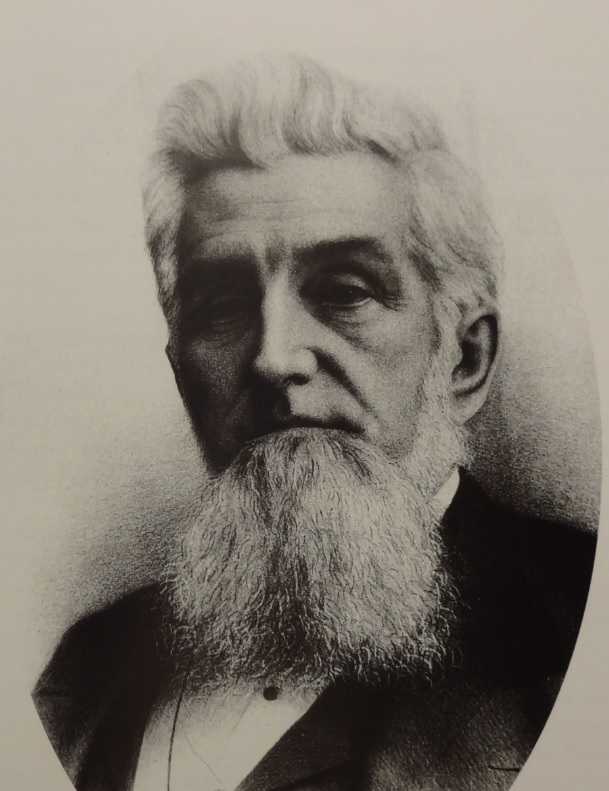

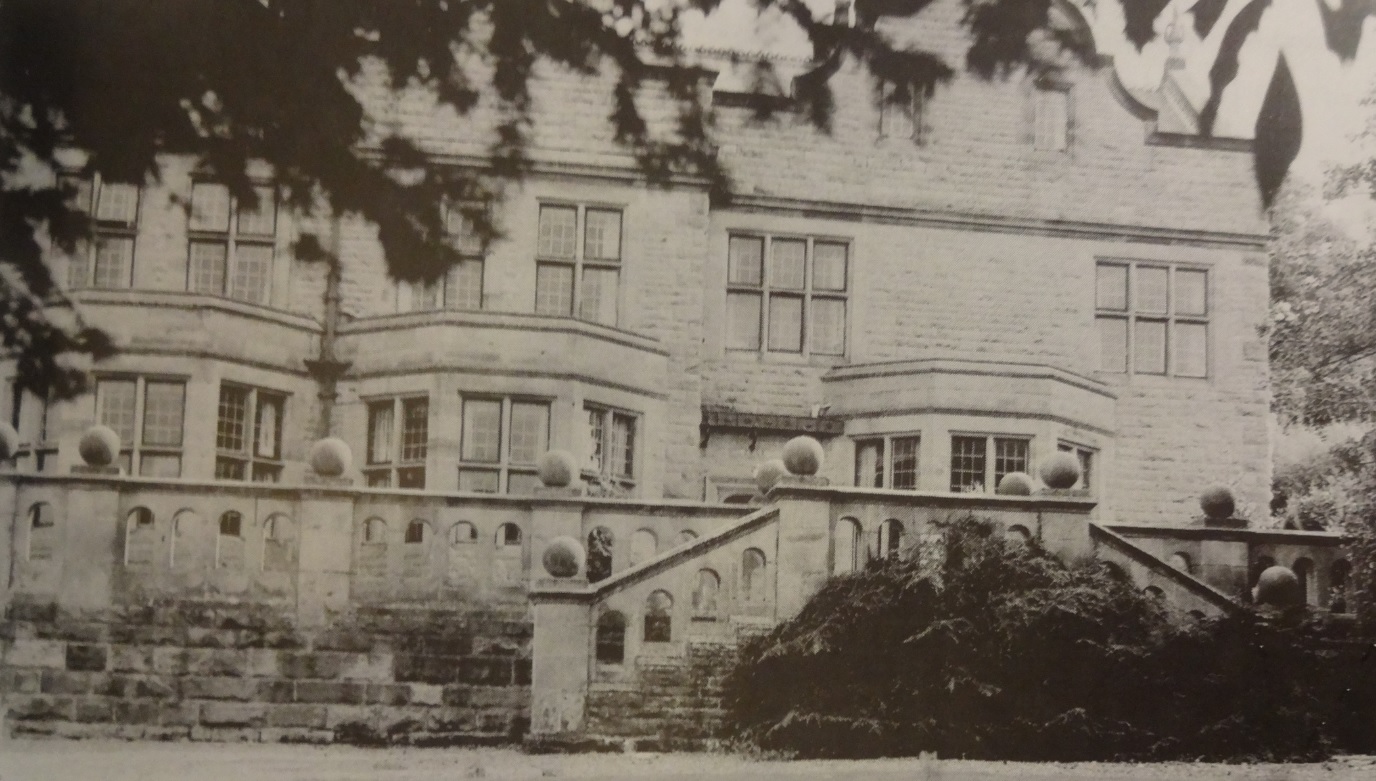
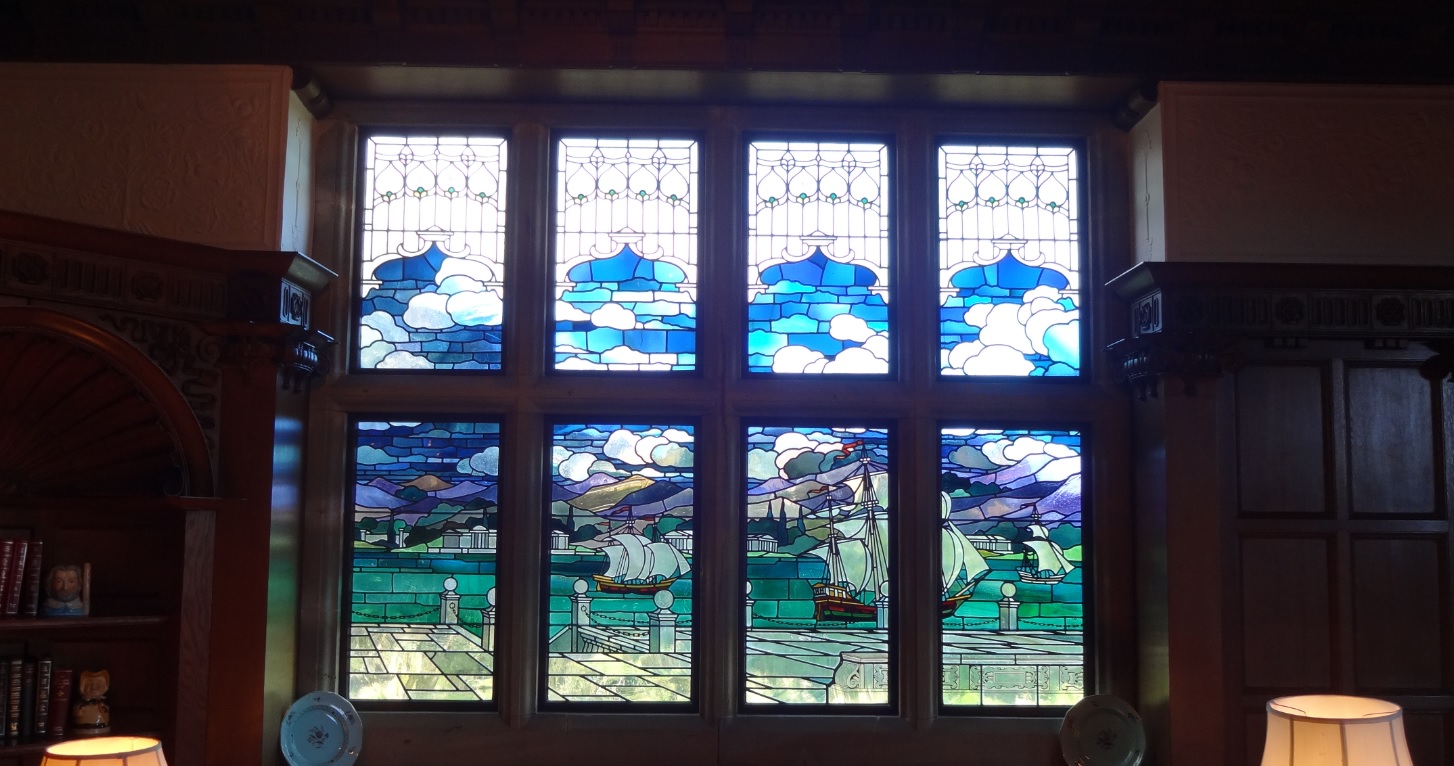

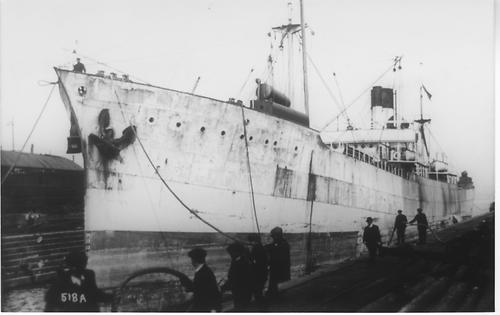


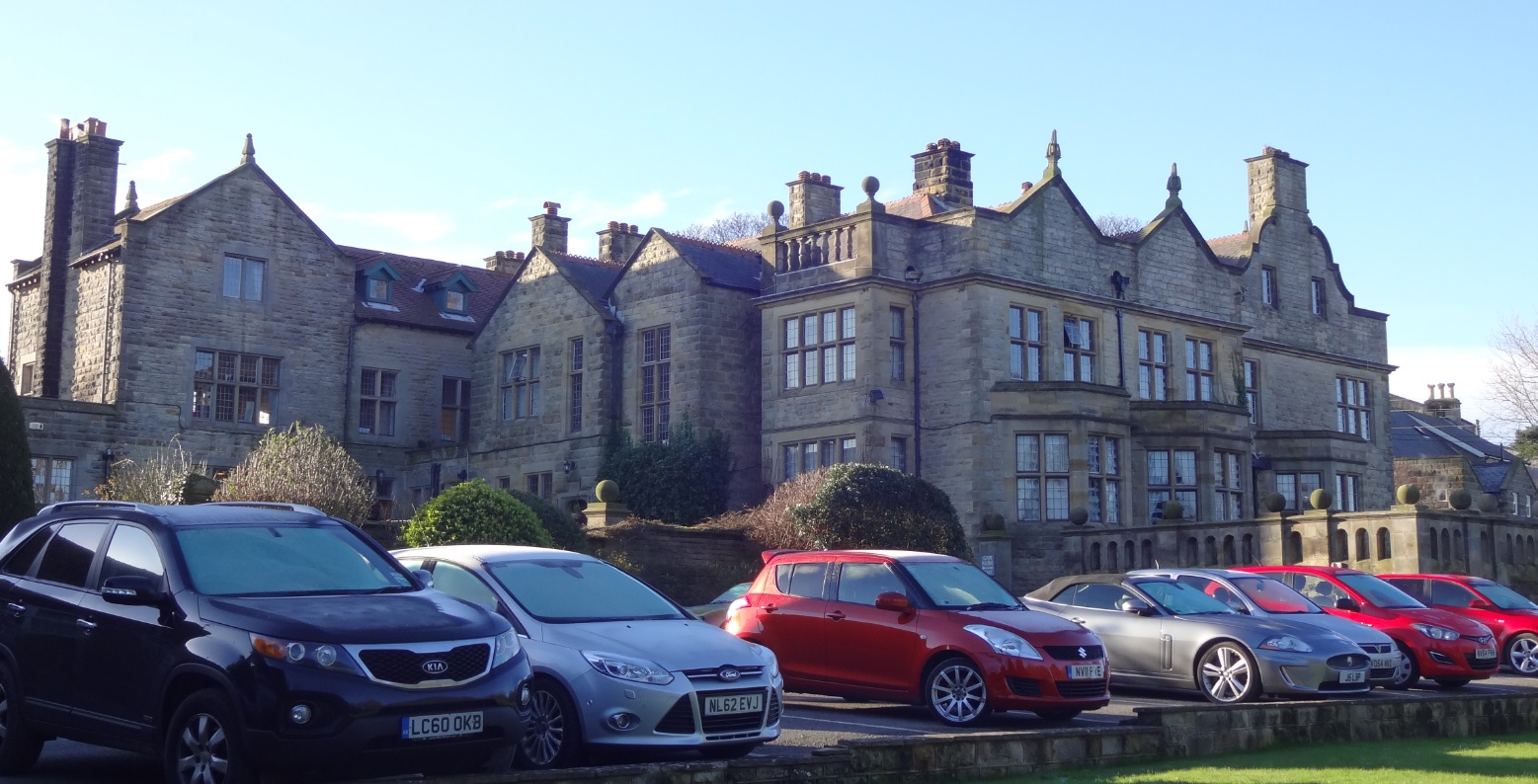

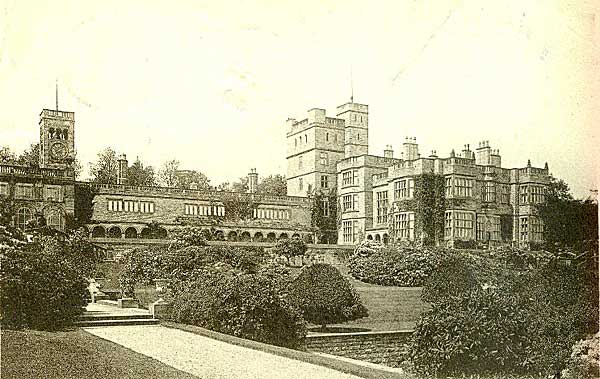

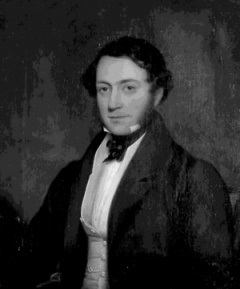


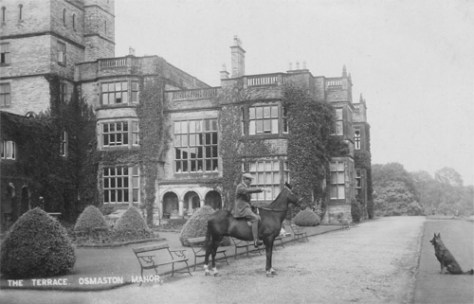


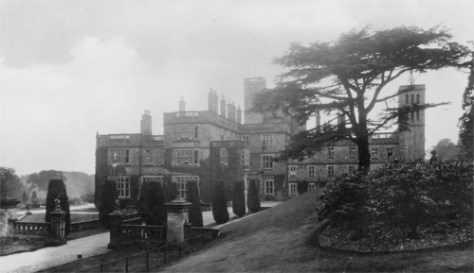
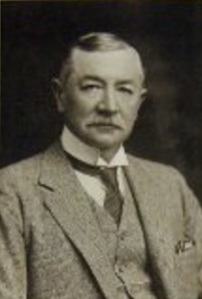
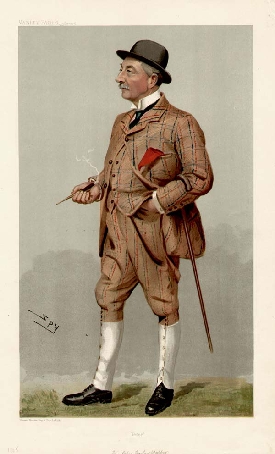
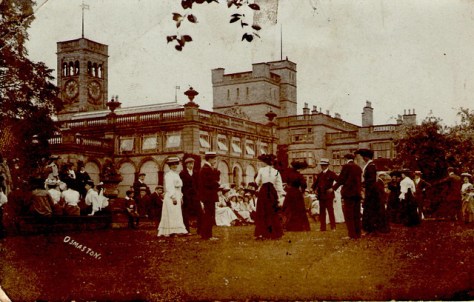
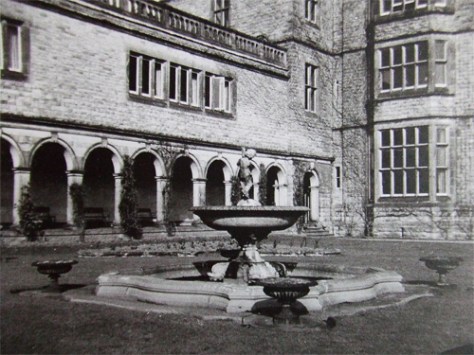

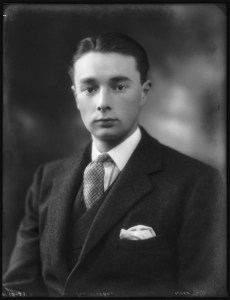


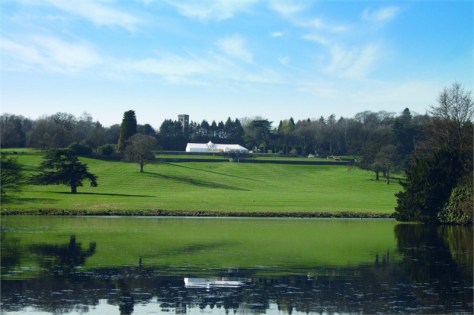

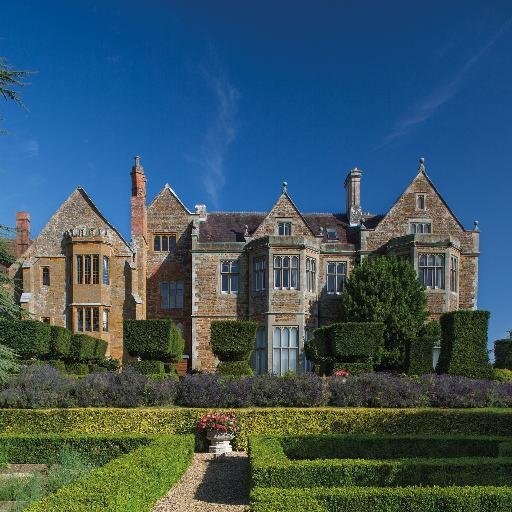
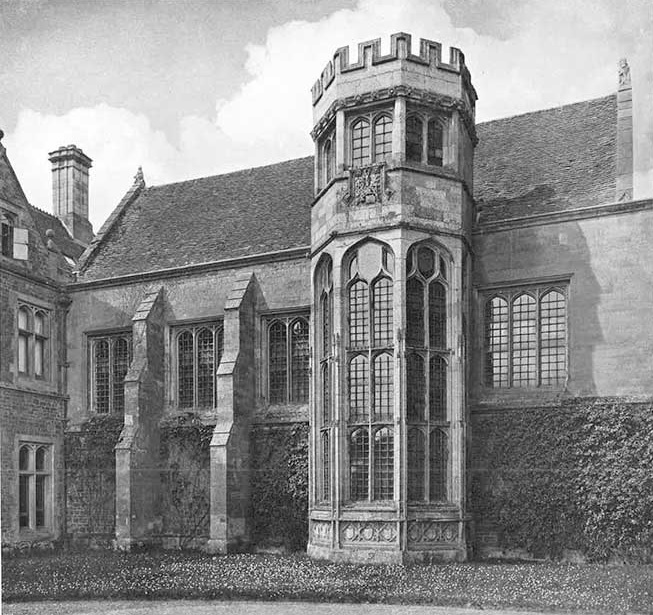
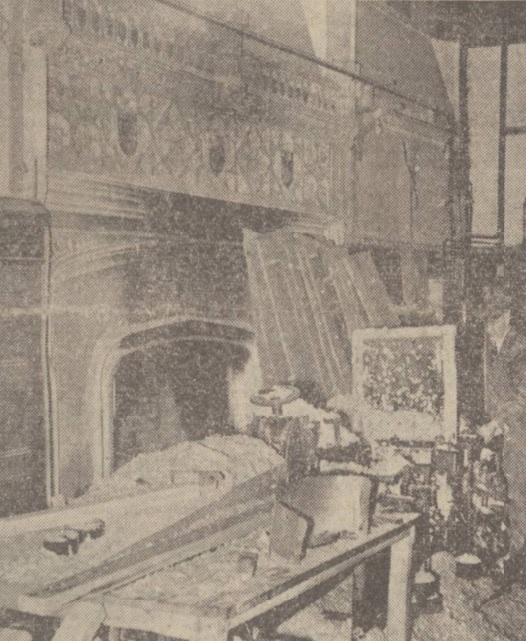
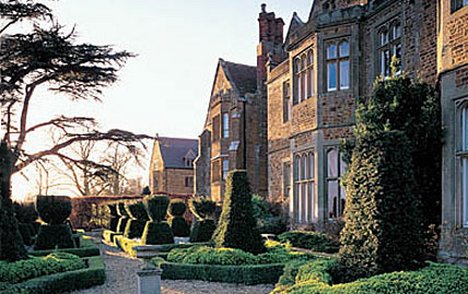
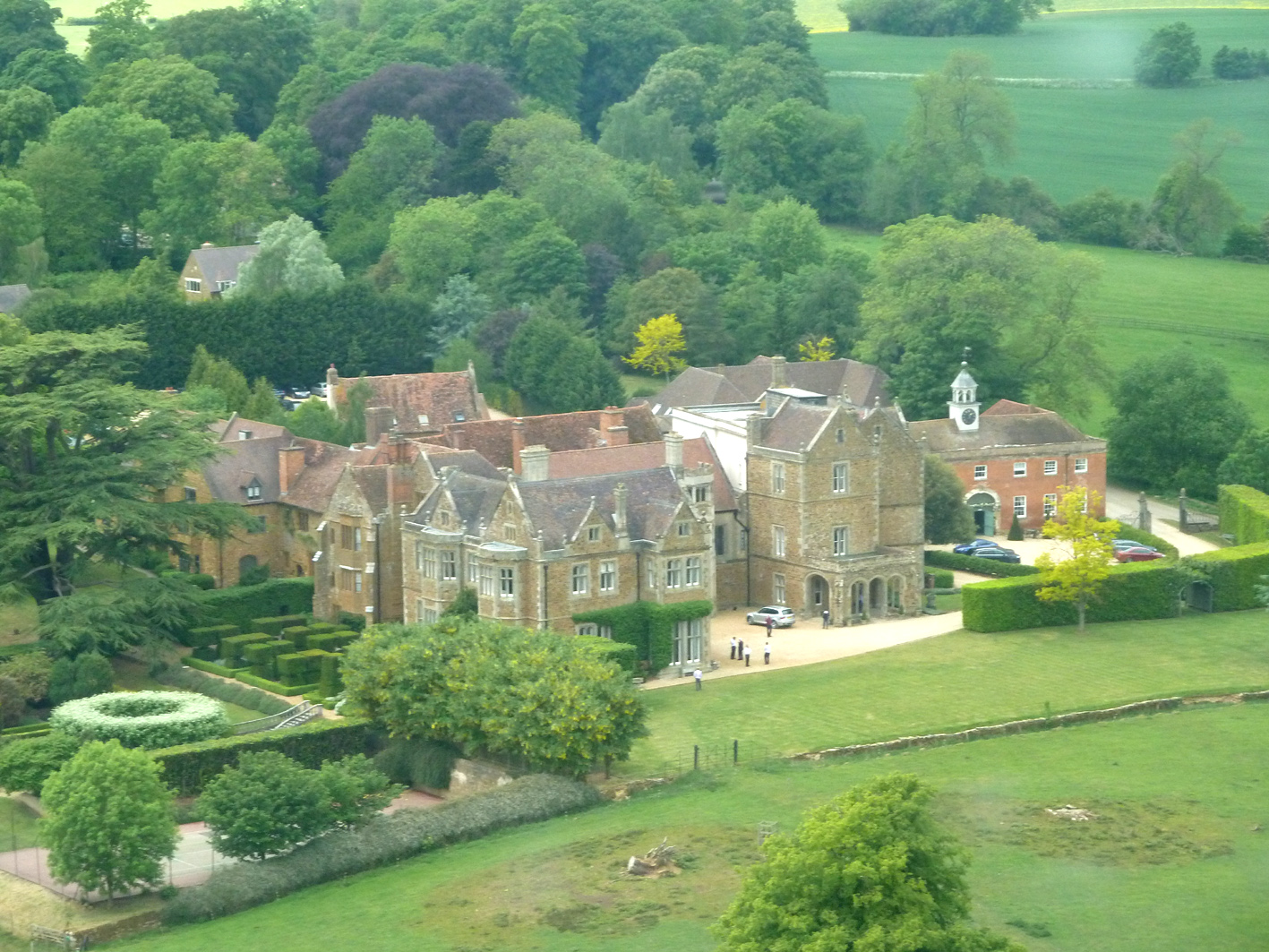
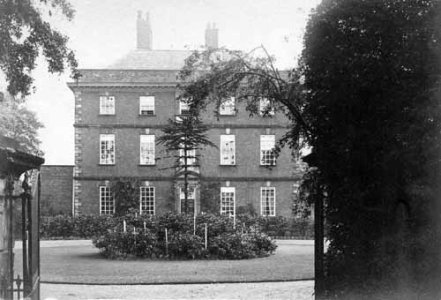
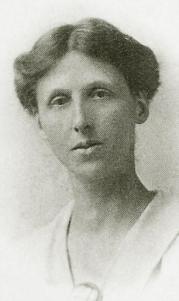
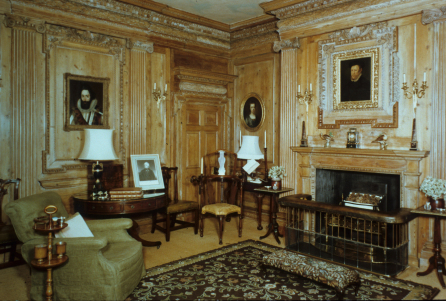
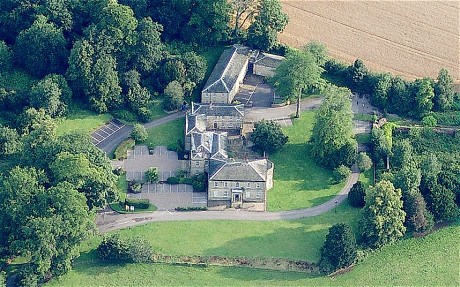

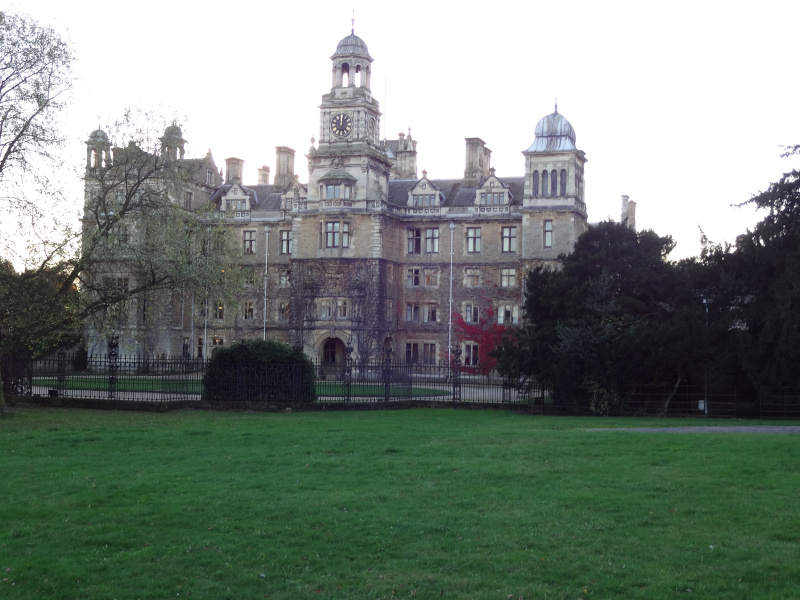
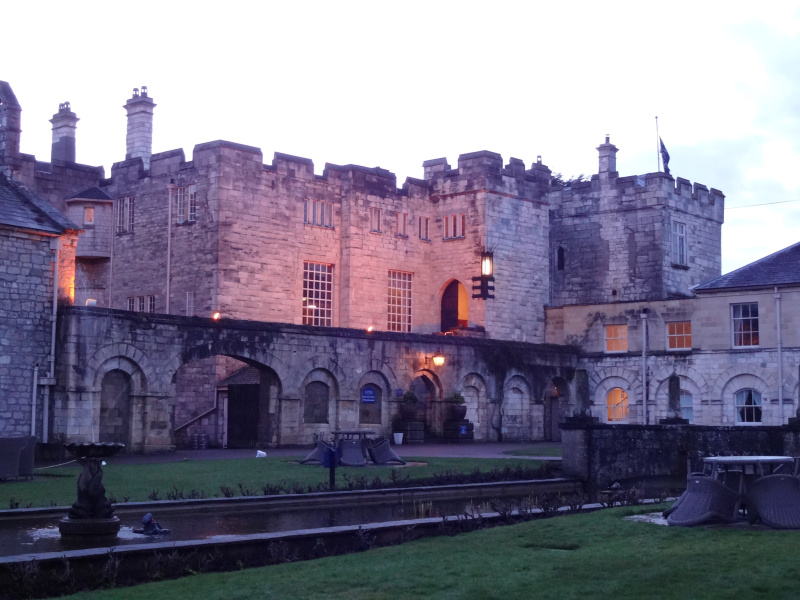
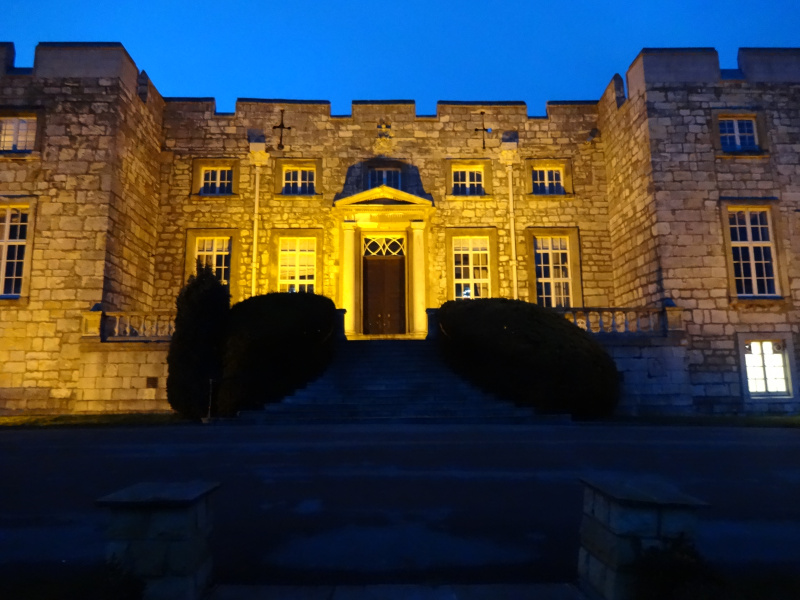
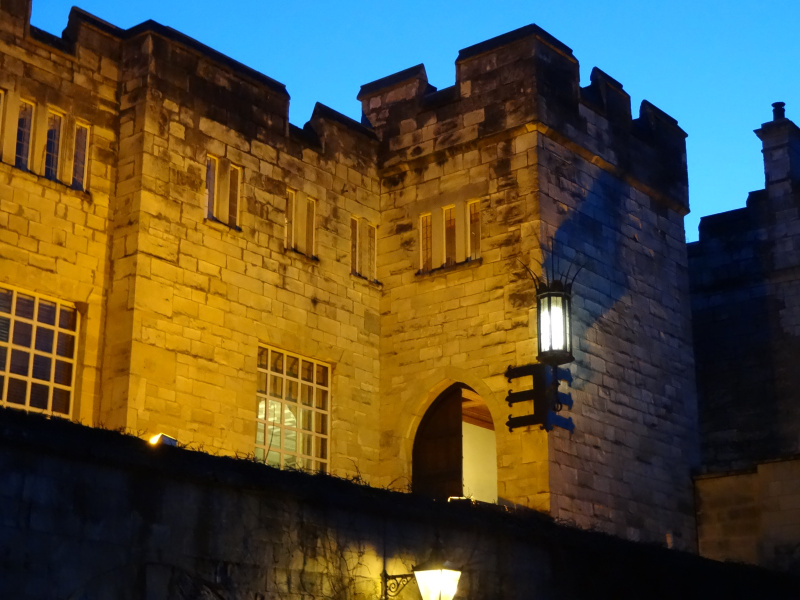

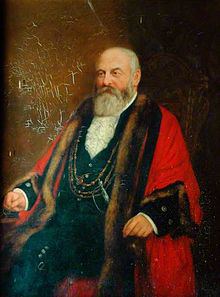


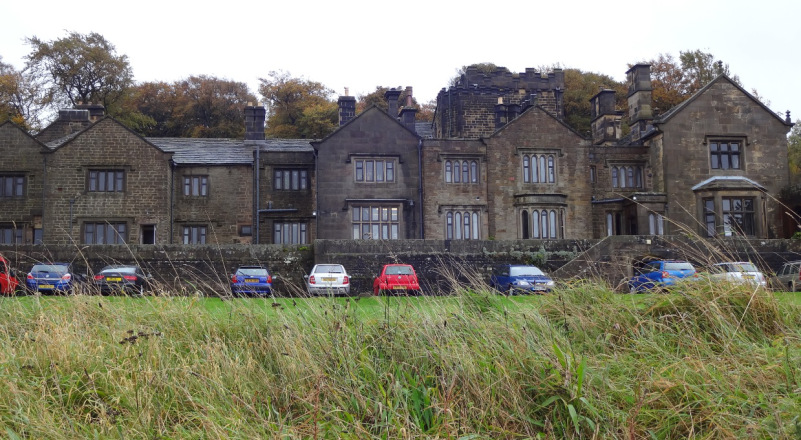
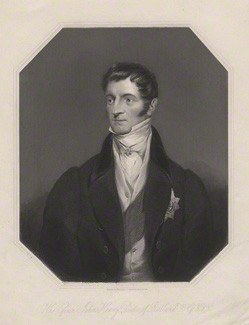
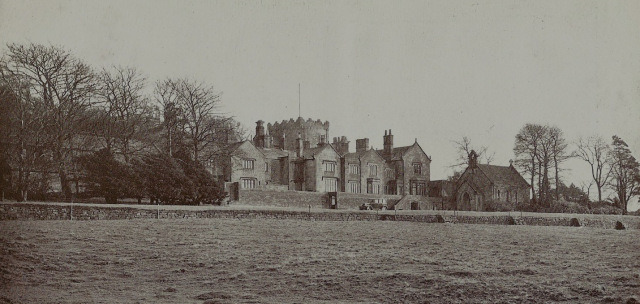


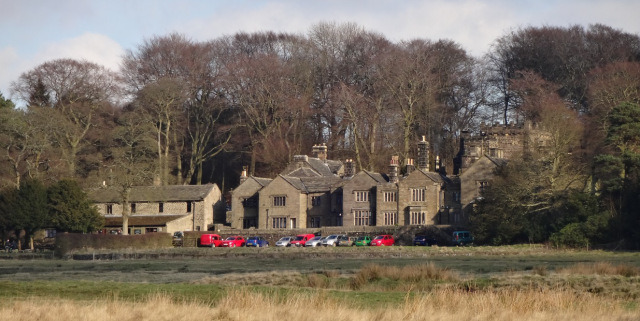
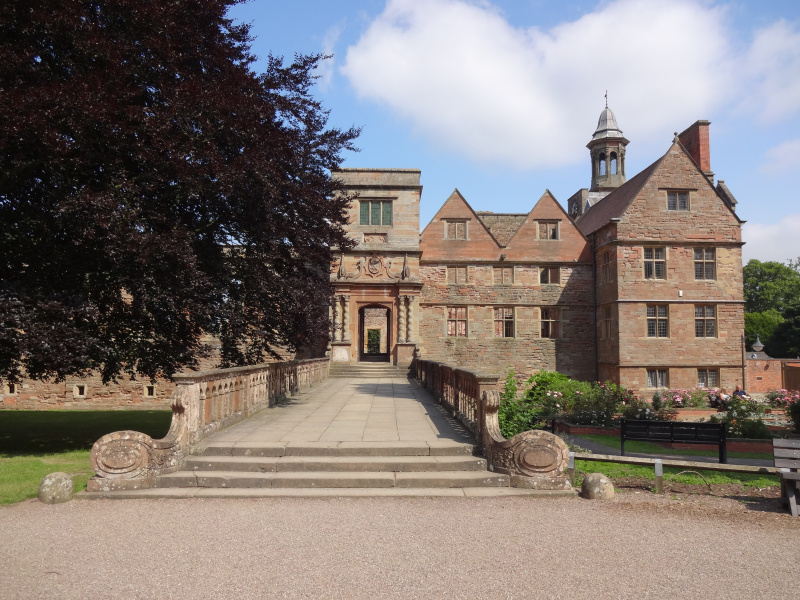

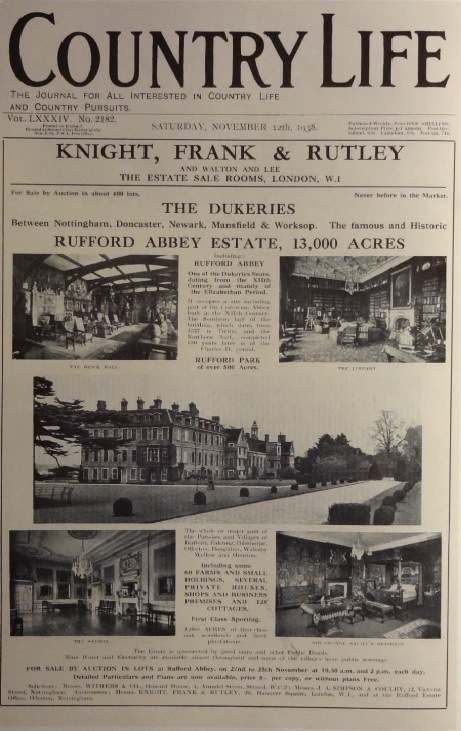
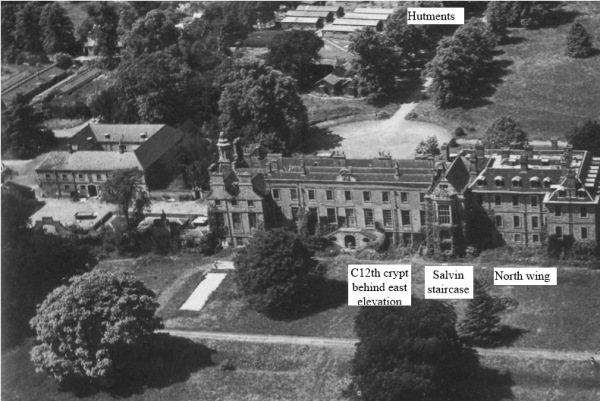
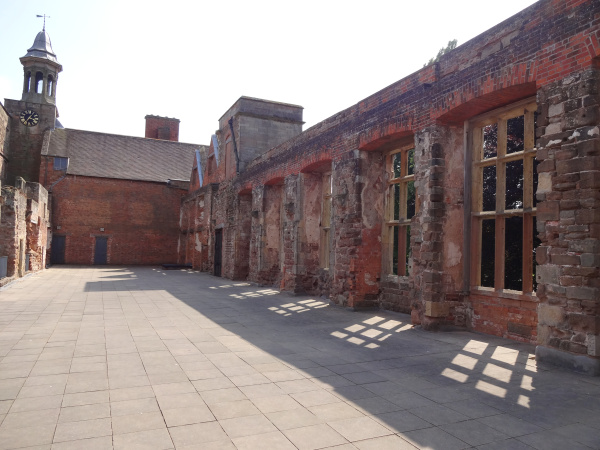


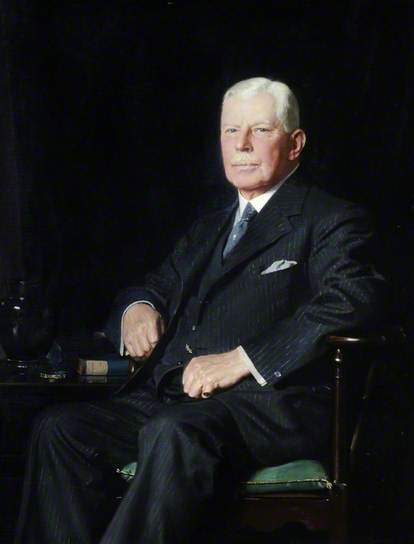

 HOUSE AND HERITAGE