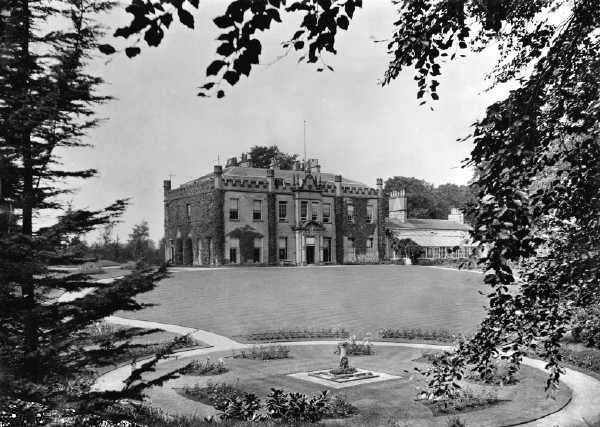
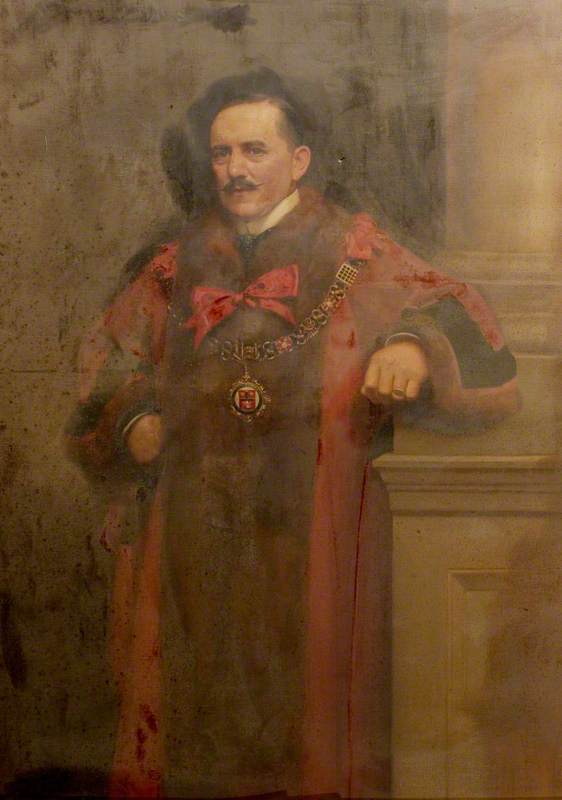
All posts by Delicto

CONKWELL GRANGE

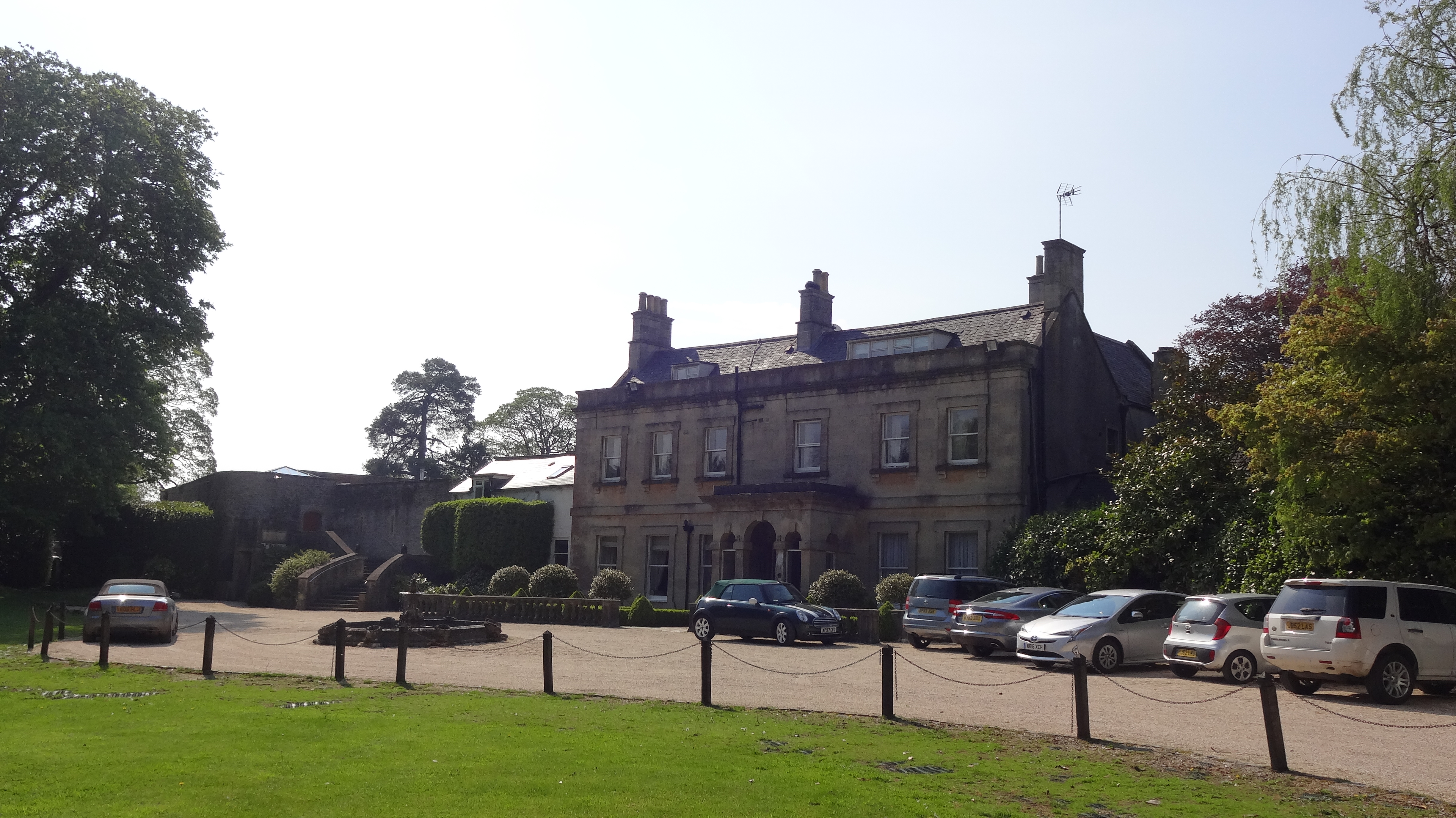
Conkwell Grange 2016 (Kinght Frank)
Conkwell Grange, Limpley Stoke, near Bath. Built in 1907 by Edward Dawber for James Thornton


Built: 1907

Architect: Sir Edward Guy Dawber
Owner: Private ownership
Country house and estate
Grade II listed

“Squared rubble stone with ashlar dressings, tall hipped stone slate roofs and prominent rubble stone stacks with ashlar quoins. Two storeys and attic, late C17 style with symmetrical garden front, asymmetrical entrance front and L-plan service court.” (Historic England)

“The selection of an appropriate local stone – taken mostly from old walls about the estate; the exceptionally suitable roofing – old stone slate – also obtained in the vicinity; and the utilisation – fused into the one design – of motives easily separated under the heads of ‘Classic’ and ‘Gothic,’ are all representative of the modern type of residence design in England.” (The Architectural Review 1907)
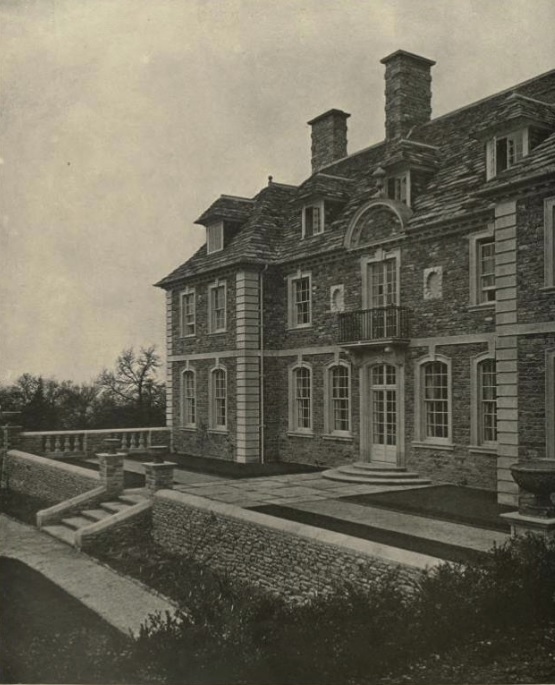
conkwell-grange-2
Conkwell Grange: Garden terrace and entrance in 1907 (The Architectural Review)

By comparison to other featured houses, Conkwell Grange, at Limpley Stoke, near Bath, is relatively new. Nevertheless, this Edwardian property, built 109 years ago, has an incredible amount of history attached to it.

Built from the proceeds of Yorkshire wool it suffered at the hands of the Russian Revolution. It was almost destroyed by fire in the 1920s and then we have the puzzling story of the spinster who bought Conkwell Grange and drove around in a chauffeur-driven Rolls-Royce. This is not to mention the Royal Navy Commander who was a failed fruit-grower and the civil servant who shaped the future of one of the world’s busiest airports. Throw in a few Arab racehorses and Conkwell Grange has more to tell than many of its older and grander neighbours.

Conkley Grange, a neo-baroque house, has far-reaching views towards the Avon Valley and Salisbury Plain. The Grade II listed mansion was built in 1907 for James Thornton to a design by the renowned country house architect, Sir Edward Guy Dawber (1861-1938) at an estimated cost of £25-30,000.

conkwell-grange-6
Entrance and vestibule (The Architectural Review)

Dawber was the president of the Royal Institute of British Architects (RIBA) between 1925 and 1927. His work consisted mainly of stone-built country houses in the Cotswolds vernacular tradition. Houses designed by him include Nether Swell Manor (Gloucestershire), Eyford Park (Gloucestershire) and Bowling Green (Dorset).
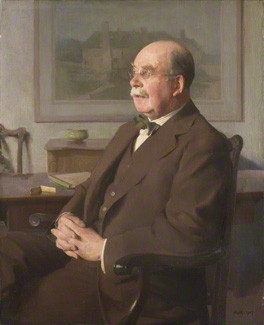
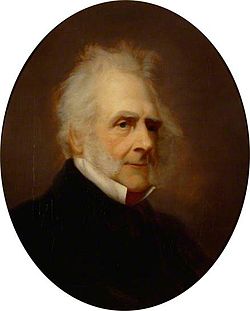
by Sir Gerald Kelly, oil on canvas, 1927
Edward Guy Dawber by Sir Gerald Kelly, 1927 (NPG)

Conkwell Grange was described as a ‘modern William and Mary-style residence’ with reception rooms, 13 bed and dressing rooms, 3 bathrooms and a squash court.
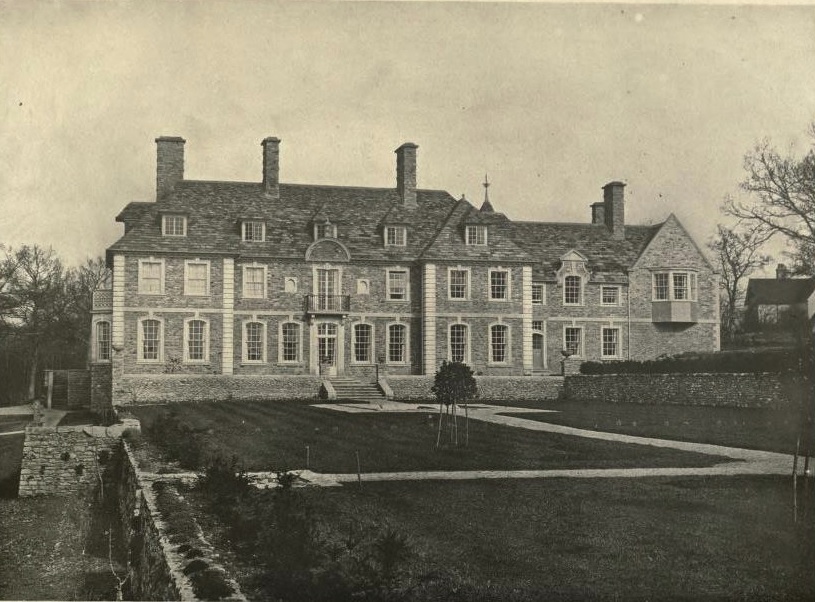
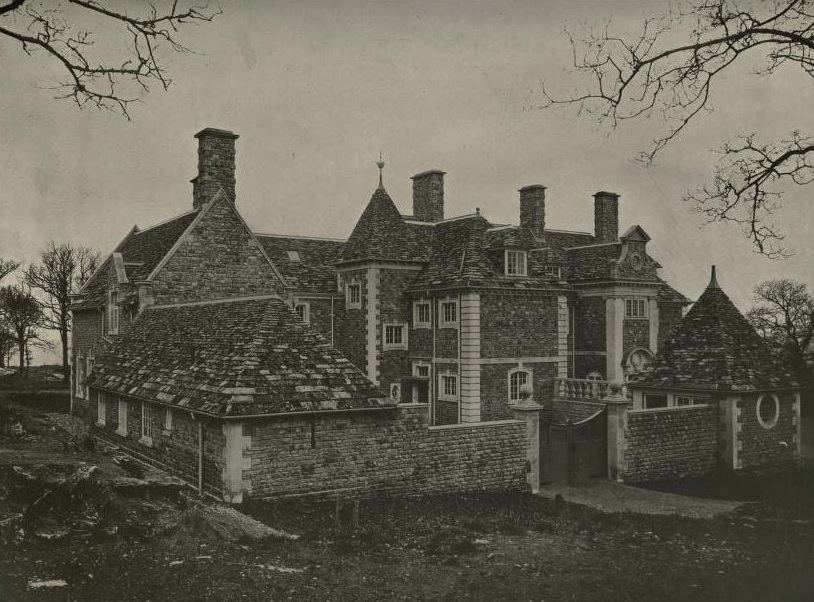
conkwell-grange-1
Conkwell Grange: South entrance and terrace garden in 1907 (The Architectural Review)
conkwell-grange-3
Conkwell Grange: Kitchen courtyard and side entrance 1907 (The Architectural Review)
conkwell-grange-4
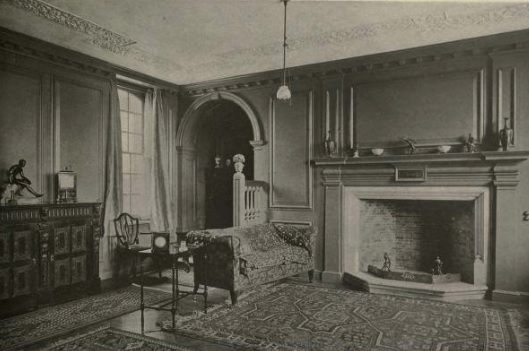
Conkwell Grange: Hall showing fireplace 1907 (The Architectural Review)
conkwell-grange-5
Conkwell Grange: The hall in 1907 (The Architectural Review)

James Thornton (1865-1939)

James Thornton was the son-in-law of Sir Charles Parry Hobhouse, of Monkton Farleigh, having married Miss Lilian Hobhouse in 1900. Prior to building Conkwell Grange the couple lived at the Priory, at Beech Hill, in Reading.

Thornton was an alderman for Wiltshire County Council and Chairman of the County Education Committee. He became a magistrate for Wiltshire and Berkshire, and contested North-West Wiltshire as a Liberal in 1895 and 1900. He strengthened his political ties by acting as President of the West Wiltshire Liberal Association. Together with Harry Plunkett Greene he also started the Wiltshire Music Festival and became President of the Bath Orpheus Glee Society.
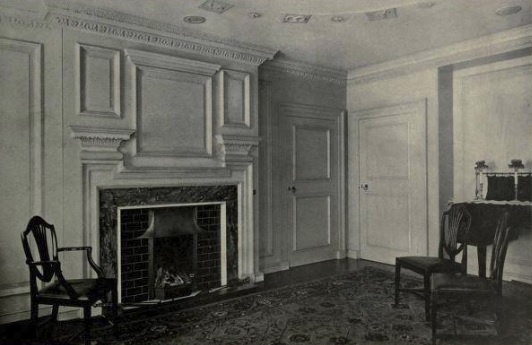
conkwell-grange-7
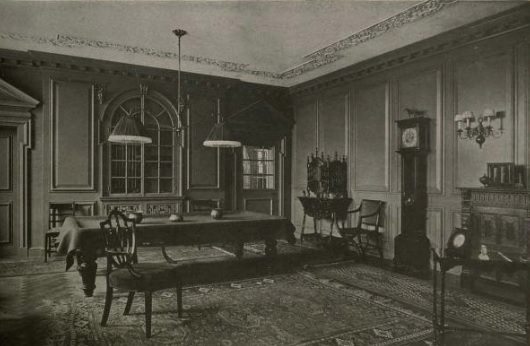
Conkwell Grange: The dining room 1907 (The Architectural Review)

His move to Conkwell Grange courted controversy almost immediately. Thornton, wanting privacy for his new home, closed access to the historic Conkwell Woods which spread across the estate. These woodland walks had been used by locals for generations and the erection of barriers didn’t make Thornton a popular man. The obstructions were demolished by frustrated walkers and a crusade was mounted by the Bath Socialist group who alleged interference with public rights of way.¹ The dispute eventually ended up at Bristol Assizes and Thornton was ordered to take down the barriers.
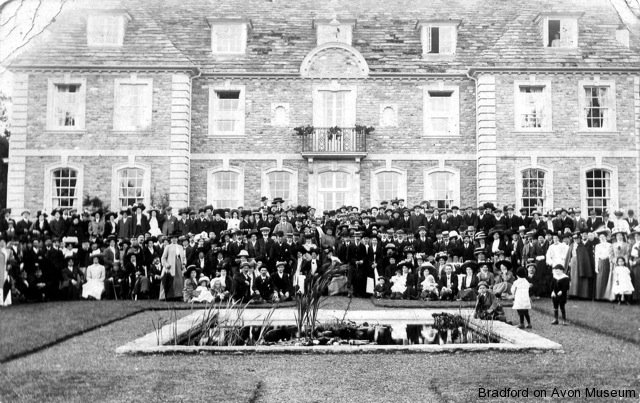
Conkwell Grange Liberal Party Meeting (Bradford on Avon Museum)
A Liberal Party rally at Conkwell Grange in 1910. The big neo-baroque house was only three years old at the time and had been built for James Thornton (Bradford on Avon Museum)

Thornton might have thought his new family home, a prestigious one at that, the beginning of a new adventure. However, the clashes with locals over Conkwell Woods were nothing compared to what lay ahead.

His immediate family, with strong ties to the Yorkshire woollen mills, had made their fortune in Russia where his father and brother spent most of their lives.  As a result James travelled regularly throughout Europe living off his own personal wealth.

At the beginning of the 20th century the Thornton family owned cloth mills near St Petersburg proudly supplying the Russian Imperial Court . This allowed the Thornton’s to accumulate significant wealth, money which paid for the construction of Conkwell Grange, but the events of 1917 had devastating consequences.

The Russian Revolution  focused around Saint Petersburg, then capital of Russia. In March 1917 members of the Imperial parliament  assumed control of the country, forming the Russian Provisional Government, resulting in the collapse of the Russian Empire and the abdication of Emperor Nicholas II. The aftermath was chaotic with frequent mutinies, protests and many strikes across the country.

Havoc was wrought on the Thornton properties and the cloth mills were smashed by angry dissidents. Production stopped and the family business collapsed with James Thornton reported to have lost nearly half a million pounds.²
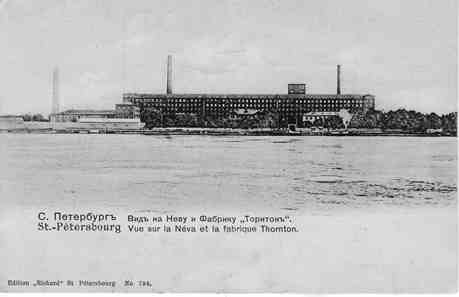
Thornton Woollen Mill
Thornton Woollen Mill, St Petersburg. The business collapsed after the 1917 Revolution

While events in Russia raged out of control, life continued quietly  in the peace of the Wiltshire countryside. The gardens at Conkwell Grange were being carefully attended by David Lewis Bolwell, a Countrycompetent gardener, who had worked for Thornton’s father-in-law, Sir Charles Hobhouse, at Monkton Farleigh. Prior to their move he had been the gardener for Thornton at the Priory before moving in 1906 to oversee the layout of the new Conkwell Grange gardens. If anyone could speak about the secrets of the house then Bolwell was the man to do it. His love affair lasted 37 years and, rather fittingly,  he collapsed and died in the gardens in  1943.

James Thornton’s stay at the house was almost at an end. In 1922, five years after the collapse of the family business, he sold up and moved to a smaller property, Turleigh Combe, at nearby Winsley.

He sold Turleigh Combe in the late 1930s looking to buy another property in the area. The search was unsuccessful and he ended up staying at Pratt’s Hotel in Bath. He died in his sleep, aged 74, in 1939. Following his death he left gross estate worth £23,578, with net personalty £22,742.³
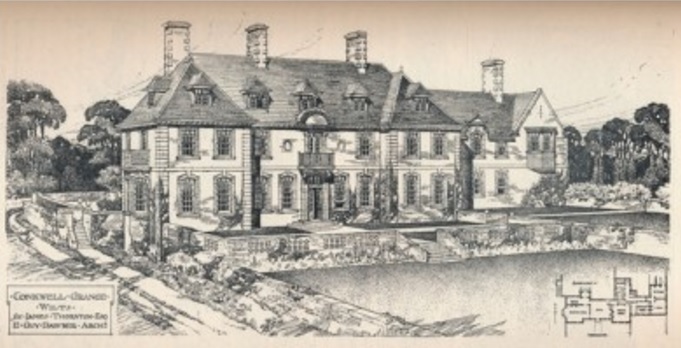
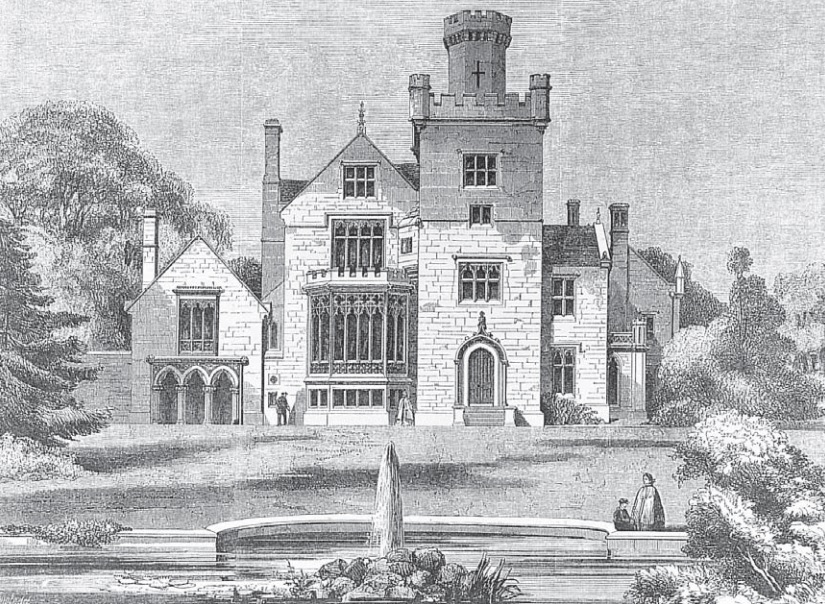
Conkwell Grange c1907 (RIBA)
Conkwell Grange, Wiltshire, newly built for James Thornton and sketched about 1907 (RIBA)


George Pollard Armitage (1867-1952)
When James Thornton left Conkwell Grange in 1922 it is possible he negotiated the sale to a friend and business contact. It may have been relief to a man who had lost half a million pounds and the man who offered a helping hand was George Pollard Armitage.

George was the only son of Joseph Armitage and Julia Francis, the daughter of George Thomas Pollard of Stannary Hall, in Yorkshire and Ashfield in Cheltenham. He was educated at Harrow and Jesus College, Cambridge.

Like the Thornton’s, the Armitage family were wealthy woollen manufacturers from Yorkshire. George’s grandfather, also Joseph, had built his first woollen mill in 1822 at Milnsbridge, two miles west of Huddersfield. In the 1840s, he handed over control of the thriving business to his sons who renamed it Armitage Bros.  The company prospered during the industrial revolution and with it came riches to match.

George’s own prosperity came about in 1898 when he inherited Milnsbridge House, a country mansion, and the lease of Storthes Hall, at Kirkburton,  quickly selling the freehold of the latter to the county council.

He later became a J.P. for the West Riding of Yorkshire in 1902 and married Coralie Eugenie, youngest daughter of Rev. Chastel de Boinville, the vicar of Burton in Westmoreland, in 1912.

By this time the woollen industry was not such a viable business after all. The boom years had gone and the First World War caused inevitable disruption to the industry.  It would be some years before the market collapsed altogether but these were ominous times for George Armitage.

He also faced a dilemma over what to do with Milnsbridge House. When built, around 1748,  the magnificent house had been  in idyllic rural surroundings.  Over time the industries of Huddersfield had advanced and now threatened to surround Milnsbridge.   About 1919-20 George decided to sell and enjoy old age in a more suitable environment.  On hindsight, his prognosis was quite correct. Armitage Bros ceased trading in 1930 while Milnsbridge House survives in an industrialised suburb of Huddersfield. For more details about Milnsbridge House please refer to an earlier post at Rudding Park.

With proceeds from the sale of Milnsbridge House George Pollard Armitage  moved to Conkwell Grange in 1922.⁴

He spent his time at Conkwell Grange developing the estate for agricultural use and extended it to about 400 acres.

His stay was not without drama and the house was nearly lost on Christmas morning in 1925. A fire started in the day nursery and a call made to the fire brigade to attend. By the time they arrived at this remote location the fire had been brought under control by hard-working servants including, no doubt, the gardener David Bolwell. The blaze caused £400 worth of damage but Conkwell Grange survived owing to the nature of the walls and ceiling, which were lined, rather alarmingly,  with asbestos. Fortunately the main damage was confined to the one room but the house was smoke-logged.

In 1933, with the collapse of Armitage Bros still rankling, George decided to put the Conkwell Grange estate on the market. He had his eyes on a nearby property, Hunters Leaze, and so appointed Thake and Paginton, of Newbury, and Fortt, Hatt and Billings, of Bath, to negotiate a sale. The land was divided and Conkwell Grange, along with about 125 acres, was sold to Miss Ethel Hallewell.

George Pollard Armitage moved to Hunters Leaze and died in 1952 leaving estate worth £14,440.
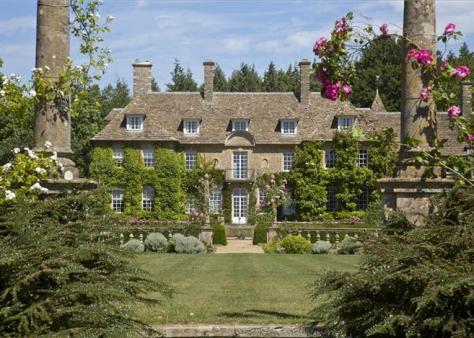
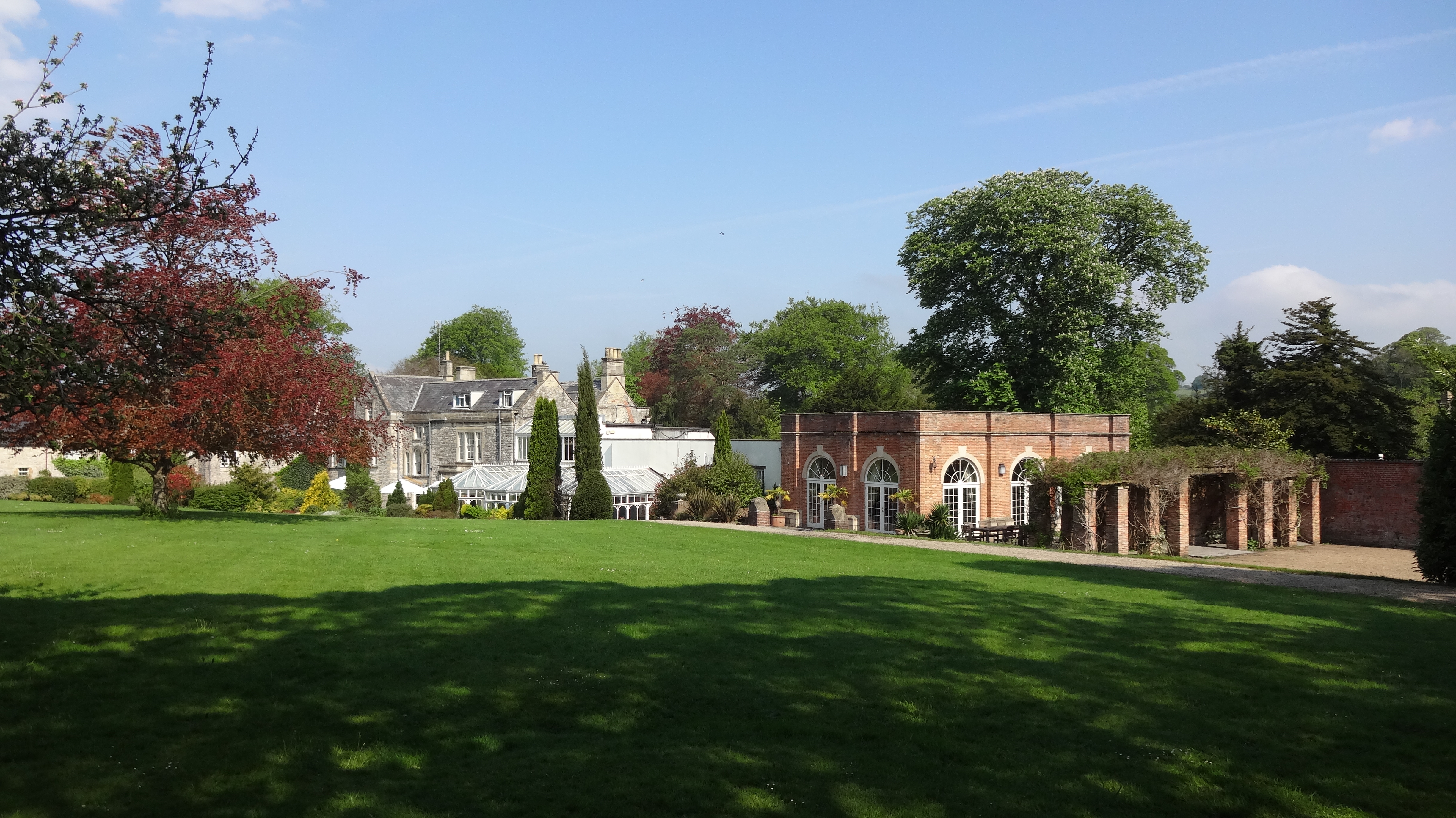
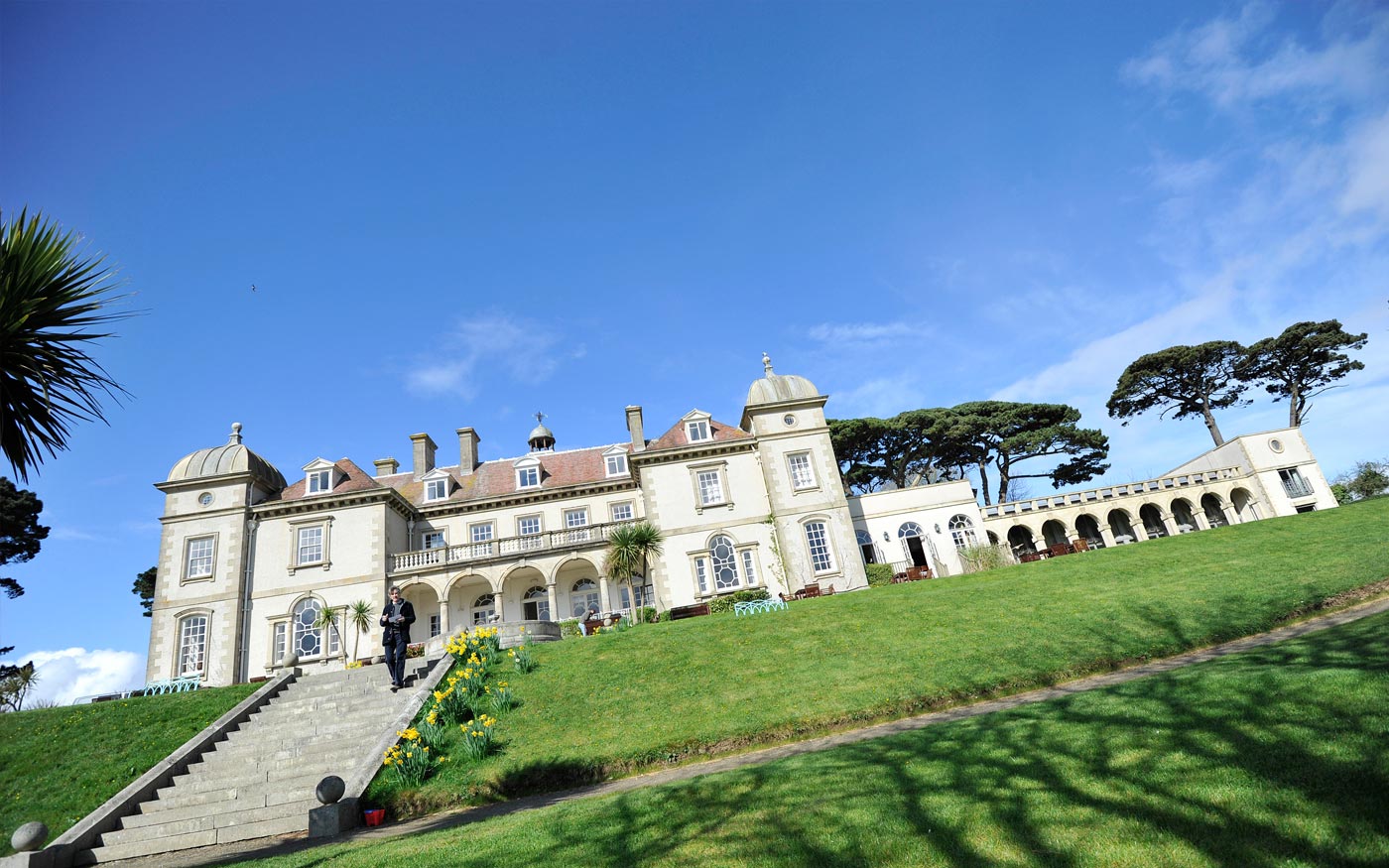
Conkwell Grange 2016 2 (Knight Frank)
Conkwell Grange, Wiltshire. Compare this image with the Liberal Rally photograph from 1910 (above) and the house looks virtually unchanged except for the climbing plants (Knight Frank)


Ethel Winifred Catherine Hallewell (1864-1945)
Ethel Hallewell was described in the press as ‘a lady who frequently visited Bath and chose to make her home in one of the choicest country districts that surround the city’.

The 1911 census reports that she was living by private means but as to how she acquired such wealth remains a mystery. For several years Ethel Hallewell had been a regular guest at the Pulteney Hotel in Bath and was most likely keeping an eye out for a suitable country house to live.

She was born in 1864 in Cape Town, the daughter of Charles James Maynard Hallewell and Amelia Catherine Barber, who had moved to South Africa.

Charles Maynard was a Captain in the Cape Mounted Rifles but the birth of Ethel prompted their return to England. He became a Lieutenant with the 19th (1st Yorkshire North Riding – Princess of Wales’s Own) Regiment but the family lived at Axminster in Devon.

Charles retired from military service in 1866 and a year later a son, Frank Maynard Hallewell, was born. In later years Charles (and his second wife Catherine Sophia Wilde) lived at Bryn Hyfryd, Conway, before returning to Devon at Deepdene, in Bathampton.

Charles died in 1919 leaving just £917 in his will. A lot of money then, but in comparison, when Ethel died in 1945 she left estate worth £144,649. She remained a spinster and, with no husband earning an income and no obvious benefactor, her finances remain a matter of speculation.

Maybe the answer to this conundrum lay thousands of miles away in South Africa? There were strong family connections and her brother, Frank, had followed in their father’s footsteps and joined the Cape Mounted Rifles. He died in 1937, aged 70, in a car accident at Vereeniging in the Transvaal. Sadly, he was also unmarried and without issue.

When Ethel died in 1945 she made provision for several charities, all of whom received £500 each.

The Child Emigration Society, founded in 1911 and better known as the Fairbridge Society, was dedicated solely to child migration, sending children to its farm schools in Australia and British Columbia and to a college in Southern Rhodesia.⁵ In addition Ethel made further provision of £500 to support the Fairbridge Homes.

The reason for Ethel’s support is speculative but no doubt she believed she was bettering the lives of impoverished children from Britain’s slums. Far from improving lives, the scheme was eventually exposed with stories of cruelty, hardship and of families torn apart.

Two further charities benefited from her will. These were the National Library for the Blind and the Royal Blind Pension Society (pensions for the blind poor). Dare we speculate that Edith was herself blind, perhaps prompting her parent’s hasty departure from South Africa after she was born? Or was it simply a case of her being a caring and wealthy individual?

Another bequest of £250 was made to the Home of St Giles, an Essex charity that raised money to fund a hospital designed specifically for the care and treatment of leprosy.  Although, by the turn of the 20th century the disease had long been eradicated in Britain, this hospital provided for the few people who had caught it abroad.⁶

Ethel also made provision for her chauffeur, Sidney J. Waldron, who had paraded her around in a Rolls-Royce, and received the handsome sum of £600. However, her greatest bequest went to a relation, Commander Edmund G Hallewell, retired of the Royal Navy, who received £12,000.

It was he who decided to put Conkwell Grange up for sale and, in 1946, sold it to another Royal Navy officer, Commander Wardell-Yerburgh.

Western Daily Press - Saturday 01 September 1945
Estate auction. Western Daily Press – Saturday 01 September 1945
Western Daily Press - Saturday 06 October 1945
Contents auction. Western Daily Press – Saturday 06 October 1945


Arthur Wardell-Yerburgh (1891-1953)
In the course of researching these articles there often comes a time when something doesn’t quite ring true about a person. All too often history tends to be kind but something about Arthur Wardell-Yerburgh suggested ‘scoundrel’.

When I originally wrote this piece I invited comment from anyone who might have been able to put the record straight. I was subsequently delighted to hear from his son, Richard Wardell-Yerburgh, who said he was “profoundly amused by the description of him as a ‘scoundrel’ because it precisely reflects my own view.”

However, Arthur’s upbringing had been impeccable, being the son of Reverend Oswald Pryor Wardell-Yerburgh, Vicar and later Canon of Tewkesbury, and Edith Wardell Potts. Arthur lived with them until his early twenties at the Abbey House in Tewkesbury.  This wealthy family were descended from the Rev. Richard Yerburgh, the vicar of Sleaford in Lincolnshire.
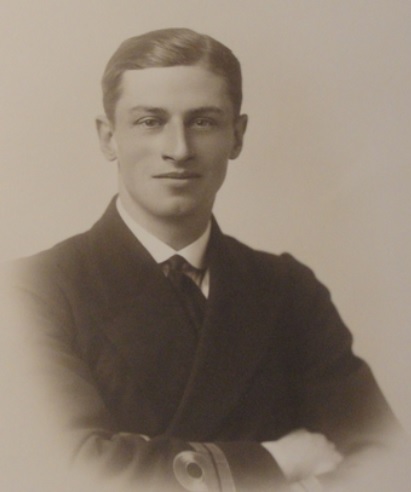
arthur-wardell-yerburgh
A handsome young Arthur Wardell-Yerburgh (Image courtesy of the Richard Wardell-Yerburgh Collection)

Arthur joined the Royal Navy in 1904 training at Royal Naval College, Osborne, on the Isle of Wight, and at Royal Naval College, Dartmouth, in Devon. He joined active service in 1909 serving as a Midshipman on HMS Agamemnon and later HMS Indefatigable. In 1914 he was promoted to Sub-Lieutenant and given command of submarines. He was decorated with the award of the Distinguished Service Cross (D.S.C.) in 1918 for operations off the Belgian coast..

The following extract is taken from The Dover Patrol 1915-17, by Admiral Sir Reginald Bacon, and refers to his preparations for a “Great Landing” on the Belgian Coast, a plan which was eventually postponed but which was at least reflected in the subsequent raids on Ostend and Zeebrugge. It also mentions Arthur Wardell-Yerburgh and the circumstances into achieving the D.S.C.:

‘It was necessary that our survey should be accurate to within six inches. A submarine (known as C30) was, therefore, sent to submerge off Nieuport, to lie on the bottom, and to register the height of the water above her hull continuously for twenty-four hours by reading the depth gauge. The rise and fall and the tide curve at this spot was thus obtained at springs, neaps and intermediate tides.

This information was obtained by Lieutenant Wardell-Yerburgh. It was a weird experience for a submarine to steal up and submerge right under the guns of the enemy’s coast defence, always with the off-chance that in her journey to the bottom she might settle down on a mine. Also as the submarine was a C Boat, and not large, and as she had to remain submerged for twenty-four hours, she was apt to get stuffy. The number of crew was therefore reduced to a minimum.’

Conkwell Grange 2016 1 (Knight Frank)
The gardens were attended by David Lewis Bolwell between 1906 and 1943 (Knight Frank)

Arthur retired from the Royal Navy in 1921 and married Enid Mary Florence Till, the daughter of John Till of Kemerton Court. In December 1921 John Till died while hunting after suffering a seizure and falling off his horse. He left gross estate worth £35,334. Kemerton Court was left for his wife, Florence, and the residue of his property was placed in trust for his three daughters, including Enid, and presumably Arthur.

He re-joined the Royal Navy in 1922, probably as a commissioned officer, and was awarded the rank of Lieutenant-Commander. However, the period between two World Wars saw a decline in the number of Royal Navy ships and Arthur probably never saw active service again. If this is the case, then considering he always referred to himself as Commander Arthur Wardell-Yerburgh, then never has such a title been so ill-used

arthur-wardell-yerburgh-rwy
A man of distinction. Arthur Wardell-Yerburgh was often photographed with a cigarette in his mouth. (Image courtesy of the Richard Wardell-Yerburgh Collection)

Without a ship to command, but a title nevertheless, Arthur and Enid moved to Wesmacott, near Tewkesbury. It was here that he hatched plans for a fruit farming business at Bredon. While at Wesmacott they had their only child, John Gerald Oswald Wardell-Yerburgh, born in 1925.

There was a difference between the sea and fruit farming and Arthur realised he had made a mistake. The business wasn’t a success and his relationship with Enid was strained  to say the least. Just how much money was lost in the enterprise is unknown but, in 1926, they sold up and went to live with Enid’s mother at Kemerton Court.

If this was an attempt to reconcile their differences within a stable family environment then it proved ill-advised. More likely the move was the result of financial hardship caused by Arthur’s failed business venture. Enid, frustrated by Arthur’s inability to gain meaningful employment and no doubt encouraged by her mother, became increasingly disenchanted. By 1929 the couple were living apart with Arthur staying at Westbourne Terrace in Paddington.

In January 1931 he and Enid were divorced on the grounds that Arthur had committed ‘misconduct’ at a London hotel.⁷ Arthur didn’t defend the suit and Enid was granted a divorce, with costs and custody of their child.

We know that many divorces were ‘staged’ affairs. The law at this time required one of the parties to be caught and witnessed in liaison with another person. In circumstances where a relationship had broken down it was not unknown for such affairs to be instigated by both parties. In this case the witnesses were John Russell, a private inquiry agent, and Thomas Hawkins, a waiter at the Hotel Central in Marylebone, where the wrongdoing was alleged to have taken place.

Richard Wardell-Yerburgh believes that Enid Till was disgracefully treated as was his half-brother, John.

“I believe the principle reason for the trouble was that Arthur Wardell-Yerburgh was in the habit of borrowing from Enid’s friends and relatives. Unfortunately, it appears he was not in the habit of re-paying these loans. Arthur never spoke or wrote to his son, John, from the day of the divorce until the day that he died. I only learned of John’s existence by accident.”

Enid might have had moral ground to obtain a divorce and we will never know whether this woman was a ‘put-up’ affair or someone directly involved with Arthur.  That someone might have been Marion Georgina Cooper, from Paddington, because, with the ink barely dry on the ‘decree nisi’, she was married to Arthur in September 1931 (although Richard Wardell-Yerburgh believes this was in 1933).

With changes in the air it was also time for Arthur to call time on the Royal Navy and he officially retired from the service.
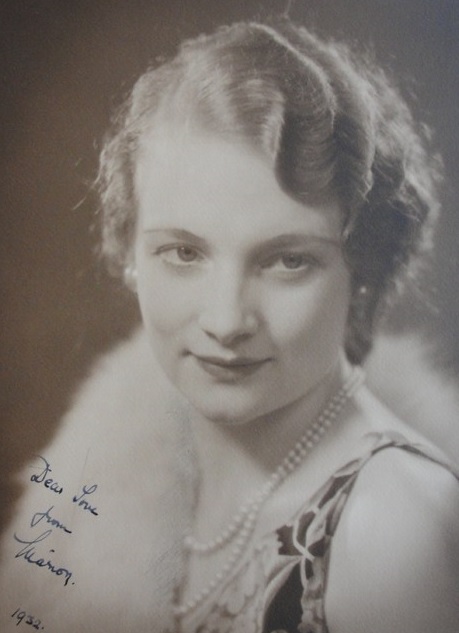
marion-cooper-1932
Marion Wardell-Yerburgh (nee Cooper) in 1932. (Image courtesy of the Richard Wardell-Yerburgh Collection)

This time the marriage appeared more compatible and lasted the course. The couple settled at Worton Grange, near Devizes, where they had a son, Richard Geoffrey Robert Wardell-Yerburgh (b. 1935), subject of welcome correspondence in this post.

“The marriage between my mother, Marion Cooper, did nothing to stabilise Arthur Wardell-Yerburgh’s financial position. She was penniless, the daughter of a London milkman, and had determined that she would somehow get herself out of Paddington. She lived in the area of Paddington either in, or adjacent to, Westbourne Terrace (where Arthur had been living in 1929).

“Arthur Wardell-Yerburgh was apparently well-healed and Marion grasped the opportunity. That she had made the wrong decision only dawned to her as the paucity of Arthur’s finances became apparent.”

father-aged-44-at-eastwood-manor-rwy
Arthur Wardell-Yerburgh, aged 44, at his mother’s home, Eastwood Manor. (Image courtesy of the Richard Wardell-Yerburgh Collection)

The move to Conkwell Grange followed a succession of deaths within Arthur’s close family.  In April 1941 his sister, Hilda, died when a fish bone caught in her throat while dining at Littlewood House, near Frampton. Three months later his mother died leaving an estate worth £14,498. Arthur received £2,200 and shared the residue of her property with his younger brother, Geoffrey Basset Wardell-Yerburgh. Geoffrey didn’t live long enough to enjoy his windfall and died in 1944.

“Arthur earned not one penny from the Royal Navy after he retired until the day he died,” says Richard Wardell-Yerburgh. “Everything came from his mother, Edith Wardell-Yerburgh, who has been described as being ‘As rich as a Croesus’ – including settling debts from two bankruptcies – the fruit farm and a business called the Light Car Company.

“In 1931 she paid a settlement figure into a Trust for the support of my half-brother, following the divorce from Enid. My mother told me this was in the sum of £25,000 (in 1931/32). According to the Historic Inflation Calculator (HIC), this equates to £1,472,650 at today’s rates. When she died, I understand my father actually inherited £167,000 after deduction of the monies paid out for his debts. According to the HIC this amounts to £8,419,963 at 2016 values.”

Arthur and Marion moved to Conkwell Grange in 1946. The house, with its stately grandeur and a Rolls-Royce to match, suited him in his retirement years.  However, they were to stay just 5 years before ‘down-sizing’ and re-locating to Hall Farm, at Thickwood, in 1951. This was where Arthur died in 1953, at the relatively young age of 61. He left effects to the value of £21,493. His wife, Marion, died in 1984.
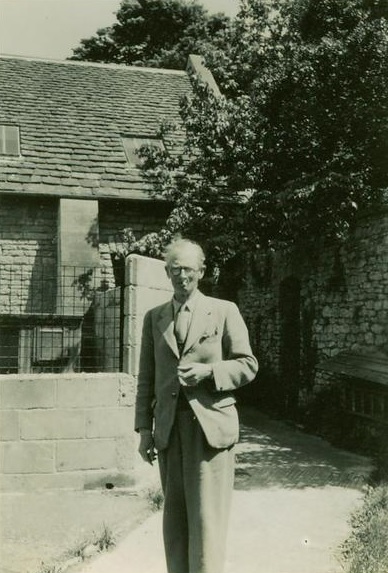
awy-aged-59-rwy
Arthur Wardell-Yerburgh, aged 59, two years before he died. (Image courtesy of the Richard Wardell-Yerburgh Collection)

The last word goes to Astra Towning (nee Wardell-Yerburgh), the daughter of Richard Wardell-Yerburgh:

“My grandfather was a very handsome young naval officer and he and my grandmother (Marion) made a very glamorous couple. Marion ended up in a small house stuffed with glorious, if unloved, furniture, antiques, jewellery and furs. Most of this went in a series of burglaries, including Arthur’s ceremonial naval swords. We have a journal from his time in the navy. This book is huge and beautifully presented – lovely writing, glorious pictures of ladies he knew in various ports, and wonderfully detailed technical drawings.”

Conkwell Grange 2016 3 (Knight Frank)
The front door has seen colourful owners with interesting stories to tell (Knight Frank)

Philip Eric Millbourn (1902-1982)
Conkwell Grange was bought by Philip Eric Milbourn (1902-1982), a Yorkshireman, whose reputation has diminished with history. He was the Honorary Advisor on Shipping in Port to the Minister of Transport and Civil Aviation.

Here was a man, from humble beginnings, who shunned publicity and chose to get on with his job while, at the same time, acquiring a personal fortune. For this reason his name is almost ‘air-brushed’ from the archives and virtually unknown today.

Eric, as he liked to be called, married Ethel Marjorie Sennett, the only daughter of Joseph Ernest Sennett, of Kingswood Grange, Reigate, in 1931. His job required a town house and for many years they lived at 41 Parkside in Knightsbridge, as well as living at a cottage on the Kingswood Grange estate.

Their move to Conkwell Grange corresponded with a glorious decade for Eric. In 1950 he had been awarded the Order of Saint Michael and Saint George (C.M.G.) and was knighted five years later. However, his greatest accomplishment came in in circumstances not dissimilar from today. Faced with escalating passenger numbers at London (Heathrow) Airport he was asked to head a committee to determine how the problem might be resolved. With meticulous foresight his findings were presented in the Millbourn Report of August 1957.

His contribution shaped the Heathrow Airport we know today. In the report he recommended that all Heathrow’s terminals be located in one central area. With this he suggested the construction of a new long-haul terminal (now Terminal 3) and a short-haul terminal (which became Terminal 1). In addition, the report called for the expansion of Gatwick Airport. The total cost of these proposals was an estimated £17 million to handle the 12 million passengers anticipated by 1970.

The Millbourn Report was the zenith of a career that demanded Eric travel the world advising on transport problems. It also made him a very wealthy man and, on his death in 1982, he left estate worth £1,779,975. Lady Millbourn died the year after and Conkwell Grange was once again put on the market.
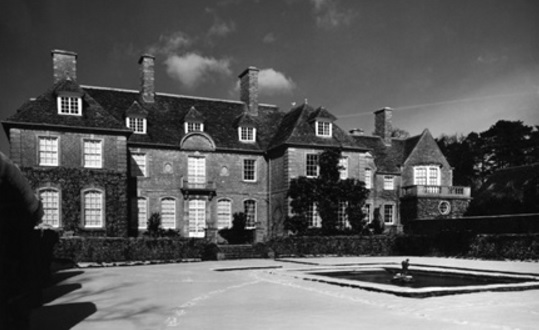
Conkwell Grange, photographed in 1979 (RIBA)
Conkwell Grange. Photographed in the ownership of Philip Eric Millbourn in 1979 (RIBA)


The Fosler family and the racehorse stud
The house was eventually purchased by the Fosler family in 1985 who made the estate the centre of a stud farm and racing stables. Today it is an estate of 300 acres mostly devoted to woodland and horses. A 100 box complex of equestrian buildings have been used as a thoroughbred stud and, at the turn of this century, was used for the breeding and training of Arab racehorses. More recently it has been the home to the Neil Mulholland stables.

Nowadays, Conkwell Grange is approached through impressive stone pillars and a pair of lodge cottages leading into a magnificent mature beech avenue. Surrounded by mature plants, accessed through its own gated drive, the property sits in a private position within maintained gardens and grounds amongst the pastureland.

In 2016 Conkwell Grange was brought to the market with a guide price of £5.9 million. Today’s accommodation is on three floors, including five reception rooms, 10 bedrooms and five bathrooms. In addition there are two lodge cottages, six further cottages and four staff flats providing secondary accommodation, with 128 acres of managed woodland to the west of the estate creating shelter and privacy for the main house.

Conkwell Grange Gates (Knight Frank)
Where Rolls-Royce’s have travelled. Modest gates leading into Conkwell Grange (Knight Frank)
Conkwell Grange Drive (Knight Frank)
The driveway leading through parkland towards Conkwell Grange (Knight Frank)
Conkwell Grange Garden (Knight Frank)
The house has far reaching views towards the Avon Valley and Salisbury Plain (Knight Frank)

References:-
¹Wiltshire Times and Trowbridge Advertiser (22 Jun 1907)
²Gloucestershire Echo (1 Apr 1939)
³Western Daily Press (3 Jun 1939)
⁴Landed families of Britain and Ireland (Nicholas Kingsley) http://landedfamilies.blogspot.co.uk/2015/07/177-armitage-of-high-royd-and.html
⁵ Child migration: philanthropy, the state and the empire – Stephen Constantine, Lancaster University (History in Focus)
⁶“Caring for Hansen’s Disease – The Hospital & Homes of St. Giles 1914-2005” by Nicholas Best
⁷Cheltenham Chronicle (17 Jan 1931)

I am indebted to Richard Wardell-Yerburgh and Astra Towning for providing fascinating details about the colourful Arthur Wardell-Yerburgh.

Notes:-
In 1937 James Thornton was involved in an unusual incident at Bradford-on-Avon Police Court. While presiding as a magistrate he left the bench and entered the witness-box to answer a charge for failing to stop at a halt sign. Thornton, who pleaded guilty, said he had a lady passenger in the car at the time who attracted his attention talking about the beauty of some trees. In future, he said, he would fix a notice on his windscreen requesting passengers not to talk to the driver while they were approaching halt signs. He was fined £1, which he paid, and then returned to the bench to administer justice elsewhere. (Bath Chronicle and Weekly Gazette – 18 Sep 1937)

Conkwell Grange,
Limpley Stoke, Bath, Wiltshire, BA2 7FD

BREADSALL PRIORY

BREA200416 (5)
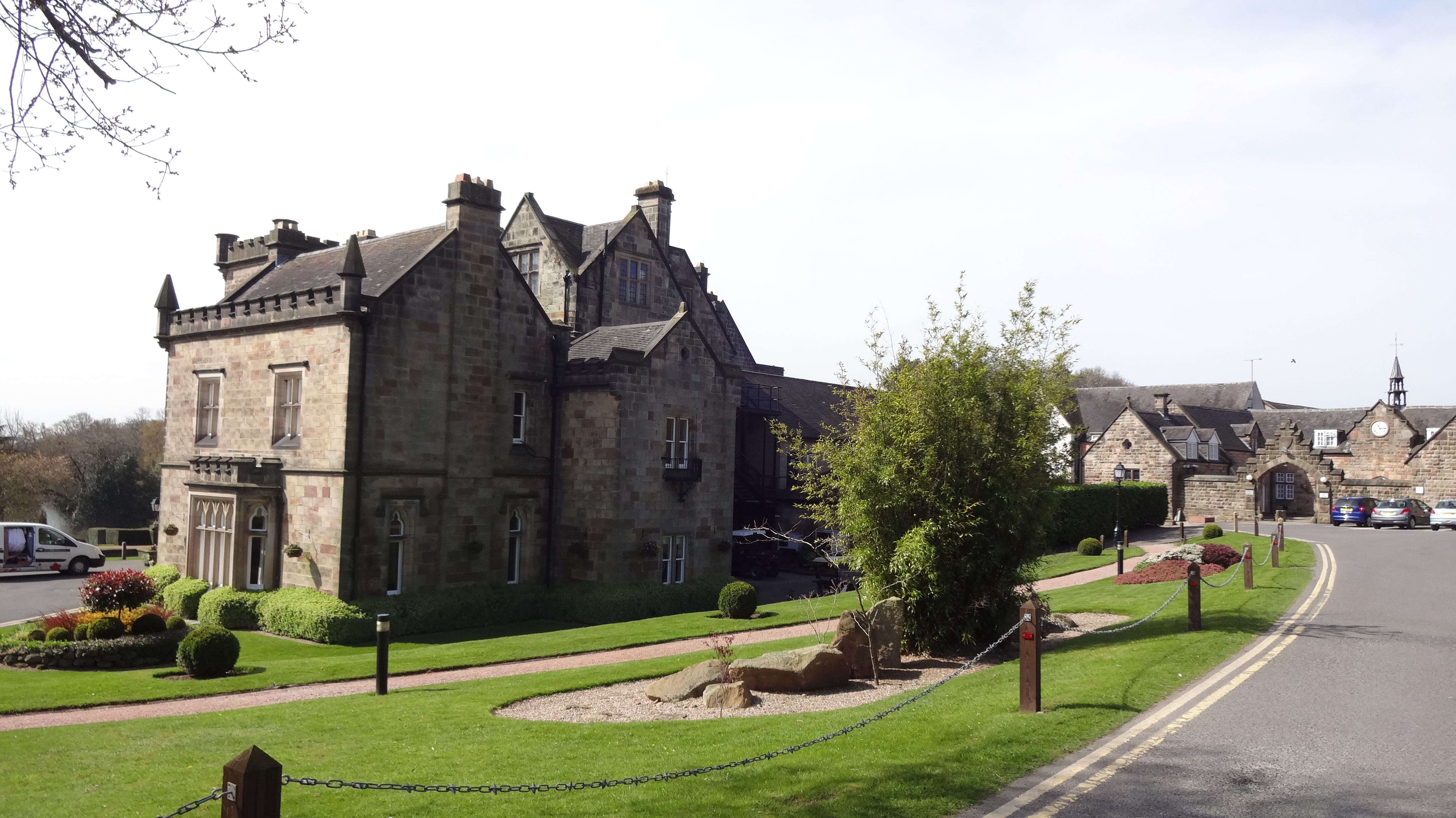
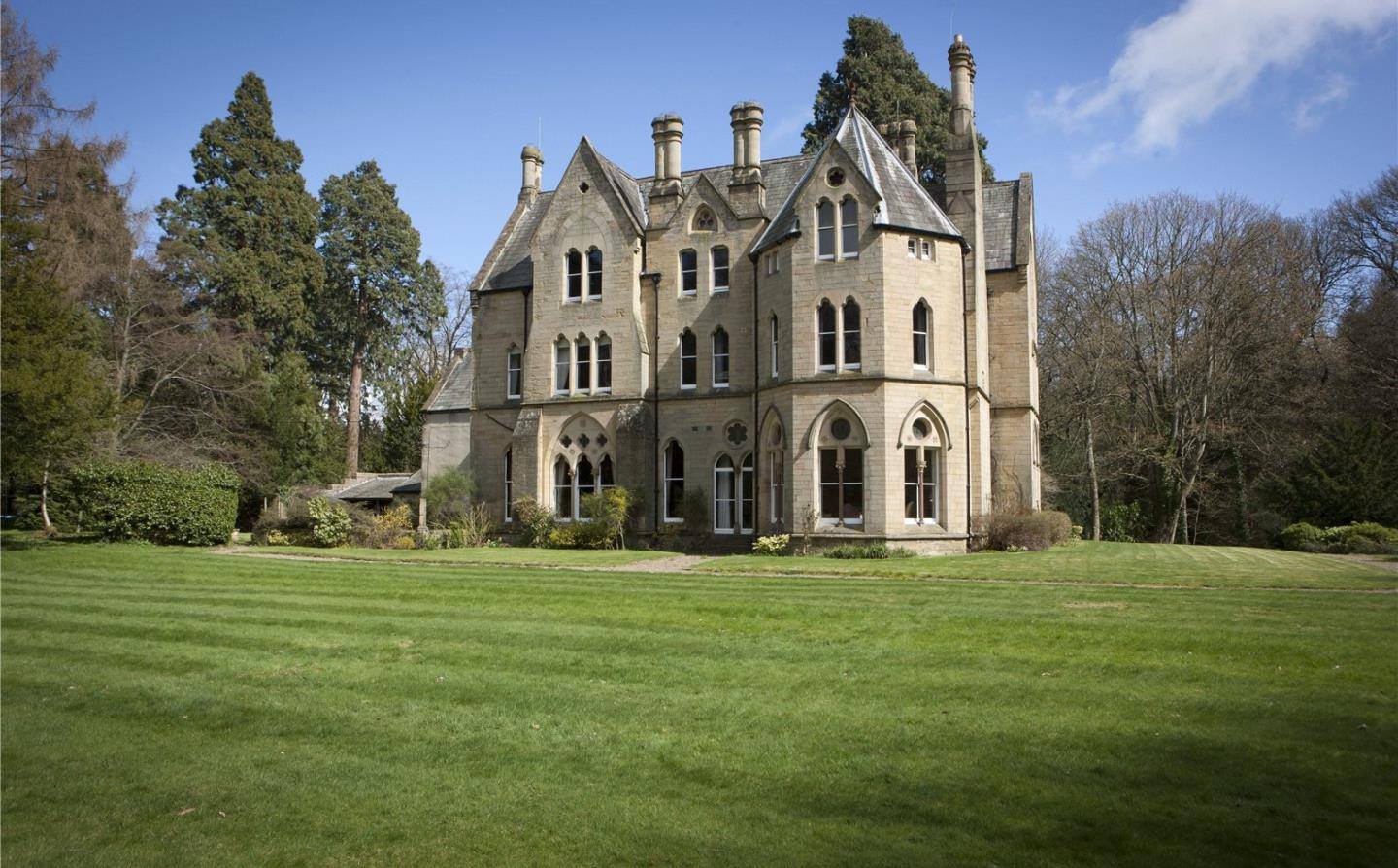
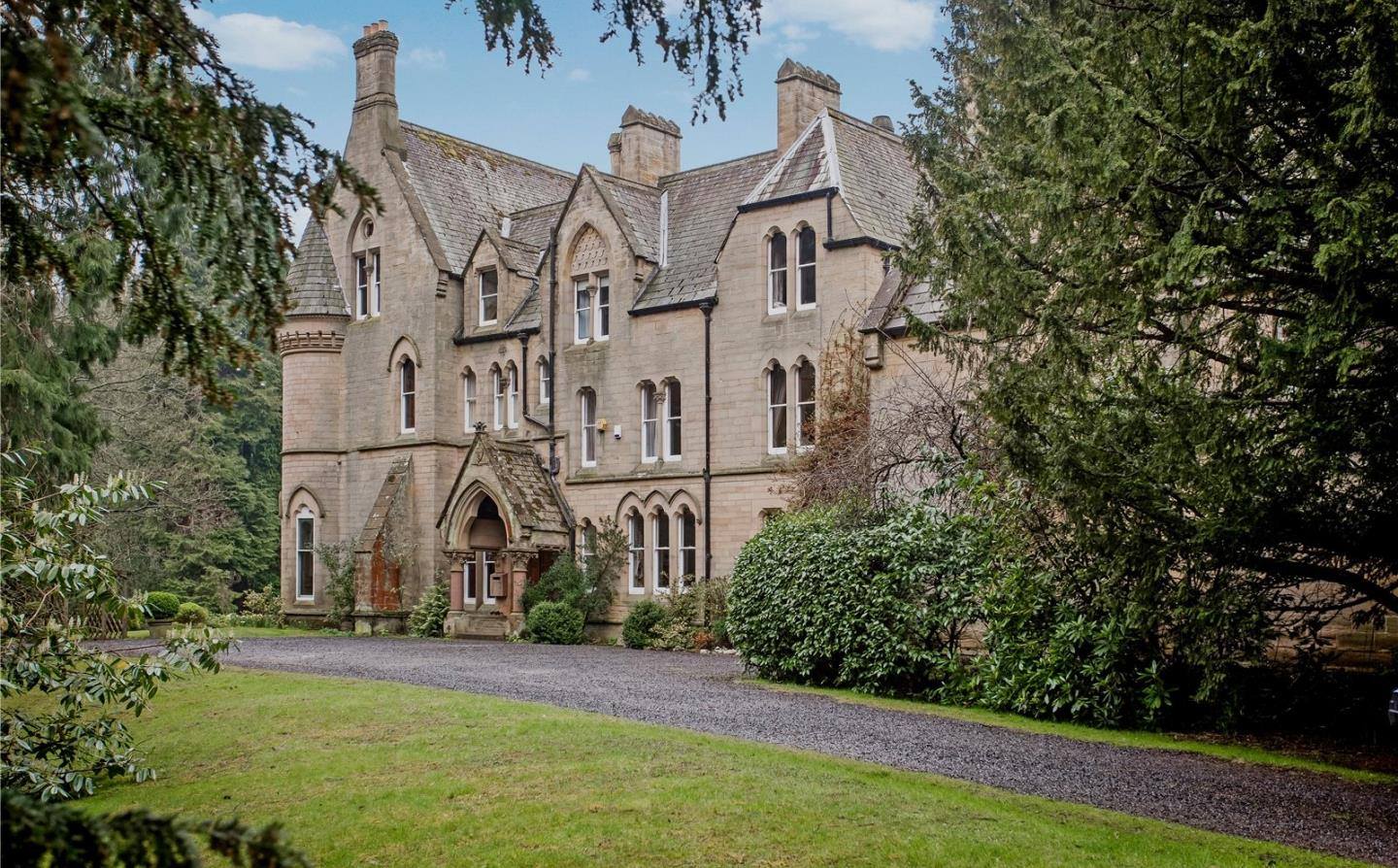
Breadsall Priory, a successful hotel, is now forgotten as a country house (House and Heritage)


Built: 1795 with extensive C19 and C20 additions

Architect: Unknown with remodelling by Robert Scrivener c1861
Owner: Marriott Hotels for the Abu Dhabi Investment Authority ADIA)
Country house hotel and country club
Grade II listed

“The plan is a trifle untidy, due to the complex evolution of this fascinating house. The general effect is rather sad.”
The Derbyshire Country House (Maxwell Craven and Michael Stanley)

The above comments may appear rather harsh. However, it is true that the visitor to Breadsall Priory wanders from old to new almost as soon as they enter this grand old mansion. Recent additions have confused the layout but there remains, at its core, an almost intact Elizabethan mansion, a 19th-century house and the ruins of a 13th century priory owned by the Austin Canons.

Breadsall Priory is a former Augustinian priory in Derbyshire, close to the city of Derby, and situated around two kilometres north of Breadsall, and two kilometres east of Little Eaton.  

The early years

In 1536 all monasteries with revenue less than £200 a year were suppressed by Henry VIII and handed over to the Crown. Breadsall Priory and its land was leased to Laurence Holland of Belper in 1537 and used for agricultural purposes.

In 1552 it was handed to Henry, Duke of Suffolk, the father of Lady Jane Grey, but he only retained ownership for a few months. He sold it to Thomas Babington of Dethick and Kingston in 1553.

Babington sold Breadsall Priory to Thomas Hutchinson in 1557 and by 1573 it was in the hands of John Leeke, the uncle of Bess of Hardwick.

Around 1795 it was bought by Sir John Bentley, a knight and Councillor-at-Law. By this time the Priory had been inhabited and in ruinous state. Bentley converted the priory into a tall e-shaped dwelling and lived there until 1621.

Breadsall Priory (Whitbread Archive)
Part of the east front of Bentley’s house now hidden behind 1860 additions (Whitbread Archive)

Following John Bentley’s death in 1622 the house passed via his heiress to Sir Gervase Cutler and then to Sir Edward Mosley of Ancoats, from whom it descended to a distant cousin, also called Sir Edward Moseley.

He granted Breadsall Priory to his son-in-law, Sir John Bland of Kippax in Yorkshire, in 1693.  Bland sold the house to Thomas Leacroft of Wirksworth for £1,675 in 1702. The following year Leacroft sold it to Andrew Greensmith of Steeple Grange, a partner in his lead smelting business.

Breadsall Priory about 1787 (Derby Local Studies Library)
East front of Breadsall Priory, farm buildings and dovecote, by Ravenhill. Published 1791, but engraved several years prior to that, possibly in about 1787 (Derby Local Studies Library)

Breadsall Priory remained with the Greensmith family until 1799 and underwent a series of alterations including re-siting of the main entrance from the east front to an extension on the north side. The last family occupant was Hannah Greensmith Beard of Lincoln who died in 1797. Her sons sold the house and grounds to Erasmus Darwin in 1799.

The Darwins

The first few years of Darwin ownership proved tragic but the name will always be associated with Breadsall Priory.

According to Nick Redman, Erasmus Darwin (1759-1799) was 41-years-old and unmarried when he bought the estate.

He was the son of Dr Erasmus Darwin (1731-1802) whose scientific and philosophical achievements were well-known across the land. He was a physician, poet, and botanist noted for his republican politics and materialistic theory of evolution. Although today he is perhaps best known as being the grandfather of naturalist Charles Darwin and of biologist Sir Francis Galton.

Erasmus darwin
Dr Erasmus Darwin. Physician, poet and botanist

Dr Erasmus Darwin had married Mary, daughter of Charles Howard of Lichfield, who produced three sons – Charles (who died aged 19), Erasmus (II) and Robert (who was father to Charles Darwin).

Erasmus, the second son and new owner of Breadsall Priory, had wanted to enter the church but instead became an attorney-at-law specialising in property and opening a practice in Derby.

He bought Breadsall Priory in November 1799 but on the night of 29 December ran out of the house in a distressed state and was later found drowned in the River Derwent. The exact circumstances of his anguish remain a mystery but the likelihood is that he committed suicide.

Breadsall Priory reverted to his father, Dr Erasmus Darwin, who had been living in Derby since 1783.

Darwin probably commissioned an extension on the east front of the house but didn’t move in until March 1802.

His stay lasted a matter of weeks and on 18 April Darwin died from a heart attack. His second wife, Elisabeth, widow of Colonel Chandos Pole of Radbourne, remained at Breadsall Priory until her death in 1832. (Darwin had married Elisabeth Pole in 1781 and had three sons and three daughters).

Following Elisabeth’s death Breadsall Priory was inherited by their only surviving son, Francis Sacheverel Darwin (1786-1859).

Graduating from Emmanuel College, Cambridge he travelled the world aged 22-years-old. Darwin had started with four others, one of whom was his brother-in-law Theodore Galton, on a tour through Spain, the Mediterranean and the Near East. They came in contact with war, robbers, privateers and the plague and only Darwin returned alive.

Francis Sacheverel Darwin
Francis Sacheverel Darwin  who made Breadsall Priory his family home

Francis became a physician inheriting his father’s tastes and distinguished abilities. He had lived for a time at Lichfield where he had an extensive practice and subsequently at Sydnope near Matlock.

In 1815 he married Jane Harriot Ryle, youngest daughter of John Ryle of Park House, Macclesfield, and had three sons and seven daughters. He was knighted by George IV in 1820 and served as a Justice of the Peace and Deputy Lieutenant of Derbyshire.

After his mother’s death Francis made Breadsall Priory available for rent. In 1842 an advertisement in Aris’s Birmingham Gazette offered the house on a 5 year let:-

‘The most beautiful and desirable residence, four miles from Derby, containing every accommodation for a genteel Family, with gardens, orchards, pleasure grounds, fish-ponds, rookery etc. And about 25 acres of rich pasture land, with a cottage for servant or labourer. There are several packs of hounds in the immediate vicinity, and the tenant may have the exclusive rights of shooting over the farm adjoining. The house is abundantly supplied with the softest and purest spring water’.¹

The last tenant at Breadsall Priory was Joseph Webster whose family developed a wire drawing business in Sutton Coldfield. He had safeguarded the firm against competition from a new patent piano wire by successfully negotiating a merger and creating Webster & Horsfall Ltd of Penns Mill. The company would also produce the wire used in the first transatlantic cable. Webster left Breadsall Priory and moved to Ashfurlong House at Sutton Coldfield.

Francis Darwin finally moved into Breadsall Priory in 1847. He was a keen antiquarian and carried out several excavations hoping to find a tunnel that was rumoured to run from the house to Horsley Castle three miles away. He dug a trench along the north side of the house but found nothing.

Breadsall Priory from the south east in September 1857, by Violetta Darwin (Rosemary Bonham-Smith)
Breadsall Priory from the south-east in 1857, by Violetta Darwin (Rosemary Bonham-Smith)
Breadsall Priory 1857 (Derek Sherborn)
Breadsall Priory north front in 1857. Apart from the insertion of Bentley’s sash windows, Bentley’s work of 1600 is virtually untouched (Derek Sherborn)

In his later years Francis Darwin lived in retirement and due to age and increasing infirmities was unable to mix in society. He died in 1859 and Lady Darwin moved to Breadsall Lodge nearby.

Breadsall Priory 1857-1880 (Derby Museums and Art Gallery)
Breadsall Priory from the south-west, by W.B. Cottam. The view was captured between 1857 and 1880 (Derby Museums and Art Gallery)

In January 1860 Breadsall Priory and its estate were put up for auction at the Royal Hotel in Derby. Bidding opened at £10,000 and was sold to Mr Francis Morley for £13,000.

Breadsall Priory Auction January 1860
The auction in January 1860 caused much excitement (BNA)

In March the entire contents of the house were auctioned and Morley took possession on March 25 1860.

Just three days later an advertisement appeared in the Derby Mercury advising builders and others ‘desirous of contracting for several works connected with alterations and additions to obtain plans and specifications from the architect’, Robert Scrivener, of Hanley in the Potteries.²

Francis Morley (1810-1883)

Francis Morley was the son of Richard Morley of Sneinton Hall near Nottingham. The hosiery firm of I. and R. Morley was established by John (1768-1849) and his brother Richard (1775-1855) in about 1797.

Hosiery was still primarily a cottage industry at the time. Entrepreneurs like I. and R. Morley were essentially wholesalers, buying in goods and storing them in warehouses in Nottingham and in the City of London.

Francis Morley might have been expected to join the family business and for a time did play an important part. However, marriage took Morley into the world of pottery with considerable success.

In 1835 he married 18-year-old Emma Ridgway, daughter of the famous potter William Ridgway. Morley became a partner in Ridgway, Morley, Wear and Co and in 1842 became sole proprietor with Ridgway.

The nineteenth-century historian Llewellyn Jewitt said that ‘Morley entered with spirit into the pottery business and into the life of Staffordshire.’

When Ridgway retired Morley continued the business alone before going into partnership with Samuel Astbury and trading as Francis Morley & Co.

Business was carried out at the Broad Street Works, Shelton, in Hanley, but Morley recognised the importance of new markets and built a factory in Philadelphia, USA.

The company became famous for its ironstone and earthenware and was producer of the acclaimed Mason’s Patent Ironstone China. (Morley had bought many of Charles James Mason’s moulds when the latter went bankrupt in 1848). This product is now highly collectable in modern antique markets.

The partnership with Samuel Astbury was dissolved in 1853 and Morley took another partner, Taylor Ashworth, with whom he worked until 1862 before taking retirement.

It was with this in mind that Morley bought Breadsall Priory in 1860. Until then the house looked almost as it did in John Bentley’s day. The only change had been east front additions and Morley was keen to bring the house up to Victorian standards.

Morley returned to the Potteries and engaged the services of the architect Robert Scrivener (1812-1878). The Ipswich-born son of master builder William Scrivener had moved to Staffordshire in the 1850s, establishing a practice in Shelton, close to Morley’s Broad Street works. Scrivener was one of North Staffordshire’s leading architects designing many of Hanley’s most notable buildings.

The style chosen for Breadsall Priory was theatrical and changed the appearance entirely. The Victorian Gothic style was complicated and hid most of the original house behind a new façade.

Nick Redman in An Illustrated History of Breadsall Priory described the dramatic effect:-

‘Morley began by removing all the additions on the east side. He then added a large three bay extension which butted up to the front of the old house, leaving only Bentley’s attic floor visible. On the central bay was a projecting porch with a balustrade and battlemented corner turrets.

‘North of the porch he placed a separate castellated extension with a new dining room at ground floor level, and with bedrooms and bathrooms above. Below it two wine cellars linked to the basement beneath Bentley’s north east tower.

‘Between this extension and the old house Morley inserted another block, also castellated. The Gun Room on the ground floor had a side door. The construction of these new buildings covered or destroyed the Priory foundations revealed earlier by Sir Francis Darwin.

‘The old entrance hall which had been very narrow, was enlarged by taking away a large portion of the lower section of Bentley’s central tower, in which was formerly a winding staircase. The new entrance hall measured 24 square feet, with solid parquet flooring, the centre of oak and walnut interlaced, with an ornamental border of elaborate design. The principal staircase was of carved oak.

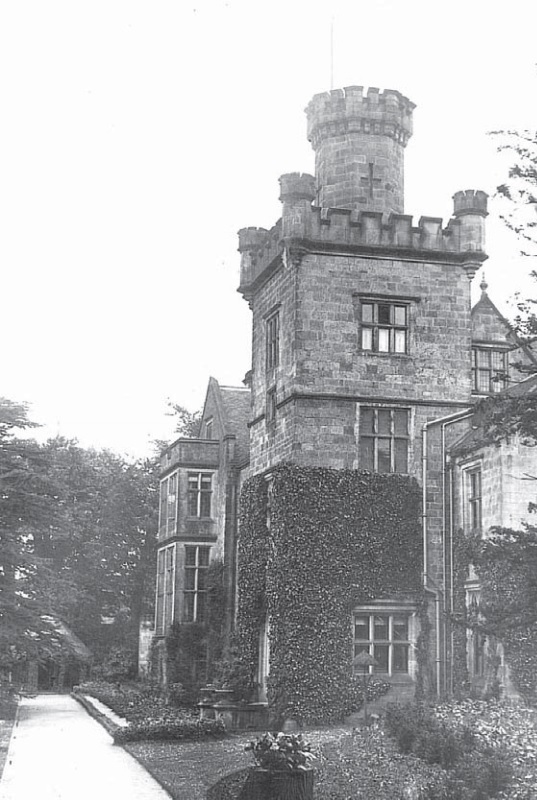
‘The gabled stage of the south-east tower was replaced by another floor with battlements and overhanging corner turrets. Above this was a tall octagonal stair tower with cross arrow slits, machicolations and battlements.

‘West of this tower Morley replaced the large gabled return with a replica of one of Bentley’s gables, but retaining Bentley’s mullioned window within it. He inserted a new window of four lights and added below it a large canted bay with a trefoil-headed battlemented windows under quatrefoil decorations.

‘West again he built a billiard room. It was single storey and thus most of the west front of Bentley’s house was left untouched. The room had an open carved roof lit by skylights, and with a three-light traceried window to the south. It was furnished in the Moorish style.’

The house was completed in autumn 1861 and Morley spent the next few years developing the grounds and parkland at a cost of about £4,000.

Breadsall Priory (1860-61) (The Building News)
Breadsall Priory south front as rebuilt by Francis Morley 1860-61. Drawn by Charles Cattermole and engraved by O. Jewitt (The Building News)

Despite originally investing in new farm buildings Morley decided to withdraw from agriculture in 1875 selling all his livestock and equipment.

In his later years Francis Morley suffered ill-health.

George Ashworth, the father of Taylor Ashworth, wrote “Mr M would beat mother just now in a walking stick match for she cannot even stand.” Jane M. Diener wrote that Morley and his wife Emma lived in retirement served by a butler, footman, housemaid and lady’s maid.³

Francis Morley died in 1883, aged 73. In his will he left personal estate amounting to over £71,000. He left Breadsall Priory and its estate to his wife for life, then his nephew, William Statham, for life, and on the death of the survivor, to his nephew’s son, Francis Statham.⁴

However, his widow had no intention of staying at Breadsall Priory. On June 17 1884 the entire estate was offered for auction at the Mart, Tokenhouse Yard, London.

Auction advertisement 1884 (BNA)
After the death of Francis Morley the house was auctioned in 1884 (BNA)


Henry Joseph Wood (1851-1920)

The purchaser of Breadsall Priory was Henry Joseph Wood. He was a native of Kent, being the son of Edward Wood of Aylesford. In 1876 he married Jane Cooper, the only daughter of Joseph Cooper of Trent Vale, Staffordshire, and moved to the midlands.

Quite how Wood made his living is uncertain but prior to buying Breadsall Priory he was living with his family at The Hollies, the Cooper’s ancestral home at Trent Vale.

In 1885 Wood qualified as a magistrate for Derbyshire and also served on Derbyshire County Council. In 1888 he was elected the President of the Derbyshire General Infirmary.

Wood was a man of many interests. In his younger days he had been a keen cricketer, playing for the Derbyshire Friars. He was also fond of hunting, and was well-known with the North Staffordshire, the Meynell and the South Nottinghamshire packs. He was also a keen shooter and kept this up until old age.

In farming he always took an active interest and regarded this as one of his chief hobbies. At Breadsall Priory he soon built up a herd of dairy cows and a stud of shire horses

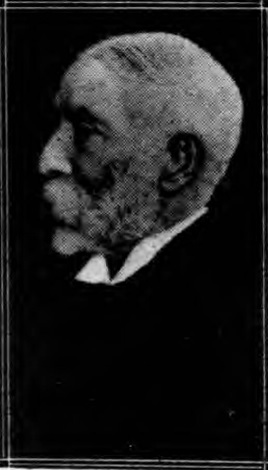
Henry Joseph Wood (BNA)
The relatively unknown Henry Joseph Wood (BNA)

His stay at Breadsall Priory proved to be relatively short. In March 1892 he auctioned his entire farming stock and made plans to return to his native Kent.

Wood moved to Bidborough Court, a huge Victorian house built in the 1860’s near Tunbridge Wells, and previously known as Elm Court.

He became a J.P. for Kent as well as serving on Kent County Council. He became a visiting justice for the Kentish Asylums and the County Gaol, and devoted much of his time with the Discharged Prisoners’ Aid Society.

Jane Cooper, his beloved ‘Jeannie’, died in 1917 and proved a devastating loss to Wood. He died in July 1920, aged 70, when heart trouble was followed by other complications. He left three sons and six daughters.⁵

 Richard Rainshaw Rothwell (1860-1948)

Henry James Wood sold Breadsall Priory to Captain Richard Rainshaw Rothwell. It is likely that he bought the house with the proceeds of an inheritance from his uncle, also called Richard Rainshaw Rothwell.

The older Rothwell had been the owner of large estates in the Bolton area of Lancashire who, for his active interest and financial contributions towards Italian unity, had been created the Marquis de Rothwell and later a Marquis of the kingdom of Italy. He lived at Sharples Hall, Bolton-le-Moors and died in 1890 leaving no male heir. The majority of his vast estate passed to his nephew, Richard Rainshaw Rothwell, the son of his brother, Ralph Rothwell.

Rothwell, the younger, was born in Dunkirk, France, in 1861. He spent most of his childhood in Kent before attending a Gentleman’s School in Hampstead. He married Mary Constance Murdock in 1881 and settled in Berkshire. By the time he inherited his fortune he was living at Finley House at Andover in Hampshire.

He became a J.P. for Lancashire but quite how he came upon Breadsall Priory is open to speculation.

Newspapers reported that Rothwell was going to make considerable improvements to the house and he made good his promise. He provided a supply of spring water from two powerful springs and created a 30,000 gallon reservoir. This supplied the house and outbuildings as well as the ornamental lake and fountains. Rothwell also installed electric lighting throughout the house.

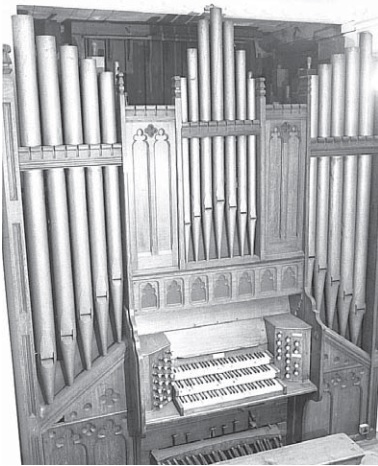
According to Nick Redman he was also thought to have installed a three-manual barrel organ built by Alfred Noble of Birmingham. This stood in the entrance hall and was used until after the First World War. In 1975 it was presented to the Darwin School at Chaddeston but subsequently dismantled.

Breadsall Priory organ, worked by hydraulic power, in 1975 (Keith Pollard Photography)
Rothwell’s hydraulic powered organ seen in 1975 (Keith Pollard Photography)

In 1894 Rothwell sold Sharples Hall and we might have expected him to have made long-term plans for Breadsall Priory.

However, Rothwell’s interest in the house was waning and may even have overstretched his finances. In November 1896 the Derbyshire Times and Chesterfield Herald reported that Sir Alfred Haslam had ‘practically acquired’ the ownership of Breadsall Priory.

The following year the following appeared in the Pall Mall Gazette:-

“Large estates continue to be put on the market. We understand that offers will now be received for Breadsall priory, the Cantley estate of 4,500 acres, near Doncaster, and Poynton Birches, on the borders of Derbyshire.”⁶

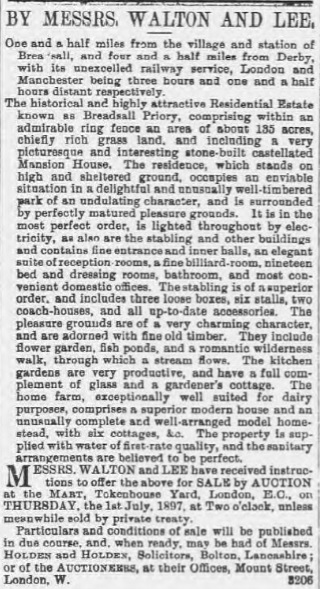
In May 1897 Messrs. Walton and Lee were preparing auction of Breadsall Priory. The house came with 135 acres of rich grass land but the property was eventually withdrawn from the market.

Auction Notice (Derby Mercury 26 May 1897)
The house was eventually withdrawn from sale (Derby Mercury)

In August 1897 the estate was sold by private treaty. The buyer was Sir Alfred Seale Haslam who had been interested in Breadsall Priory for several months.

Richard Rainshaw Rothwell moved to Hove, in Sussex, where he was reported to be living on his own personal wealth. He later moved to Devon where he resided at Morebath Manor until his death in 1948.

Sir Alfred Seale Haslam (1844-1927)

“Sir Alfred was very proud of the place, and when I called on him, not many months before his death, he took the greatest pleasure in showing me round the house and grounds.” (Gossiper – Derby Daily Telegraph 9 July 1930)

Alfred Seale Haslam was the fourth son of William Haslam, an iron-trader from Derby.

Alfred was educated at the Diocesan School and privately. He started work as a practical engineer at the works of the Midland Railway Company in Derby and the establishment of W.C. Armstrong and Co at Newcastle-upon-Tyne. In 1868 he returned to Derby and joined the Union Foundry and Engineering Works at Little Chester.

Sir Alfred Seale Haslam (NPG)
Sir Alfred Seale Haslam (1844-1927), one of Derby’s greatest industrialists (NPG)

It was in 1880 that Alfred had pioneered an early refrigeration system. The equipment allowed for the transport of meat in sound condition from the colonies of the Antipodes. The following year it was fitted to a steamer which transported 17,000 carcases to Britain from Australia.

The idea was ridiculed at first and there was opposition from the British agricultural interest and the prejudice of the British consumer.

He risked between £25,000 and £30,000 in support of his guarantee that the meat carcases would not suffer in transportation. It revolutionised the meat trade and changed the meat-eating habits of the country.⁷

The process made a fortune for Alfred Seale Haslam and in no time at all millions of carcases and sheep were imported from far away. It quickly became an indispensable part of equipment for warships, liners and meat stores. The process was also applied to other colonial food products such as butter, cheese and fruit. Its usefulness also allowed warships to store explosives at an even temperature. Other products  manufactured included boilers, hoists, mill machinery and air conditioning equipment for hospitals overseas.⁸

The company was converted into a limited company in 1876 and was renamed as the Haslam Foundry and Engineering Company Ltd. He became the Managing Director and principal shareholder.

A devout Baptist, Alfred married Annie Tatum, the daughter of Mr Thomas Tatum of the Elms, Little Eaton, in 1875. They lived at North Lees, Duffield Road, Derby.

Haslam became a Borough magistrate in 1886 and a Derbyshire magistrate in 1891. He became Mayor of Derby in 1890 and 1891. In the year of his second term he received Queen Victoria on her visit to the town and was later knighted on the platform of Derby Station.

Alfred was chosen as a Unionist candidate for Derby in the general election of 1892 but suffered defeat. He filled many public offices in Derby, including the Presidency of the Derby Chamber of Commerce and the Derby Children’s Hospital.

With considerable personal wealth it was only fitting that Alfred Seale Haslam was looking for a home of better standing. However, his move to Breadsall Priory in 1898 led to a parting of ways with Derby Corporation.

His new house was outside the borough and disqualified him from council matters. His qualification further failed owing to his company being a limited liability company and therefore carried no vote. The difficulty might have been overcome had Haslam rented a single room at his works or even taken a room elsewhere in the borough. Haslam refused and his council duties came to an abrupt end.

Settled in his new home Alfred offered his services to Newcastle-under-Lyme across the border in Staffordshire. He was not a regular member of the council but was Mayor for three successive years from 1902. For a time he combined this role with that of Unionist M.P. for Newcastle, winning his seat by 182 votes in 1900, and sat until 1906 when he was a victim of the great Unionist debacle of that year.

Alfred donated a statue of Queen Victoria which still stands at the Blackfriars end of the Thames Embankment in London. Similar statues were also funded for Derby and Newcastle-under-Lyme.

Although Sir Alfred Seale Haslam resided in London he spent as much time as possible at Breadsall Priory. He added a large west wing in Elizabethan style obscuring half of Bentley’s west front.

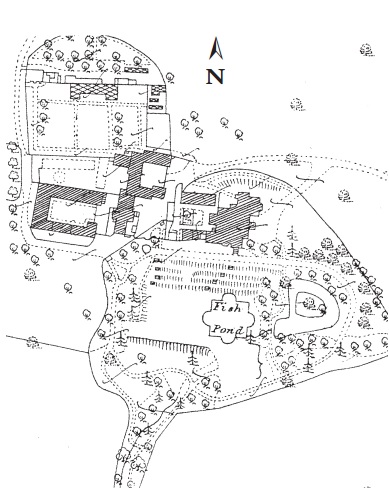
Plan of Breadsall Priory 1889 (Ordnance Survey Office)
A plan of the Breadsall Priory estate in 1889 (Ordnance Survey Office)

According to Nick Redman he made significant alterations:-

“He demolished Morley’s billiard room, replacing it with a library. Beyond that he built his own billiard room complete with minstrels’ gallery and raised seats for the spectators. It was a striking room, decorated like Morley’s in Moorish style, with a moulded plaster ceiling with pendants. The large window on the north side looked out in Haslam’s day into a little courtyard complete with a rockery.

“At the west end of the south front Haslam built a gable matching Morley’s replica gable of 1861. Haslam’s coat of arms and the date 1899 are still visible above the library’s bay window. In the room at ground floor level below the billiard room was a small windowless area for use as a photographic dark room. (This was used by Haslam’s eldest son, Alfred Victor Haslam who took many photographs of Breadsall Priory).

“The drawing room was accessed from the entrance hall by a separate flight of stairs running parallel to the main staircase.

“In the dining room the fine oak panelling covering the lower half of the walls came from Sir Alfred’s Derby home (presumably North Lees).

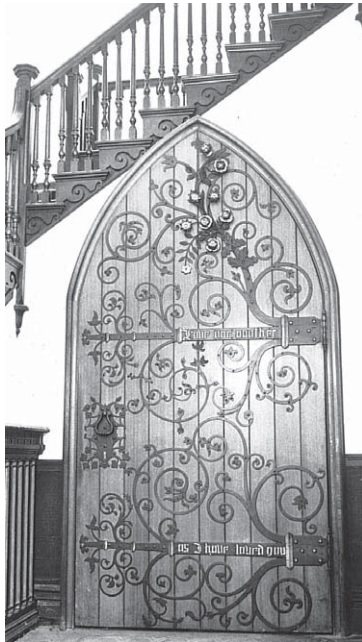
“Outside the dining room Haslam installed a large Gothic door made by his father, William Haslam. The door had been displayed at the Great Exhibition in 1851 as an example of ancient church wrought iron-work and was hugely praised.

“Haslam made only one change to the east front of the house. He inserted into the balustrade over Morley’s porch a large stone bearing his coat of arms and motto ‘Agnus Dei Salvator Meus’”

Chapel door made by William Haslam for 1851 Great Exhibition. Installed at Breadsall Priory in 1900 (Keith Pollard Photography)

In August 1904, Alfred, keen to show off his new country house, invited the whole of his workpeople at the Haslam Engineering Works to Breadsall Priory, together with their wives. In total there were about 700 people present for the occasion of the homecoming of his son, Alfred Victor Haslam, and his new bride.

Haslam later commissioned Thomas Hayton Mawson, the garden designer, to develop the pleasure grounds. A new rose garden was created in 1909 and it is thought that many fragments of stone from the old priory were finally cleared away.

Sir Alfred Haslam attracted much interest at the outbreak of World War One.

When hostilities started Haslam, along with his two daughters, was visiting the German spa at Homberg. For several days the three, together with other English visitors, were semi-prisoners in their hotel. His release was probably due to his age, and a most unpleasant journey to the Dutch border followed, before travelling back to Breadsall Priory. The ordeal caused Alfred much anxiety and he was confined to bed suffering from a severe shock to his nerves.⁹

While Breadsall Priory became Alfred’s ‘pride and joy’ it also experienced tragedy.

In 1907 Alfred’s eldest son, Alfred Victor Haslam, died at Northfield, his residence on Duffield Road, Derby.

In 1917 Captain Kenneth Seale Haslam, his youngest son, of the North Midland Howitzer Brigade, was killed in action at Guémappe, east of Arras.

Of the three sons only Eric Haslam survived as well as his two daughters – Edith Hannah Haslam, who still lived at home, and Hilda Annie Ham, wife of the Rev Herbert Ham, Vicar of Wirksworth and later Provost of Derby Cathedral.

His wife, Lady Haslam, died in March 1924 at Breadsall Priory.

South front Breadsall Priory c1900 (Frank Eade)
The south front c1900. Haslam’s new wing contrasts with Morley’s work (A. Victor Haslam)

Sir Alfred Haslam had been far from well but rallied sufficiently to continue his business affairs. He still visited his factory every day and travelled the country for meetings.

It was on such matters that he travelled to London in January 1927. He was staying at the Midland Grand St Pancras Hotel and on the night of January 12 complained of feeling unwell. He retired to his room with orders for a hotel servant to wake him early next morning. After receiving no response to his knock the servant entered the room and found Sir Alfred dead in bed.

His estate amounted to £1,064,393 after estate duty of £288,691 had already been paid. Newspapers of the day took great delight in calling him the ‘millionaire businessman’.

Breadsall Priory 1905 (A Victor Haslam - Derbyshire Archives)
East front, Breadsall Priory, 1905. Morley’s castellated work of 1860-61 dominates, but the gables of Bentley’s house can still be seen behind (A. Victor Haslam – Derbyshire Archives)

Both Sir Alfred and Lady Haslam were buried at Morley. The Breadsall Priory estate was left to Alfred’s second son, Captain Eric Seale Haslam, who was 41-years-old, and his houses on Duffield Road were given to his daughters.

Eric Seale Haslam (1886-1967)

“Sitting in my library, watching the herd of cows making their way across the park is one of the joys of my life.” (Captain Eric Seale Haslam)

Eric Seale Haslam was born in 1886 and educated at Haileybury College in Hertfordshire. He later trained to be an engineer at the Rhos Prepatory School in Colwyn Bay.

During the First World War he served with the Territorial Artillery, and was wounded at Loos in 1915. He returned to action but was invalided out of France following a serious railway accident in 1916. Just a year later his younger brother, Kenneth Haslam, was killed in action.

Eric Seale Haslam (Derby Daily Telegraph)
Eric Haslam (1886-1967) (Derby Daily Telegraph)

Eric Seale Haslam had joined the family business and became chairman, choosing to rename the company as the Derby Pure Ice and Cold Storage Co Ltd*.

A freemason with the Tyrioan Lodge he was also on the board of the Derby Canal Company and a manager at the Derby Savings Bank. Outside of his business interests he was a keen agriculturalist being the president of the Derby and District Milk Recording Society and the West Hallam Ploughing Association. He was later appointed a magistrate for Derbyshire and became High Sheriff of Derbyshire in 1937.¹º

The story of Eric Seale Haslam at Breadsall Priory might also be the story of his sister, Edith Hannah Haslam. She remained at Breadsall following the death of her father and appeared to live happily alongside her brother. While Eric was the person safeguarding the finances it was Edith who became the public figure.

She was known throughout the county for her generosity. In 1927 she opened the St Christopher’s Home for Wayfaring Women at North Parade, in Derby. She attended Breadsall Church and was a committee member of the Queen Victoria Memorial Home of Rest. Edith also championed the conversion of the St Alkmund’s old burial ground into a rest garden and playground for children.¹¹

She later wrote a book, The Garden with Two Keys, published by the Oxford University Press. It was in the form of weekly letters, originally written to her god-daughter, June. The little girl had been so delighted that Edith thought other children might care for the letters too. She also designed a model garden as a companion to the book.¹²

Edith Hannah Haslam (Derby Daily Telegraph)
His sister, Edith Hannah Haslam (Derby Daily Telegraph)

One interest that brother and sister shared at Breadsall Priory was the gardens. Both lavished attention to them and they were regularly opened in aid of charity. They were later enhanced with a programme of tree planting. A visitor to Breadsall Priory in 1938 wrote of the “air of comfortable well-being… the well-kept lawns and gardens… everything’s in harmony.”

In June 1932 the columnist of the Derby – and Joan feature in the Derby Daily Telegraph made observations of her visit:-

“I went over to Breadsall Priory and , after tea with Miss Edith Haslam, Mr Eric Haslam, her brother, and Sister Ward of the St Christopher’s Home for Wayfaring Women, was taken to look at the terrace, rock garden and stream.

“There are some grounds which never give a caller the pleasure occasioned by the first visit, but those belonging to Breadsall priory have the knack of making a greater appeal every time they are seen.

“A flag path had to be treated carefully because of the aubrietas which grew in every crevice. In every shade of purple they were exquisite.

“On being advised to look the way I had come, one of the prettiest garden pictures met the gaze. Flowers, bushes and trees hugged the line of the rivulet and, in the distance, a flame coloured azalea added just the right touch.”

Breadsall Priory from south east 1930s (Derby Evening Telegraph)
Breadsall Priory from the south-east in the 1930s (Derby Evening Telegraph)

Nick Redman states that the tall stair turret and four bartizans on top of the tower were removed at the beginning of the Second World War. This was to avoid Luftwaffe bombers using Breadsall Priory as a landmark as they headed towards the Rolls-Royce factory in Derby where Spitfire engines were made. The drawing room was also used by the Derbyshire Children’s Hospital as a convalescent ward. During this period Eric Haslam served as a Special Constable around Derby.

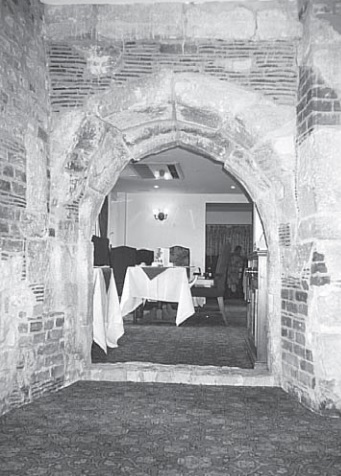
The war also unearthed another one of Breadsall’s secrets. While excavating to build an air raid shelter a 13th century doorway was discovered from the old priory. This was later restored and is visible today. Further excavations also revealed part of a lower floor level with drains that turned out to be the canon’s washing area, fragments of the old priory walls and the remains of the bake-oven.

13th century doorway in west wall of old Priory, discovered in the 1940s (Whitbread Archive)

Redman also says that during a fire in one of the outbuildings in 1947, water was used from the ornamental lake to put it out. The following year the lake developed a leak and emptied gradually filling with bushes and small trees until restored in the 1970s.

Breadsall Priory, south front,1950s. Rurret and coping stones on tower have been removed. Ornamental pond, right, overgrown (Derby Evening Telegraph)
Breadsall Priory, south front,1950s. The turret and coping stones on tower have been removed. The ornamental pond, on the right, is overgrown (Derby Evening Telegraph)

Edith Haslam died in December 1941. She left a will of £52,611 but it was the contents of the will that summed up her generosity.

£5,000 was given to her nephew, Christopher Haslam Dillon Ham, with £2,000 each to Eric and her sister Hilda Ham. Edith gave £1,000 each to Gwendoline Peach and May Ward. She left St Christopher’s House to Hilda, £200 was given to St Alkmund’s Garden and £500 each to Derby Hospital for Sick Children, the Victoria Home of Rest and the Mission of Lepers in Covent Garden. Edith also gave £100 each to her maids of three years’ service.

It was later revealed that Edith had offered a house at 125 Osmaston Road, Derby, to become the Derby Hostel for Lads (which opened in 1942). This property had originally been where she had helped to found the St Michael’s Hostel for Girls in 1937.¹³

Eric Haslam married in November 1943. His bride was Norah Apphia Woodroffe, the younger daughter of the late G.F. Woodroffe of Wimbledon and Mrs Woodroffe of Hillesley House, near Wooton-on-the-Edge, Gloucestershire. The wedding took place at St Mary’s Church in Wimbledon.¹⁴

Aerial view, 1969, showing buildings and kitchen garden to the west of the house (Genius Photography)
Aerial view, 1969, showing buildings and kitchen garden to west of house (Genius Photography)

Eric Haslam, long retired and calling himself a ‘farmer’, died of cancer in 1967 and was buried at St Matthew’s Church at Morley.

His widow, Norah, lived alone before moving to a new house, Priory Chase, built-in one of the quarries near the entrance lodge. She lived here until her death in 1988.

There was a sale of surplus contents in May 1970 but the main house was unoccupied. It was a target for thieves and the garden and grounds slowly became overgrown and the drive rutted. For a house that once prided itself in its lovely gardens it was a sad demise.

Finally, in late 1970, the Breadsall Estate was put up for sale. It included the house and its grounds that had now been extended to 828 acres.

Charles Arthur Richard Harpur-Crewe (1917-1981)

Breadsall Priory was bought by Charles Harpur-Crewe, whose family already owned much of the land around it. Charles (born Jenney) was the grandson of Sir Vauncey Harpur-Crewe, the last baronet of Calke Abbey in Derbyshire. The Calke Abbey estate had passed down the female line until Charles (now called Harpur-Crewe) inherited it in 1949.

The Harpur-Crewe’s estate holdings were very large; apart from Calke abbey and the thousand or so acres of parkland immediately adjoining it, they had some 9,000 acres of land in Staffordshire, Derbyshire and Leicestershire, for the most part let to agricultural tenants, and also about 3,000 acres of moorland in the Staffordshire Peak District.

Charles Harpur-Crewe was unmarried, shy, retiring and had made Calke Abbey one of the most impenetrable country houses in England. He had very little to do with other Derbyshire landowners and preferred to converse with his tenant farmers. In 1961 he served as High Sheriff of Derbyshire and was a hereditary governor of Repton School, a member of South Derbyshire District Council and Chairman of the local Conservative Party.¹⁵

Patrick O’Connor, a jockey who rode horses for Charles’ younger brother, Henry Harpur-Crewe, described a meeting with Charles Harpur-Crewe  in 1981:-

“First impressions of Harpur-Crewe certainly didn’t fit the image of what one would expect of an aristocrat, owner of large tracts of land and former Lord Lieutenant of Derbyshire. He was untidily dressed and had an unfriendly look in his eye that had probably been honed to intimidating perfection dealing with tradesmen and troublesome employees on his estate.”¹⁶

Harpur-Crewe probably wanted Breadsall Priory for its land rather than the house. The purchase came with uncertainty and he wrestled for most of his life with large death duties and had little or no money to spend.

Charles Arthur Richard Harpur-Crewe (1917-1981) (National Trust)
The eccentric Charles Arthur Richard Harpur-Crewe (1917-1981) (National Trust)

In September 1971 David Cox, a hotel owner and property developer, visited Breadsall Priory while it lay empty. He wrote:-

“The Priory’s a superb old building and it’s ideal for the purpose I’ve got in mind. I want people to be able to go there for golf, swimming, squash, all sorts of recreational purposes, and just relax in a good club atmosphere. When it’s finished there won’t be anything like it in the country.”

It is likely that David Cox’s approach to Charles Harpur-Crewe was a difficult and complicated affair. We know that Harpur-Crewe was a stubborn man and planning and legal delays meant it wasn’t until October 1974 that permission was finally granted. Cox signed a long lease to convert Breadsall Priory into a country house hotel and golf complex.

Cox set about refurbishing the sad and empty house. The dining room was turned into the Elizabethan Restaurant and Rothwell’s organ was dismantled to make way for the new hotel reception. The Billiard Room became the Oak Room and the Drawing Room was renamed the Wedgewood Room.

A bar, called the Monk’s Bar, was built over the canon’s old washing area, and the 13th century doorway, discovered by Eric Haslam, was made a feature of the room. Cox created 17 bedrooms upstairs and opened for business in May 1976.

Breadsall Priory hotel reception in 1976. Staircase on the left removed 1990 (Derby Evening Telegraph)
Hotel reception in 1976. The staircase on left was removed in 1990 (Derby Evening Telegraph)

Alongside the hotel development, a new golf course was created within the parkland. The course, enhanced with Cumberland turf, was designed by David Cox, John Flanders and Richard Lambert.

The Home Farm building was converted into a club house and in 1977 the Breadsall Priory Golf and Country Club was officially opened.

The gardens, once the pride and joy of the Haslam family, were cleared and restored and the ornamental lake put back in working order.

Charles Harpur-Crewe died in 1981 and inheritance tax problems enforced the sale of the Breadsall Priory estate.

David Cox was able to buy it outright while Calke Abbey passed to the National Trust in 1985.

In 1986 David Cox was approached by Country Club Hotels, a subsidiary of Whitbread PLC, about buying Breadsall Priory. Negotiations over the sale lasted two years and a deal wasn’t concluded until January 1988.

Whitbread and the Marriott Hotel

The purchase by Whitbread marked a significant change for the house. Their first priority was to increase the number of bedrooms to 92 by constructing a new bedroom block. A leisure complex was also added using old farm buildings and a swimming pool was created in place of the old farmyard.

More importantly a restoration programme was carried out on the old house and a new kitchen block was built alongside.

The golf facilities were also improved with the creation of the Moorland course and a new pavilion which opened in 1992.

Breadsall Priory Hotel Golf and Country Club opened in 1990.

In 1996 Whitbread obtained the franchise rights for the Marriott name in Great Britain and the hotel was rebranded as the Marriott Breadsall Hotel and Country Club.

A new accommodation block, with 24 bedrooms, was built in 1997.

As a salute to its former owners a number of rooms were renamed to become the Haslam, Darwin and Morley Rooms.

Whitbread sold its portfolio of 46 Marriott hotels to the Royal Bank of Scotland (RBS) in 2006. The deal, reported to be £954m, allowed the Marriott Corporation to operate the hotels on behalf of the new owner.

RBS eventually sold the chain to the British Virgin Islands-based Professional Ventures Corporation (PVC) for £1.1bn in 2007.

In 2008 Marriott refurbished the historic meeting rooms, leisure complex, restaurant and golf facilities at Breadsall Priory.  However, there were still troubled times ahead.

In 2011 it was reported that the Marriott hotels chain had been placed in administrative receivership after PVC failed to make loan repayments.

RBS, the majority lender on the debt, regained control of the property portfolio and eventually sold the chain, including Breadsall Priory, to the Abu Dhabi Investment Authority (ADIA) for £640m in 2013.

Breadsall Priory is now regarded as the oldest Marriott hotel in the world.

BREA200416 (20)
The north and east front. Former estate buildings are in the background (House and Heritage)
BREA200416 (23)
Modern-day east front with castellated entrance leading into the reception (House and Heritage)
BREA200416 (29)
The turret on the tower was removed during World War Two to avoid Breadsall Priory being used as a landmark for German bombers heading for Derby (House and Heritage)
BREA200416 (2)
The gardens were restored in the 1970s and the pond cleared of weeds. The glories of Eric Haslam Seale’s gardens are long forgotten but still provide pleasant surroundings (House and Heritage)
BREA200416 (14)
The south front at Breadsall Priory in 2016. All that remains of the terrace gardens are the original stone steps heading down towards the ornamental pond (House and Heritage)
BREA200416 (28)
Breadsall Priory has developed as a country house hotel. Modern accommodation blocks were added to the west of the house in 1988 and 1997 (House and Heritage)

References:-
The process of writing this post has been made considerably easier due to the chronology of events and extensive research already carried out by Nick Redman . An excellent account of its evolution is included in his book An Illustrated History of Breadsall Priory (2009) which proved invaluable and is quoted often.

 ¹Aris’s Birmingham Gazette (23 May 1842)
²Derby Mercury (28 Mar 1860)
³White Ironstone Notes (Winter 2011)
⁴Derby Daily Telegraph (8 Jun 1883)
⁵Kent and Sussex Courier (30 Jul 1920)
⁶Pall Mall Gazette (2 Feb 1897)
⁷Derby Daily Telegraph (13 Jan 1927)
⁸National Archives
⁹Derby Daily Telegraph (20 Aug 1914)
¹ºDerby Daily Telegraph (18 Mar 1937)
¹¹Derby Daily Telegraph (30 Apr 1932)
¹²Derby Daily Telegraph (6 May 1936)
¹³Derby Daily Telegraph (1 Jul 1942)/Derby Daily Telegraph (3 Sep 1942)
¹⁴Derby Daily Telegraph (6 Oct 1943)/Derby Daily Telegraph (19 Nov 1943)
¹⁵Calke Abbey (Harold Colvin). National Trust 1989
¹⁶Glorious Obsessions of Calke Abbey (Patrick O’Connor) Patrick O’Connor 2013

Notes:-
*Eric Seale Haslam, continued in the family business, renamed the Derby Pure Ice and Cold Storage Company. In 1928, the Haslam Foundry Company was taken over by the electrical engineers Newton Brothers Ltd who changed its name, in 1935, to Newton Brothers Ltd. But the refrigeration side was bought in 1935 by L Sterne & Company Ltd of Glasgow who had been making refrigeration machinery since about 1882.

Louis Sterne died in 1953; the company continuing in the refrigeration business until it virtually ceased trading in 1961, being acquired by Prestcold Ltd, owned by British Leyland, in 1968. The Sterne name was phased out in 1971. The name ‘Derby Pure Ice and Cold Storage Company’ was liquidated in 1976.

Breadsall Priory Marriott Hotel & Country Club
Moor Road, Morley, Derby, DE7 6DL

ELLEN BANK

EllenBank (Rightmove)
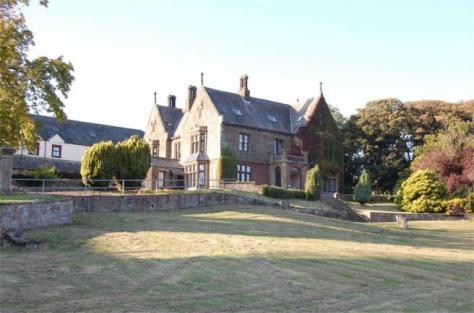
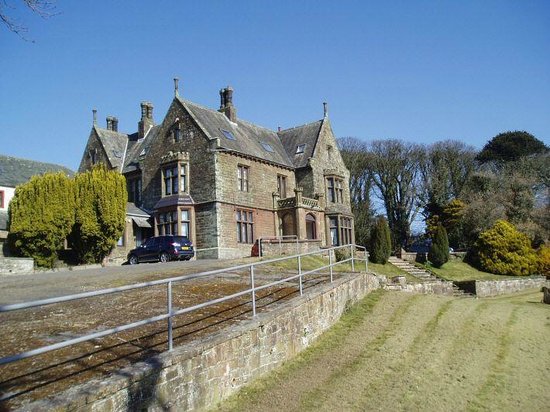
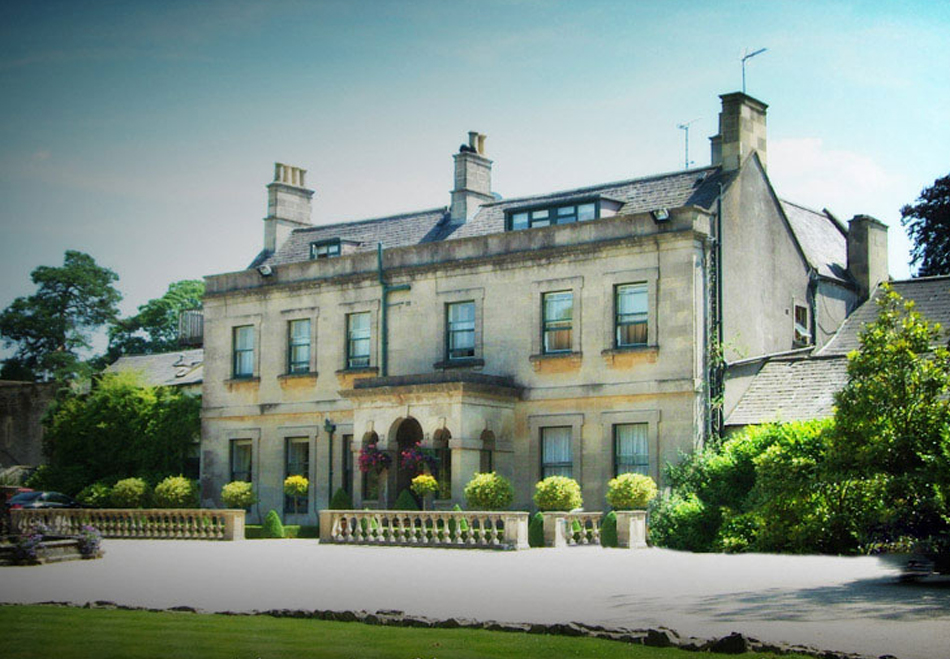
Ellen Bank, near Maryport, Cumbria. Built looking towards the River Ellen (Rightmove)

Built: 1852
Architect: Unknown
Owner: The Mitchell family
Country house hotel

Ellen Bank was built about 1852, probably by Mr Robert Ritson (1811-1887), the head of Messrs Ritson and Co, a long-established firm of shipbuilders, timber merchants and sailmakers of Maryport, Cumbria.†

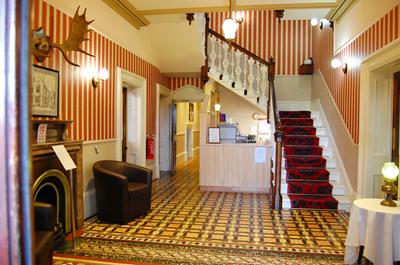
It was typical of many Victorian manor houses and stood within 3 acres overlooking the rolling countryside to the west of Maryport. It was built with stone mullioned windows, decorative fireplaces, a cellar and elaborate wood-workings. An entrance portico leads into the entrance hall and various reception rooms.

The house was originally known as Ellen Bank but became known as Ellenbank in more recent years.

EllenbankC
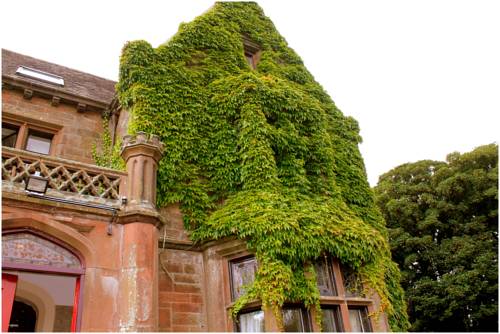
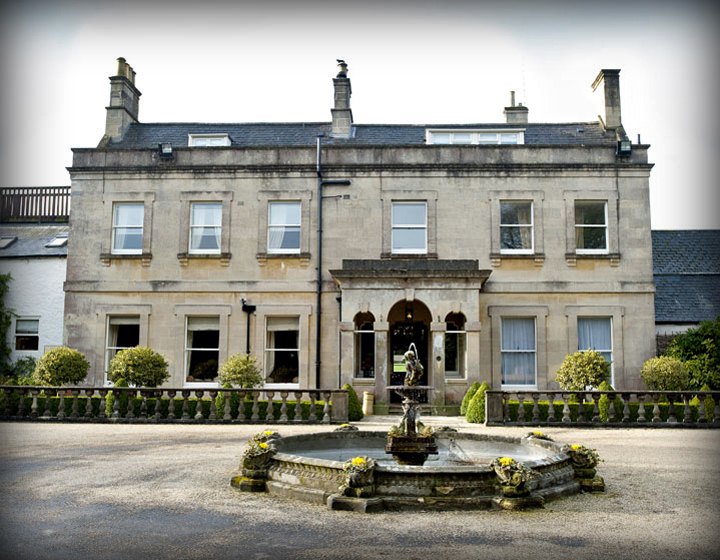
The house was always known as Ellen Bank but has been abbreviated to Ellenbank

In addition to Ellen Bank Ritson owned land and cottages at Allerby, Aspatria, Byerstead Southerfield and Bromfield as well as land at Toxteth Park in Liverpool.

He married Mary Anne Smith in 1842 and lived at 122 High Street, in Maryport. They had four sons, the oldest being John Ritson (1848-1897), and four daughters.

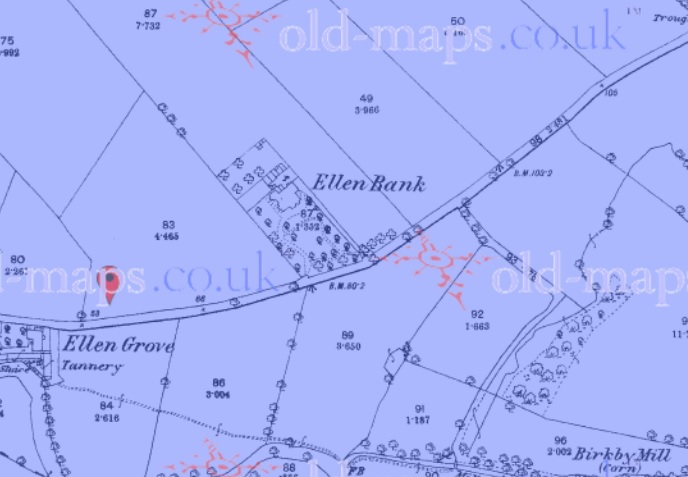
Ellen Bank 1863 (Old Maps)
A Cumberland map of 1863, showing Ellen Bank in reduced grounds with smaller outbuildings to the rear and different access (Old maps)

By 1852 the Ritson family had moved to Ellen Bank and employed a cook and two housemaids. However, with increasing wealth, they had obtained the services of a groom, John Bainbridge, by 1871.

Front door taken from hallway (Tripadvisor)
Original stained glass in the front door (Tripadvisor)

Robert Ritson died in 1887. On his death he left £89,343 and all his shares in ships and shipping companies to his sons John and William. His prized collection of silver plate and china was shared amongst the rest of his family.¹

John Ritson (1848-1897) inherited the mansion house at Ellen Bank as well as the farmland and cottages at Allerby and Aspatria. He also acquired the land at Toxteth Park which was under contract for sale to Mr Hugh Jones.

EllenBank Driveway from lodge to house (Tripadvisor)
The original driveway and gates looking from the lodge to the house (Tripadvisor)

In early life John Ritson was an officer in the Cumberland Militia. He then took an active part in the management of the family business and gained a reputation as ‘a man of sterling character’. He was also a director of the Maryport and Carlisle Railway, the West Cumberland Iron and Steel Company and the Cumberland Union Bank. He was also a J.P. for Cumberland.

In 1865 John Ritson married Mary Jane Logan, the daughter of Captain John Logan, of Maryport, at St Luke’s Parish Church in Chelsea.

Between them they had two sons, Robert and John, and two daughters, Marjory and Kathleen. In 1891 they employed three servants as well as a governess to take charge of the children.

aJohn Ritson’s first iron ship Ellenbank being launched broadside at high tide in 1885. (Cumbrianblues.com)
John Ritson’s first iron ship ‘Ellenbank’ being launched broadside in 1885 (Cumbrian Blues)

John Ritson died suddenly in 1897 aged 50.

He had suffered heart problems for a while but this didn’t deter him from being an enthusiastic cyclist, one of his greatest passions.

On Monday 13 September 1897 he had spent the day shooting partridges with his two sons at Allonby. In the evening he took the train from Bullgill to Cockermouth and cycled with Mr W.B. Mathias to Keswick, where his wife and family had been staying.  He then cycled back to Maryport the same night.

The next day, while attending business at his office, he complained of feeling faint, and asked for a glass of water. His brother, Thomas Smith Ritson, took him outside for a breath of fresh air but he suffered complete collapse. John was taken home by stretcher but never rallied and died on Wednesday 15 September 1897. He was later interred at Maryport Cemetery.²

Ellen Bank Maryport 1897 (Ordnance Survey of England)
An Ordnance Survey Map from 1897 showing larger grounds, a new driveway and gatehouse at the entrance. Small outbuildings had been replaced with a much larger extension to the rear

At the time of his death his eldest son, Robert, was just 9-years-old. His widow remained at Ellen Bank until her death in 1939 and the house remained in the family until the 1980s.

ellenbank-hotel
Ellen Bank is now a country house hotel with modern accommodation behind (Ellenbank Hotel)

The house was purchased by the Mitchell family in 1985 who turned the house into a country house hotel. It was subsequently converted and extended resulting in 26 en-suite guest bedrooms and a function room.

It became popular as a country hotel and became a meeting place for organists from all over Cumbria who played there on a regular basis.

When the Mitchell’s decided to retire the property was placed on the open market. However, like similar size Victorian properties, the cost of renovation looks to have discouraged potential purchasers.

In August 2016 the Mitchell family asked for permission to turn the hotel into 16 flats and create eight townhouses in the grounds.³

EllenbankA
The entrance hall with a view of the grand staircase
EllenbankD (Booking.com)
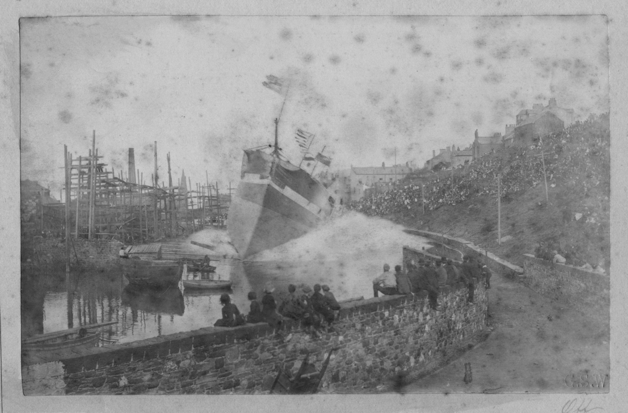
The staircase gets natural light from a ceiling window (Booking.com)
Original fireplace in main dining room (Maryport through the ages)
An original fireplace in the dining room (Maryport through the ages)


References:-
¹Carlisle Patriot (16 Sep 1887)

²Carlisle Patriot (17 Sep 1897)
³Times and Star (5 Aug 2016)

Notes:-
†There is a possibility that the house may have been built by Joseph Ritson, his father, who died in 1865.  In March 1866 the Carlisle Patriot carried an advertisement for ‘ a desirable dwelling house, known as Ellen Bank, near Aspatria’. It contained 4 sitting rooms, 6 bedrooms, dressing room, pantry, cellar, good kitchen, carriage house and two-stalled stable. With views over the River Ellen it was described as being ‘very substantial, well-fitted, having been built about 10 years ago by the late proprietor for his own occupation’. This may be Ellen Bank of this article and may refer to Joseph Ritson who died the previous year. However, we must regard this with caution as there might well have been a similar dwelling called Ellen Bank at Aspatria. The subject of this article is much nearer Maryport.

Maryport quickly developed as an industrial centre throughout the 19th century. An iron foundry opened and the port developed as did shipyards, such as Wood’s yard and Ritson’s yard, which was famous for launching ships broadside into the River Ellen because it was not wide enough to allow ships to be launched the usual way. Ritson’s operated until 1914.

RitsonsShipyard (Heritage Explorer)
Ritson’s Shipyard, Maryport, in early days. It eventually closed in 1914 (Heritage Explorer)


Ellenbank Country House Hotel
,
Maryport, Cumbria, CA15 6RE

CHARLTON HOUSE

Charlton House1 (Charlton House)
Charlton House, originally built close to the road, at Shepton Mallet (Charlton House)


Built: c1810
Architect: Unknown
Owner: The Bannatyne Group
Country house hotel and spa
Grade II listed

Country house in landscaped grounds. Circa 1810. Doulting ashlar, hipped slate roof with dormers, 3-ashlar stacks, moulded around base and apex. “L”-shaped on plan, 2-storeys and attic. (Historic England)

Charlton House stands on land once owned by the Ames family, a famous Somerset name, who made their fortune as merchants and clothiers. They owned the land from at least 1630 onwards and it is Roger Ames who is thought to have built Charlton House for his bride between 1630 and 1650.

Nikolaus Pevsner in The Buildings of England believed Ames actually extended and rebuilt a much earlier house. Charlton House remained in the Ames family until 1804 when they sold it and moved to Bristol.

In 1804 it was sold to the Reverend William Provis Wickham who moved the road away from the front door and relocated it to the other side of a trout stream running nearby. He built a bridge across the stream and dammed it to form an ornamental lake within the gardens.

Charlton House2 (Charlton House)
Charlton House with Georgian porch added by Rev William Provis Wickham (Charlton House)

Wickham also added a Georgian porch on the front and carried out remodelling of the reception rooms including the purchase of mahogany doors from a house demolished nearby.

The Rev William Provis Wickham died, aged 76, in 1843. Charlton House was offered at auction. In advertisements it was described as a comfortable family residence, adapted to ‘the occupation of a Gentleman’s family’, within 10 acres of land. It comprised an entrance hall, dining room, drawing room, breakfast room, gentleman’s morning room and an elegant staircase.¹

Auction Notice (Bath Chronicle & Weekly Gazette 6 July 1843)
The auction notice for Charlton House in 1843 (BNA)

It was not until 1847 that the house was bought from Wickham’s trustees by Colonel Richard Leckenby Phipps (1804-1876). He became a J.P. and Deputy Lieutenant of Somerset. Phipps built new stables nearer the house. The old stables were situated in the ‘top yard’ with an old dovecote, granary and coach house.

Phipps attempted to offload the property in 1849 by offering it for sale by private contract or let. However, the house remained with Phipps and was offered for sale again in 1850.

Phipps finally left Charlton House in 1882 when he sold it to Lieutenant-Colonel Robert Mildmay Clerk (1845-1938), a cousin.

Clerk was a member of an old Somerset family but had been born in Port Fairy, Victoria, Australia. He was also a cousin of Reverend Angus Clerk of Bath.

Clerk had served as Deputy-Adjutant Quartermaster-General, Indian Division, in the Egyptian Campaign of 1882, an Assistant Adjutant-General with the Madras Army between 1853 and 1888, and finally a Lieutenant-Colonel in the 4th Madras Pioneers, 1889-90, before retiring to Charlton House.

It was at Charlton House that he campaigned tirelessly for the Soldiers and Sailors Families Association. His wife, Mary Jacintha, was the daughter of the previous owner, Colonel Richard Leckonby Phipps.²

Charl;tonHouse3 (Charlton House)
21st-century styling of the main staircase (Charlton House)

The house remained with the Clerk family until 1921. Following an auction of surplus household furniture and effects it was sold to Charles Edward Burnell (1872-1959), J.P., Managing Director of the Charlton Brewery Co Ltd and a director of George’s Brewery in Bristol. He became High Sheriff of Somerset in 1942 and lived at Charlton House until his death in 1959.

The house was bought by Mr Hughes, a ‘property dealer’, in September 1959. The following year it was offered to Mr Francis Dix, the founder and Headmaster of All Hallows School.

“I was immediately enraptured by its intimate air of tranquillity. I walked into the grounds at 10 o’clock and captured by its mood, had purchased it before leaving at midday.”

Francis Dix did little structural work at Charlton House but is thought to have removed the ceiling in an upper room, exposing the rafters and turning it into a chapel where mass was celebrated once a week. He redecorated the house (“Painted brown pillars white, etc.”) and completed urgent repair works on the roof. Dix also accommodated eight boys in the house and transported them to All Hallows by minibus each morning. (All Hallows Roman Catholic Prep School was attended by the journalist Auberon Waugh, the eldest son of Evelyn Waugh.)

Dix sold Charlton House to Ken Seaton in 1965. Seaton was the proprietor of the Ilchester Hotel, Ilchester, and in the cellars had started experimenting combining cheese with chives, beer (the first cheese blended with draught Worthington E bitter) and a blend of spices. These he served to customers in the hotel and from this he formed the Ilchester Cheese Company, known to this day and now owned by Norseland.

In time the company created some of Britain’s best-known cheeses: -Five Counties cheese containing Double Gloucester, Cheddar, Derby, Red Leicester and Cheshire cheese; Mexicana flavoured cheese; Abbeydale; Crandale;  White Stilton and apricots; and Applewood smoked cheese.

Ken Seaton (applewoodcheese.co.uk)
Ken Seaton (Applewood Cheese Company)

Seaton turned Charlton House into a country house hotel and it soon became a respected venue. Visitors to the hotel included the Duke of Edinburgh, Cliff Richard and the King of Thailand.

However, according to local historians, the house suffered under Ken Seaton’s ownership. Colonel Phipps’ stables were turned into flats and the grounds were reported to be neglected. There were also plans to turn Charlton House into flats and apartments that were opposed by Mendip Council and the Shepton Mallet Society. It might be suggested that, with the growth of the Ilchester Cheese Company,  Seaton had lost interest in the hotel.⁴

After Seaton died Charlton House underwent several changes of ownership until bought by Roger Saul in 1996.

Saul had created the designer label Mulberry in 1971 with his mother Joan from their Somerset home. At first, he sold belts and then handbags to trendy London boutiques. In the 1980s and 1990s Saul had opened 25 designer shops around the world.

In 1996, he opened the Charlton House Hotel and bought the Kilver Court estate outside Shepton Mallet as the headquarters for Mulberry.

With his wife Monty (a former model) he used the hotel to showcase the Mulberry Home Collection in a country house environment. According to Saul the hotel had “settled on its springs” and needed a complete restoration.

Roger Saul (The Telegraph)
Roger Saul, who masterminded the renaissance of Charlton House (The Telegraph)

A new kitchen was built and the conservatory restaurant extended. In 2004 eight new bedrooms were constructed in a new south wing and a spa was created in the old stable block. The hotel went into administration in 2009.

In 2010 Charlton House was bought by the Bannatyne Group, headed by the entrepreneur Duncan Bannatyne, better known for his role in BBC TV’s Dragon’s Den.

A former Royal Navy mechanic, Mr Bannatyne began his business career with an ice cream van he bought for £450 in the early 1970s. He quickly built up an ice cream empire before moving into care homes, children’s nurseries, and, more recently, gyms, spas and hotels.

Charlton House now operates as a luxury hotel, wedding venue, conference centre, health club and spa. A far cry from its days as a quiet country house.

Duncan Bannatyne at the Charlton House Hotel in Shepton Mallet, Somerset.
Duncan Bannatyne at the Charlton House Hotel in Shepton Mallet, Somerset
GLA130516 (23)
Charlton House, once a remote country house, is now a busy hotel and spa (House and Heritage)
GLA130516 (11)
The grounds at Charlton House with conservatory restaurant and orangery (House and Heritage)


References:_

I am grateful to Charlton House for providing notes and timeline for the house.
¹Bath Chronicle and Weekly Gazette (6 Jul 1843)
²Bath Chronicle and Weekly Gazette (29 Oct 1896)
³theilchesterarms.com
sheptonmallethistory.blogspot.co.uk

For further information on the Ames family of Bristol please refer to Landed Families of Britain and Ireland

Charlton House
Shepton Mallet, nr Glastonbury, Somerset, BA4 4PR

SHOTLEY HALL

ShotleyHall1
Shotley Hall, a beautiful Victorian mansion, with William Morris features (Savills)

Built: 1863
Architect: Edward Robson
Private ownership
Country House
Grade II* listed

Dressed sandstone with ashlar dressings; graduated lakeland slate roof, stone chimneys. Playful Gothic style (Historic England)

Shotley Hall, near Consett, County Durham, was designed and built in 1863 by renowned architect Edward Robson, an associate of both John Dobson and Sir George Gilbert Scott, for Thomas Wilson (1800-1880), local magistrate and Deputy Lieutenant for Cumberland. The Hall’s beautiful High Victorian neo Gothic design and solid but romantic style fulfilled the aspirations of the wealthy owner.

Edward Robson (1836-1917)
Edward Robson, architect (1836-1917)

The family originally came from Nent Head and made their fortune in the lead mining industry. They arrived in 1830 when there was already an extant Queen Anne house. Because they had the money they decided to replace it with this ‘muscular gothic’ design.

It was built in dressed sandstone with ashlar dressings, a graduating lakeland slate roof and stone chimneys. Historic England call it ‘playful Gothic style’.

ShotleyHall4
Image: Savills

Shotley Hall’s importance in British architecture is emphasised by the outstanding works of William Morris, with his pieces and inspiration prevalent throughout the property. William Morris’ influence in Shotley Hall is clearly present; from the ten stained glass windows, the brass fireplace surrounds, the unique tile roundels set into the dining room fireplace to the main hall staircase wrought iron balustrading.

It has been lived in throughout by members of the same family who built it and is Grade II* listed. In 2016 it was offered for sale with Savills at a guide price of £1,350,000.

References:-
Savills

Shotley Hall,
Shotley Bridge, Consett, County Durham, DH8 9TE

FOXHUNT MANOR

FoxhuntManor4
Foxhunt Manor. A typical Victorian country house (Image: Jackson-Stops)


Built: 1898

Architect: Joseph Lucas
Owner: Order of The Visitation
Unoccupied

Foxhunt Manor at Waldron in East Sussex is a magnificent manor house dating from 1898 and built by Joseph Lucas J.P., a builder who designed and built the property for himself and his family.

In context of most country houses it is not necessarily beautiful. Its appearance is very Victorian but not necessarily for the better. The house has a foreboding look of ‘institution’ about it and could have been built as a public building.

Joseph Lucas sold Foxhunt Manor in 1920 and moved to Birkdale, Branksome Park, Bournemouth. The house was sold to Eugene Fitzroy Oakshott in 1920 who remained until his death in 1934.

Eugene Fitzroy Oakshott was the son of Eugene Phillip Oakshott who had made his money building up the department store, Spencer and Co of Madras, in India.

Following Eugene Fitzroy Oakshott’s death the house and estate were offered at auction by Knight, Frank and Rutley in 1935.

Oakshott
The Oakshott family whose wealth derived from India (The Oakshott Chronicles)

Auction notices at the time described Foxhunt Manor as standing high and having magnificent views to the South Downs. It was a ‘modern’ house with 2 halls, 3 reception rooms, a billiard room, 17 bed and dressing rooms, 4 bathrooms and several offices. It offered an ample private water supply, electric light and central heating. Its pleasure grounds came with tennis courts, bowling green and a ‘prolific’ orchard.

FoxhuntManor3
Image: On the Market

The house and estate failed to sell but sold privately to the Xaverian Brothers in December 1935. It was run as a preparatory boarding school for Mayfield College (then known as the School of St. Edward the Confessor).

The school closed in 1959 when it was purchased by the Order of The Visitation and used as a Monastery for the Visitation. The religious order recently moved to stables on the original estate and Foxhunt Manor put up for sale.

The house has brick elevations with matching coloured mullions, under a tiled roof.

It is uncertain how much of the original interior remains but the joinery is high quality oak with panelled dados and doors, carved friezes and chimney pieces, fine carved archways and wood panelled ceilings to some rooms, with oak strip floors.

FoxhuntManor1
Image: Jackson-Stops

The current accommodation is arranged over 4 floors and an architect has drawn up proposals to create a reception hall, library, drawing room, conservatory, dining room, music room, kitchen, scullery and morning room on the ground floor; a master bedroom suite and 6 further first floor bedrooms; extensive staff accommodation on the second floor; and gymnasium and service areas on the lower ground floor. In the 1960’s a substantial addition was built housing a chapel and ancillary rooms.


References:-

Jackson-Stops & Staff

Foxhunt Manor
Foxhunt Green, Waldron, East Sussex, TN21 0RX

ILAM HALL

Ilamhall
Built: 1821-1826. Main part demolished in 1935
Architect James Trubshaw
Owner: National Trust under lease to the Youth Hostels Association  

Youth Hostel
Grade II* listed

Family mansion of considerable dignity and splendour, erected of freestone in a most substantial manner, the masonry being very strong and durable, principally in the Tudor style of architecture, with Norman towers. The mansion contains 40 principal, secondary, and servants’ bed-chambers, besides dressing rooms, men’s rooms, etc.; a noble suite of reception rooms and private apartments, lately re-decorated, and extensive domestic offices. . There is good stabling for 11 horses, a large carriage house and out buildings. (Morning Post, 5th July, 1885)

‘It is popularly thought that the road by the river side approaching Ilam Hall is the scene of the ‘Happy Valley’ in Johnson’s ‘Rasselas’ , and here, no doubt, Congreve when a youth wrote his celebrated comedy of the ‘Old Bachelor’ and a part of the ‘Mourning Bride’.’

The story of Ilam Hall is typical of many country houses. It was built on the riches of industry and became a showy country retreat for two prominent men. However, the advent of the 20th-century marked a rapid and quite remarkable decline in its fortunes.

The Ilam estate stands on land that used to be part of Burton-on-Trent Abbey. Around it sweeps the rich and lovely Vale of Ilam embellished with hanging woodland and views towards the swelling hills of limestone around Dovedale. At its extremity are the River Hamp and River Manifold, which after taking separate subterranean courses emerge and unite to form a wide river at the valley bottom.

Following the Dissolution of the Monasteries the land passed to William Paget, Principal Private Secretary to the King, who sold the manor to John Port in 1547. The Port family built a Tudor mansion on the ridge over the river and remained there for the next 250 years.

Old Hall at Ilam (peakgistrict.gov.uk)
The old hall at Ilam built by the Port family and later demolished  (peakdistrict.gov.uk)

With its beauty came its remoteness. A tale is told of the old Countess of Shrewsbury, who visited Ilam Hall, in the days when the roads were dreadful and carriages extremely uncomfortable. On her arrival from Alton Towers she inspected the beauty of the ‘Happy Valley’ with her companion, the Rev. Bernard Port. He proudly exclaimed, “Now my lady, you are in Paradise.” Her ladyship turned on the parson and retorted, “I thought that must be so, for sure, we’ve been in purgatory all the way we’ve come.”¹

In the end, its isolation probably contributed to its downfall.

David Pike Watts (NPG)
David Pike Watts (1754-1816) (NPG)

In 1809 the house and estate was sold to David Pike Watts, an extremely wealthy brewer and vintner, of Portland Place in London. His daughter and heiress, Mary (1792-1840), married Jesse Russell in 1811 and here the story of Ilam Hall really begins.

Jesse Watts-Russell (1786-1875)

Jesse Russell was the son of Mr Jesse Russell, a successful soap boiler of Goodman’s Yard, Minories, residing at Walthamstow, and Elizabeth Russell, the daughter and heiress of Mr Thomas Noble, of Boroughbridge, in Yorkshire.

He was educated at Worcester College, Oxford, and took his Bachelor’s degree in 1808, presiding his Master of Arts in 1811 as a ‘Grand Compounder’. Russell appears to have taken little interest in his father’s business and by the time of his marriage was resident in Staffordshire.

The newly-weds made Ilam Hall their principal home and inherited the property on the death of David Pike Watts in 1816. From here on Jesse Russell adopted the Watts name by Royal Licence and by this marriage had four daughters and four sons. He became High Sheriff of Staffordshire in 1819.

On the death of his father in 1820, Jesse Watts-Russell was a very wealthy man. He inherited half-share of estates in Essex and a third-share in the remaining fortune. In the same year he became the M.P. for Gatton. Combining the two family fortunes he made plans to build a new house at Ilam to compete with the Earl of Shrewsbury’s grand house at Alton Towers.

The first part of the process was to clear Ilam Hall of its historical contents. In November 1820 he auctioned household furniture and fittings including chimney-pieces, plate glass windows and doors.² Later he commissioned James Trubshaw (1777-1853) to build a new hall to the designs of John Shaw (1776-1832). Work commenced in 1821 and was completed by 1826.

Ilam Hall Auction 1820 (Derby Mercury)
The writer, Ebenezer Rhodes (1762-1839), visited the new Ilam Hall in 1823 and reported his findings in the publication of Peak Scenery, or the Derbyshire Tourist in 1824:-

‘Ilam Hall, though not entirely finished, had a grand effect even at a distance; approaching nearer, the detail began to display itself, and the general design and arrangement to be clearly understood. On a verdant knoll, a little above the margin of the river manifold, that ran rippling and sparkling through the meadows below, I stopped to gaze upon the new mansion at Ilam, which is truly a noble structure, and a proof of the professional skill and taste of the architect (John Shaw, Esq., of Bedford Square, London). The principal part of the building, with its large bay windows, octagonal projections, and richly ornamented parapets, is in that peculiar style of architecture which was fashionable in the reign of Elizabeth; but there are portions of this structure that nearly a-similate with the gothic, both in character and ornament, and these are decidedly the finest and most imposing parts. The whole appears to be admirably contrived, both for picturesque effect and convenience: but the most beautiful feature in this noble mansion is the circular gothic lantern by which it is surrounded. It is not a paltry thing, made merely for the purpose of admitting light; its dimensions are ample, and perfectly in proportion with the capacious base on which it rests. The circle of which it is composed presents to the eye a series of pointed arches, resting on appropriate shafts: these, in connexion with each other, describe a circle, and constitute the framework of the lantern. Where light is wanted in the central part of a building, the dome is sometimes so constructed as to be a noble ornament: but the lantern at Ilam is a more noble contrivance, and one of the most tasteful and elegant architectural ornaments that ever adorned a building. I have mentioned a part only of what is already accomplished at Ilam: a museum, a splendid conservatory, and a picture gallery, upwards of eighty feet long, are intended to be added.’

Illam Hall 1 (Lost Heritage)
Ilam Hall in happier times. The main part of the house later demolished (Lost heritage)

In 1832 Jesse Watts-Russell put himself forward in the Conservative interest for North Staffordshire but was defeated by Sir Oswald Mosley and Sir Edward Buller. It was a gallant and determined fight and his supporters later descended on Ilam Hall to present him with a silver candelabra which stood four feet high.

Mary Watts-Russell died in 1840 but Jesse Watts-Russell would marry twice more. In 1843 he married Maria Ellen, daughter of Peter Barker of Bedford and, in 1862, Martha, daughter of John Leach of Wexford.

by George Salisbury Shury, published by Henry Graves & Co, after Eden Upton Eddis, mezzotint, published 16 September 1857
Jesse Watts-Russell ( 1786-1875)

In his later years Jesse Watts-Russell was in a poor state of health. He died at Ilam Hall on Good Friday in 1875 aged 88. His remains were interred in the family mausoleum at Ilam Church, a building rebuilt by Watts-Russell some years previous, following a quiet and unostentatious funeral. The sombre occasion did not pass without farce. The Rev. C.F. Broughton, of Snelston, was walking up the aisle of the church when he inadvertently stepped into the opening leading to the mausoleum and fell headlong sustaining severe bruising.³

Ilam Hall, along with estates in Derbyshire and Northamptonshire, passed to his eldest son, Jesse David Watts-Russell (1812-1879). However, the former M.P. for North Staffordshire, preferred the family’s other country house, Biggin House in Northamptonshire, and promptly made plans to dispose of Ilam Hall.

First to go was Jesse Watts-Russell’s collection of paintings ‘chiefly of the English school’ which were auctioned at Christie’s. The works included those by Landseer (St Bernard Dogs), Callcott (Dutch Fishing Boats), Collins (The Fisherman’s Return), Constable (Harwich Lighthouse), Turner (Two Street Views in Oxford) and Opie – considered eminent modern painters at the time – as well as a few old masters including A Wood Scene by Gainsborough.  Amongst the prized items was a portrait by Sir Peter Lely, of Congreve, with a landscape background. Also auctioned were a number of decorative objects including clocks, carved oak chimney-pieces, and statuary by Chantrey and Gibson.⁴

In August Ilam Hall was auctioned but failed to sell. Bidding started at £50,000 and reached £73,000 before stalling and promptly withdrawn. The presence of a private buyer in the background might have influenced the decision because, on the same day, the Staffordshire Journal was reporting that Ilam Hall had been bought by Mr Robert Hanbury, the M.P. for Tamworth.

Estate auction (Derby Mercury 30061885)
Ilam Hall  auction notice (1875)

Robert William Hanbury (1845-1903)

With a new owner at Ilam Hall there was still outstanding business in relation to its previous owner. Trustees of the late Jesse Watts-Russell put the library contents up for sale in 1876. The auction by Sotheby, Wilkinson and Hodge contained numerous important works which excited considerable competition.⁵

Library Sale (Morning Post 26011876)Robert William Hanbury was the only son of Mr Robert Hanbury and Mary Anne, of Bolehall House in Warwickshire. He was educated at Rugby and Corpus Christi College, Oxford, with adeptness at rowing. He had captained the Corpus boat when it was head of the river.

Hanbury had also travelled throughout the world – from the Holy Land “from Dan even into Beersheba” and explored Egypt a quarter of a century before the days of Kitchener’s “Express to Khartoum”.⁶

A man of importance he was a magistrate and Deputy-Lieutenant for Staffordshire, Derbyshire and Warwickshire. From 1873 until 1880 he was a Captain in the Queen’s Own Royal Regiment of the Staffordshire Yeomanry. He sat as the M.P. for Tamworth between 1872 and 1878, a seat he vacated to become the short-lived M.P. for North Staffordshire. He would later become the elected M.P. for Preston in 1885. In 1895 he was appointed Financial Secretary by Lord Salisbury but the pinnacle of his parliamentary career was being made President of the Board of Agriculture and a place in the cabinet in 1900.

In 1874 Mr Hanbury made the overland tour to India by the Euphrates and Tigris, a route not often taken.  The journey through Asia Minor was carried out with comparative ease. Dervish Pasha, the Ottoman War Minister, placing at his disposal a troop of Turkish cavalry, to protect his caravan from possible attacks by marauding Arabs.

Robert Hanbury married Ismena Tindal, daughter of Thomas Morgan Gepp of Chelmsford, in 1869. She died in 1871 and he later married Ellen Hamilton Knox.

Hanbury was a man of wealth. He was the son of a country gentleman of ample fortune, and was left fatherless at an early age. Much of his wealth derived from collieries around Cannock Chase and he could now claim to be Lord of the Manor at Norton Canes, Ilam and Calton in Staffordshire.

The fact that Hanbury spent most of his time in London meant he took no part in local affairs and only sat on the local bench on two occasions. However, he used Ilam Hall to entertain political and other friends and was held in high esteem by farmers of the district. This was partly due to his role as Chairman of the Board of Agriculture for which he laboured for the domain of farming.

His stay at Illam Hall was one of improvement. He carried out a comprehensive scheme of electric lighting, power being obtained from the River Manifold. Hanbury’s plan was to power the hall, farm buildings, the church and the nearby village. He also improved the gardens and would personally supervise planting schemes and garden layouts.

Robert Hanbury (NPG)
Robert William Hanbury (1845-1903) (NPG)

The house was full of treasures, antiques and curios, gathered from all parts of the world. His most prized possession was said to be a short bronze sword, which was said to the oldest weapon extant, with an inscription showing its age. Hanbury had obtained it while making an overland journey from Europe to India, when he came across a colony of Franciscan monks at Nineveh, who presented him with the sword as a souvenir of his visit. The British Museum later declared it was Egyptian and, from the cuneiform characters three times repeated on it, had belonged to an Assyrian king reigning about 1300 BC.⁷

Hanbury’s second marriage to Ellen Hamilton, the only child of Colonel Knott Hamilton, took place in 1884. This marriage, like his first, produced no children,  but the couple settled down to life in London and at Ilam.

In April 1903 Hanbury returned to his home at Belgrave Square, London, after a short visit to Preston. The following day he entertained friends but left the dining table feeling ill. Dr Jones, his medical adviser, arrived shortly after and pronounced that Hanbury was suffering from a severe attack of pneumonia and influenza. A week later he grew much weaker and died on 28th April. At Ashbourne, where he was entitled to sit as a Magistrate, flags were flown at half-mast in recognition of the man.

Hanbury’s coffin was conveyed from Herbert House, in Belgrave Square, to Ilam and remained in the spacious hall covered with floral tributes. The funeral was mainly a local affair attended by villagers, tenants and farmers. The coffin was carried from the hall by twelve employees from the Coppice Colliery, Cannock Chase, in which Hanbury held a large interest. His body was finally laid to rest at Ilam Church, a stone’s throw from the house.

Ilam Hall’s remote location meant that most of his political colleagues attended a memorial service at St. Margaret’s, Westminster, instead. However, Lord Newport made the long journey as representative of the Prime Minister.  At the memorial service the Prince of Wales was represented, as also was Prince Christian. The Prime Minister, the Duke of Westminster, and practically every member of the cabinet was also in attendance.⁸

His death sparked a number of tributes, the most glowing coming from the Sussex Agricultural Express:-

“It has been said with truth that no one since the Board of Agriculture was called into existence did more to study the difficulties of the British landowner, the needs of the British farmer, and the circumstances of the agricultural labourer. Mr Hanbury during the closing months of his life laboured unweariedly to master this complex – perhaps insoluble – problem, and in the endeavour to do so, by personal inspection and inquiry, he amassed a fund of knowledge that has been lost with him.”

Robert Hanbury left personal estate to the net value of £104,667 (£204,000 at gross value) but the executors, his wife Ellen Hanbury and Charles Fisher, of the Coppice Colliery, would face difficult times ahead.

Ilam Hall image - from Derby Library (National Trust)
A recently discovered image of Ilam Hall  before demolition – from Derby Library (National Trust)
Ilam Hall today looking towards the church (House and Heritage)
Then and now. All that remains from above is the the circular fountain  – now a flower bed and  the square turreted tower to the right (House and Heritage)


Ellen Bowring-Hanbury (1861-1931)

Robert Hanbury’s coffin had barely been in the ground before widow Ellen Hanbury found herself a suitor. The fellow in question was Victor Henry Bowring (1867-1943), a close family friend who had attended the funeral.

The attachment was no surprise as Ellen Hanbury was regarded as a ‘strikingly beautiful and vivacious woman’. (In 1931 the Birmingham Mail reported that she was had been very popular with the miners at the Coppice Colliery. She had cut the first sod in 1892 when the pit was sunk and the miners had chosen to name the colliery ‘The Fair Lady’ after her.)

Bowring was the youngest son of Edgar Alfred Bowring, past M.P. for Exeter and former librarian and registrar to the Board of Trade as well as a former Royal Commissioner of the Great Exhibition of 1851. His grandfather had been Sir John Bowring whose adventurous career had been full enough for half a dozen lives. He had been kept in prison by the Bourbons in 1822 and after the French Revolution of 1830 had been the first Englishman received by Louis Philippe. He became Envoy and Minister Plenipotentiary to China, and involved Britain in the war with the Celestial Empire. On his way home he had been shipwrecked, and spent three days on a coral island without food or shelter before being rescued. He spent the rest of his days writing poetry and prose.

Victor Bowring had been educated at Cambridge and was a 36-year-old eligible bachelor living at 30 Eaton Place, London, as well as owning a country house near Brighton.  His family background opened doors to the upper crust with endless invitations to royal and aristocratic occasions. He might also have been called somewhat ‘eccentric’ – the press enchanted at his aptitude for embroidery and his ability to make curtain hangings for his mother’s home. (In 1925 he displayed his work in an exhibition.)

When his marriage to Ellen Hanbury was announced in February 1904 it was regarded as one of the most fashionable weddings of the year.

It was welcome relief for Ellen Hanbury as she had just concluded litigation with in the courts with respect to her late husband’s will. The question at issue was whether under the will Robert Hanbury had gifted his estate to his wife or whether she simply had life rent. The wording of the will proved  rather ambiguous –  “the whole of my real and personal estate absolutely and in full confidence that my wife will make such use of it as I should have made myself, and that at her death she will devise it to such one or more of my nieces as she may think fit.”

It would appear that Ellen Hanbury needed clarification as to her obligations to Robert’s seven nieces. We can only speculate as to the circumstances leading to the court action. Had the seven nieces wanted to benefit from Hanbury’s death or were they simply protecting their own interests? After all, provision had been made for them in his clumsily worded will, and the presence of Victor Bowring might well have been seen as a threat to any entitlement that they had a legal right to.

The will was subject to scrutiny and after several court cases ended up in the Appeal Court. The ruling was that Robert Hanbury had left his property absolutely to the widow without giving a reversionary interest to his nieces, leaving their future participation to the widow’s discretion.

It wasn’t until 1905 that the matter was resolved once and for all. After the nieces had appealed the original decision the matter returned to the House of Lords where the Lord Chancellor, in giving judgement, said he thought that it was quite clear what Robert Hanbury intended was to give his wife life interest in the property (a trust), and that at her death she should make such selection of his nieces as she thought fit. ⁹

The wedding took place at St Peter’s Church, Eaton Square, on Tuesday 16th February 1904. Despite being billed as one of the most anticipated weddings of the year it was attended by only twelve people. Ellen Hanbury wore a deep diamond collar and brooch which was reputed to have once belonged to Marie Antoinette.¹º Afterwards the party attended an informal reception at the Hyde Park Hotel. From now on the couple would be known as Victor and Ellen Bowring-Hanbury.

The newly-weds retreated to Victor Bowring-Hanbury’s house at Brighton before making their first visit to Ilam Hall in June. For the occasion the village was gaily decorated, the church bells rang and schoolchildren and villagers gave them a warm welcome. It also provided an opportunity to present them with a belated wedding gift – a beautiful rose bowl.¹¹

In December 1905 the Bowring-Hanbury name hit the headline again. This time it was news that Ellen Bowring-Hanbury had been robbed of £8,000 worth of jewellery while waiting with her maid at Euston Station for the train to take them back to Staffordshire. Among the items was a diamond tiara given to her by Robert Hanbury. The train had left London when the loss was discovered and after all efforts to find the jewels failed, the train was stopped by means of the communication cord.

The robbery captivated the press for the next two years. Ellen Bowring-Hanbury had originally offered a reward of £100 for information that would lead to the arrest of the jewel thief. This was boosted by £500 from the London police authorities and after a lapse of nearly seventeen months the Goldsmiths’ and Silversmiths’ Company of Regent Street offered a further £1,000. In the end the jewellery was never recovered, believed to have been spirited away to America where the jewels were broken up and the gold melted.¹²

Ellen Bowring-Hanbury in 1906 (The Tatler)

In July 1910 Victor and Ellen Bowring-Hanbury made their first attempt to dispose of the Ilam Hall estate. However, with the terms of the will in mind the reserve price was set by the Court of Chancery. At the Royal Hotel, Derby, the house and the estate were put up for auction. It was originally offered as one lot but, with no bids forthcoming, the sale was split into several lots. Lot 1 included the hall, grounds and farms, amounting to 852-acres. The bidding opened at £35,000 and reached £38,500 before the auctioneer, Mr Howard G. Frank of Knight, Frank and Rutley, referred to a sealed envelope that contained the reserve price. With the final offer failing to reach reserve the estate remained unsold.¹³

Ilam Hall Auction Notice 1910 (Yorkshire Post and Leeds Intelligencer)
Ilam Hall auction notice from 1910

Events might suggest that the Victor and Ellen Bowring-Hanbury were living beyond their means. Future events would dictate that Victor Bowring-Hanbury was not the best guardian of financial matters and the family wealth was obviously tied up in Ellen’s inherited estate. In 1911 Knight, Frank and Rutley offered for sale 30 lots of Ellen Bowring-Hanbury’s fortune which realised over £50,000 and included Worcestershire and Derbyshire properties.¹⁴

Ilam Hall, however, remained a sticking point, and the couple would remain at the house until 1926. By now Ellen was an invalid and ill-health forced Victor to be virtually house-bound. Every year he would make the long journey to Brighton for a few months but seldom left the house.

In August 1926 the Ilam Hall was once again put up for auction, still governed by a high court order concerning the settled estates of Robert Hanbury. The sale took place at the Midland Hotel, Derby, under the direction of Knight, Frank and Rutley. Bidding for the whole estate started at £15,000 and reached £28,000 before being withdrawn. The sale was split into lots and Ilam Hall and its grounds were once again withdrawn at £7,000. The sale was further split and Ilam Hall once again withdrawn when bidding reached £3,500.¹⁵

Victor and Ellen-Bowring left Ilam Hall and took up residence at 5 Belgrave Square. It was another year before Ilam Hall was finally sold by private treaty.

Ellen Bowring-Hanbury died in March 1931 leaving unsettled property to the value of £26,395. The residue of her property went to Victor Bowring-Hanbury who went on to sell parts of her art collection, among them some ten pastels by Dunkarton, and works by Gainsborough Dupont, Hickel, Hurter, King and Morland.

Victor Bowring-Hanbury became a ‘society sensation’ of the 1930’s. The house at Belgrave Square contained old masters, rare china and old furniture, which he valued at over £150,000. However, some of the collection had been collected without the means to pay for it. In 1935, while Victor was spending the day at Ascot, part of the collection was seized for a debt of £5,000. Soon after he declared bankruptcy and was discharged in 1938. Fortunately for Victor, two women friends had bought up a large number of his confiscated lots, and duly returned them before his death in December 1943.

A place of amusement

In April 1927 Ilam Hall was bought by Edward C.S. Backhouse for an undisclosed fee. Backhouse had been one of the bidders in the August 1926 auction and frustrated when his bid was rejected. However, he eventually managed to get ownership of Ilam Hall as well as the nearby Izaak Walton Hotel.

He converted parts of the house into a restaurant with plans to develop the grounds into an amusement park. The restaurant was advertised with ‘excellent catering at popular prices’ and encouraged customers to send for ‘our menus of satisfaction’. A hotel opened in the hall soon after.

By 1930 Ilam Hall was advertised with an 18-hole miniature golf course, archery, dancing in the ballroom to popular bands such as the British Legion Band, and an invite to visitors to see the ‘priceless massive oak 15th-century fireplace and underground rivers’. Later advertisements showed that visitors were also able to play tennis.

Ilam Hall and its grounds were open daily from April and newspaper advertisements showed that popular coach companies like Bartons and the Trent Motor Traction Co were including the hall in their motor excursions.

Derby Daily Telegraph 1931
Ilam Hall advertisement from Derby Daily Telegraph (1931)

Ilam Hall’s location in its beautiful Dovedale surroundings must have been welcome relief for the working classes of Derby, Nottingham and Stoke-on-Trent. However, quite how successful Mr Backhouse’s business venture proved to be is open to question.

In 1932 the North Midlands Regional Council of the Youth Hostels Association rented the right wing of Ilam Hall. The plan was for four dormitory bedrooms accommodating ten men and ten women. In addition there was a large common room, kitchen, cooking apparatus and shower baths for the residents. The intention was to attract hikers, ramblers and cyclists who regularly visited the beautiful countryside around Ilam and Dovedale.

Illam Hall (Lost Heritage)
The demolished Victorian frontage of Illam Hall (Lost Heritage)

The interest shown in the youth hostel was not lost on Edward Backhouse. The YHA, doubtful that the number of beds was insufficient, were relieved when he agreed that any overflow could be lodged in the main hall, having decided upon a special low tariff for hikers and cyclists. He also offered meals for guests if required. Quick to see a business opportunity he was soon telling people to ‘Make Ilam Hall your holiday centre’.

With summer occupancy at capacity the YHA didn’t bargain for the isolation and severe weather conditions that affected the peaks in winter. Quite unsuitable for winter accommodation the hostel closed and was not brought into use again.

The closure of the hostel was a devastating blow to Edward Backhouse who would declare bankruptcy in 1933. By September solicitors acting on behalf of Mr Backhouse put Ilam Hall and its grounds up for auction in six lots including the mansion, fishing lodge, country cottage, entrance lodge, accommodation, parkland and woodland. Buried within the newspaper advertisement was the gloomy declaration of ‘building land’ – obviously aimed at aspiring property developers.¹⁶

Auction Notice Staffordshire Advertiser (2 Sep 1933)
With Edward Backhouse facing ruin the Ilam Hall estate was put up for sale


William Twigg (1881-1958)

The new owner of Ilam Hall was William Twigg, a constructional engineer from Matlock, who paid £1,600. If Edward Backhouse had failed to turn a profit on Ilam Hall then William Twigg was well qualified to do so.

Born in 1881, the son of a farmer, he had developed an interest in second hand plant and machinery. In 1905 he borrowed money to buy Slack Quarry in Ashover and later set up business buying and selling old quarry machinery. He would later buy the Manifold Valley Railway from the L.M.S. Railway Company, including nine miles of track, railway engines and stations, and immediately sell it at a profit to a rival bidder.

William Twigg (twiggs.co.uk)
William Twigg (1881-1958) (twiggs.co.uk)

With regard to Ilam Hall the reasons for his purchase were quite clear.

In the 1920’s Twigg had bought Wingerworth Hall from the Hunloke family and stripped the flat roof of 50 tons of lead, which sold for £1,500. In addition he spent two years stripping and selling the interiors making a handsome profit in the process. (This massacre of a fine old house has been described as ‘recycling’ by some modern-day observers.) Once stripped of anything salvageable the house had eventually been demolished.

Twigg was mindful that Ilam Hall also had a flat roof but well aware that the price for lead had fallen dramatically. To what extent he stripped Ilam Hall of its glories is uncertain but we know that the ballroom fireplace was sold to Arthur Rank studios for use in film productions.¹⁷

William Twigg, satisfied he had taken whatever riches Ilam Hall offered, declared he would look for a quick sale on the property. If unsold by the start of 1934 he said he would have no hesitation in demolishing the entire building.

Sir Robert McDougall (1871-1938)

History books state that demolition was well under way by the time Robert McDougall bought Ilam Hall in June 1934. This is untrue but the house was in such a sorry state that demolition might have been the cheapest option.

Robert McDougall, of Cheadle Hulme, Cheshire, had been brought up in the family’s flour mills business and later became a director of its flour milling companies. McDougall’s Flour was created by the McDougall brothers. It followed their discovery of a new type of baking powder, a ‘yeast substitute’, in 1864 and, later, a product called ‘self-raising’ flour that revolutionised home baking.¹⁸

1930's advertisement for McDougall's Self-Raising Flour (Pinterest)
1930’s advertisement for McDougall’s Self-Raising Flour

McDougall was keenly interested in social and philanthropic work and, in 1933, gave £20,000 to the Society of Friends for a scheme providing allotments for the unemployed. He had bought up large swathes of Dovedale and gifted it to the National Trust. He contested the High Peak division for the Liberals without success on three occasions and would be appointed the unpaid Deputy Treasurer at the University of Manchester. In 1937 he would be knighted for social and philanthropic work in the Coronation Honours.

Sir Robert McDougall
Sir Robert McDougall (1871-1938)

McDougall bought Ilam Hall and 20 acres of grounds for a nominal fee with the intention of saving this once grand house. His first task was to gift it to the City of Stoke-on-Trent but, after careful consideration, the council rejected the offer.

McDougall had approached the council because of the interest which the Stoke-on-Trent Corporation had made, through its representatives on the National Trust Committee. The council’s General Purposes Committee visited Ilam Hall and determined that the only viable option would have been to use it as a hospital for tubercular patients. However, the majority of the committee thought that it would be a very costly matter and almost impossible to use in the winter due to its inaccessibility. Alderman Sir Fred Hayward said that Ilam Hall “had all the faults of architecture 100 years ago. It had 17 staircases and very lofty rooms.”²º

Photoograph of Ilam from Bunker Hill - Late C19 (peakdistrict.gov.uk)
Photograph of Ilam from Bunker Hill – late C19 (peakdistrict.gov.uk)

McDougall’s second option was to donate Ilam Hall with its woodlands and parkland to the National Trust.

He had already decided that portions of the hall would be let to the Youth Hostels Association (YHA), who would also keep up the kitchen garden, and eventually run a tea house for the benefit of the general public. A common room, refectory, kitchen and wardens’ quarters were planned for the old manor house and dormitories would be provided in separate blocks, with bathrooms for men and women. It was anticipated that the entrance hall would be converted into a conference room.²¹

The cost of this project, with central heating and hot and cold water for 150 people, was estimated at more than £3,000.

Part of the plan was the demolition of the greater part of Ilam Hall allowing the old house – built c1600 – to be exposed to view. This meant only the formal entrance, service wings and estate buildings would survive from Jesse Watts-Russell’s house.

Work began immediately and projected for completion in May 1935. However, complications meant the youth hostel did not open until September when it was officially opened by Mr William A. Cadbury of Birmingham.

As well as Robert McDougall, cash gifts were given by the W.A. Cadbury Trust and the Carnegie Trust. It became the largest youth hostel in England with the entrance hall and east wing adapted for the purpose.

Derby Evening Telegraph 23 May 1935Derby Daily Telegraph 24th May 1935
Wartime and beyond

With the youth hostel proving extremely popular, the arrival of the German Youth Orchestra in March 1938 did not detract from future events. The orchestra, consisting of 35 men and 15 girls, played a programme of folk dances and songs as well as classical works. The concert was recorded for broadcast on the BBC Midland Regional service.

Derby Evening Telegraph 28 March 1938
In December 1938 Sir Robert McDougall died. After a business meeting in London he hailed a taxi outside Mansion House Station but on arrival at Euston Station was found unconscious in his seat. The driver drove to the National Temperance Hospital where it was found that he was dead.

With the outbreak of World War Two the YHA activities at Ilam Hall slowed down.

The house was instead used to house a party of 29 Czech refugees, mainly clerical and engineering workers, from Sudetenland. As the Germans plundered the countryside and villages the British Committee for the Refugees from Czechoslovakia had offered them refuge in Britain.

“As the storm clouds massed over Dovedale’s heights and the rain dripped steadily from the tall firs, I heard 28 Czech refugees sing of their ‘fatherland across the sea’.” (Derby Daily Telegraph 27 Feb 1939)

The refugees had to be accommodated elsewhere over the Easter weekend as the hall had been booked up months in advance by people wanting to use the youth hostel.

In May, now numbering 38 people, they were moved to Farley Hall, a residence owned by Major C.F. Bill, near Oakamoor and close to Alton Towers.

The war had forced the YHA to seriously reconsider their position and by September Ilam Hall had closed indefinitely.

The house was used to accommodate a party of blind people evacuated from Derby for ‘national purposes’.²² They stayed at Ilam Hall until 1943 when the Derby Health Committee decided to return them to Derby.

The hall had been taken over at short notice and was considered far from ideal for its purpose. Two severe winters had proved a trial and had once been cut off by snow for four days. During this time a patient had died and it was nearly a fortnight before transport could be obtained to remove the body. ²³

Illam Hall Youth Hostel (derbyshirepostcards.co.uk)
Youth Hostel Association postcards of Ilam Hall (dates unknown)

Ilam YHA multi (derbyshirepostcards.co.uk)
At the end of the war Ilam Hall once again reopened as a youth hostel and still remains in use to this day. It stands in Ilam Park which, alongside Dovedale, both gifted by Sir Robert McDougall, are managed by the National Trust.

Illam Hall (West Leigh Junior School)
The original entrance at Ilam Hall looking towards the church (West Leigh Junior School)
Ilam Hall (House and Heritage)
Once grand – now ordinary. The site of the demolished Victorian house (House and Heritage)
Ilam Hall view (House and Heritage)
View from the River Manifold towards Ilam Hall – a shadow of its former self (House and Heritage)
Ilam Hall entrance (House and Heritage)
The lost Victorian house stood to the left of the image (House and Heritage)

References:-
¹Derby Daily Telegraph (25 Oct 1910)
²Derby Mercury (22 Nov 1820)
³Derby Mercury (7 April 1875)
⁴Staffordshire Sentinel (29 Jun 1875)
⁵Morning Post (26 Jan 1876)
⁶Lancashire Evening Post (12 Feb 1901)
⁷Derby Daily Telegraph (7 May 1903)
⁸Taunton Courier and Western Advertiser (13 May 1903)
⁹Manchester Courier and Lancashire General Advertiser (8 Feb 1905)
¹ºCornubian and Redruth Times (13 Jan 1906)
¹¹Lancashire Evening Post (13 Jun 1904)
¹²Manchester Courier and Lancashire General Advertiser (9 Feb 1906)
¹³Derby Daily Telegraph (26 Jul 1910)
¹⁴Belper News (31 Mar 1911)
¹⁵Derby Daily Telegraph (16 Aug 1926)
¹⁶Staffordshire Advertiser (2 Sep 1933)
¹⁷Derby Daily Telegraph (29 Jun 1950)
¹⁸www.togethertrustarchive.blogspot.co.uk
²ºStaffordshire Advertiser (30 Jun 1934)
²¹Derby Daily Telegraph (30 Oct 1934)
²²Derby Evening Telegraph (26 Sep 1939)
²³Derby Daily Telegraph (24 Dec 1943)

All above courtesy of the British Newspaper Archive.

Notes:-
Notes on William Twigg were provided from ‘William Twigg – a successful and caring company’ by Brian Hall. The company, bearing William Twigg’s name, still survives. William Twigg (Matlock) Ltd provides steel fabrication, steel stock holding and hardware and plumbing supplies.

We have learned that Jesse Watts-Russell built Ilam Hall to emulate the glories surrounding Alton Towers, the home of the Earl of Shrewsbury. The attempt by Edward Backhouse to create an amusement park at Ilam Hall compared with similar plans taking shape at Alton Towers around the same time. Ilam Hall’s inaccessibility meant the project was always doomed to failure, thankfully so for lovers of the countryside. As for Alton Towers, the rest is history! In the end, both houses were lost in some way or another – Ilam Hall partly demolished and Alton Towers becoming a monumental ruin – but still exist in vastly different circumstances. Some might say that Ilam Hall has come out of it the best of all. 

Ilam Park, Dovedale and the White Peak
Ashbourne, Derbyshire DE6 2AZ

(Ashbourne, the ‘post town’, is in Derbyshire and thus so is Ilam’s postal address, but the Park, and Ilam, are in Staffordshire; the county boundary.)

FOWEY HALL

Fowey Hall (Family Holidays)
Fowey Hall – former seaside residence of Sir Charles Augustin Hanson (Family Holidays)


Built: 1899

Architect unknown
Owner: Luxury Family Hotels
Hotel and Spa
Grade II listed

Roughcast render with Portland Stone dressings; red tile roofs over stone modillioned eaves cornices; pedimented dormers and large stone axial stacks with moulded cornices; lead domed central bellcote with turned wooden balustrade and a weather vane; ogee lead roofs to corner towers. Built in a large nearly symmetrical plan with 2 cross wings plus square corner towers projecting at the front plus parallel range at the rear plus C20 extension to ground floor of right-hand return. Queen Anne style. Built as 2 storeys plus attics. (Historic England)

Fowey is fêted for long-established families. In Victorian times the names of Hanson, Rashleigh and Treffry were uppermost in the growth of this picturesque little Cornish town. Their names still evoke pride amongst the locals who realise that, without their intervention, the town’s present day prosperity might never have happened.

The Treffry family are still resident at Place, a wonderful house, hidden within Fowey’s narrow streets and a stone’s throw from the harbour. The Rashleigh’s have retreated to Menabilly, a country house now more famous as being the former home of Daphne Du Maurier. However, the Hanson family have gone but can take pleasure that they are not forgotten.

Fowey Hall is a lasting reminder to one of the town’s most famous sons. It echoes the story of a young boy who left Fowey to make his fortune. He travelled afar and returned home an extremely wealthy man.

His legacy is Fowey Hall, one of the last country houses to be built in England, and constructed with such grandeur that suggests it was built in earlier times.

Our story starts in 1889 when the businessman Charles Hanson looked to build a new house in his beloved Fowey. He found a plot of land in a commanding position with fine views of the harbour. The land was owned by the Rashleigh family and overlooked Place, the ancestral home of the influential Treffry family, and no doubt cost Hanson a lot of money to buy.

It would be another ten years before the house was completed. According to deeds the land was far more extensive than the grounds which exist today and it is likely that much of this was sold off in later years.

Fowey from Hall Walk c1950 (Francis Firth)
Fowey Hall perched above the ancient Cornish town c1950’s (Francis Firth Collection)

Charles Augustin Hanson (1846-1922)

Charles Augustin Hanson was born in Polruan, across the river from Fowey, in 1846.  He was the eldest of five children of Mr Joseph M.A. Hanson, a master mariner, and Mary Ann Rogers Hicks who lived at St Catherine’s Street in Polruan.

The family moved to Fore Street in Fowey and Charles completed his education at Fowey Grammar School. He nurtured ambitions to work in finance and, on leaving school, worked as an assurance office clerk in Plymouth. He stayed for two years or three years before moving to Canada. It would appear that his parents also made this perilous journey across the Atlantic.

Charles Hanson The Sketch 14 Nov 1917
Charles Hanson. A photograph from The Sketch, 14 November, 1917. (British Newspaper Archive)

In Canada he initially worked in the lumber trade before entering the finance markets. He was joined by two brothers and became stockbrokers in utility investment. Hanson Brothers Montreal eventually became one of the largest firms of private bankers in Canada.

Charles Hanson was a pioneer in introducing Canadian Government, municipal and railway securities to the London market, and one noteworthy result of his many trips back to England was his entry into partnership with Messrs. Coates, Son and Co, of Gresham Street, London, and the Stock Exchange.

In 1868 Hanson married Martha Sabina Appelbe (1849-1924) of Trafalgar, Halton, in Canada. She was a wealthy heiress and they would have one son, Charles Edwin Bourne Hanson, and a daughter, Alice Maud Appelbe Hanson, both born in Ontario.

He remained in Canada for 22 years and was a member of the Wesleyan Ministry. His business interests were identified with Canada and Newfoundland, but he increasingly controlled his financial undertakings in London. On the rare occasions when he was released from business pressures he often returned to Fowey.

Hanson returned to London in the late 1880’s and gave the go ahead to build Fowey Hall.  At the close of the century he was living at 9 Wilton Crescent, in Belgravia Square. By 1899 Fowey Hall was ready to receive its roof and shortly after he moved in with his wife. The Royal Cornwall Gazette described it as ‘a fine mansion looking from the harbour’. Today the date is inscribed on drain pipe headings around the property.

Fowey Hall Aerial (Such Good Pictures)
Modern day aerial view of the  Fowey Hall Hotel  and grounds (Such Good Pictures)

Fowey Hall was extremely grand, built of the finest materials by master craftsmen. It boasted electric lights, Baroque plasterwork, a vaulted kitchen, elaborate marble fireplaces and warm air central heating.  According to records the main painting in the dining room was by Canaletto and is now displayed at the Walpole Gallery in London. The house was bedecked throughout with wooden panelling, much of which still exists to this day.

The road leading to the house was specially constructed and known as the Ropewalk. It still exists and has been renamed Hanson Drive.

In the grounds of Fowey Hall stood an ancient windmill which had originally been built in 1290. The tower was dilapidated and in danger of falling down but Hanson paid a considerable fortune to have it restored and strengthened.

His return to England heralded the golden period for Charles Hanson. He became a Justice of the Peace in 1904 and was High Sheriff of Cornwall in 1907.

His business activities also included the chairmanship of the Gresham Life Assurance Society and the Gresham Fire Insurance Society, the latter formed under his guidance. He was also interested in the China Clay Corporation Ltd which carried out activities at Redlake, near Ivybridge, and of which he was chairman.

Hanson found time to serve the corporate life of the City of London, becoming an Alderman in 1909 and Sheriff in 1911-12. He was also one of the representatives of the City on the London County Council.

In 1916 Hanson won Bodmin for the Conservative Party where he served as M.P. until his death. His introduction into Parliament rejuvenated the 70-year-old although he was never to raise his voice in the House of Commons. Observers noted that Hanson was more interested in other people’s talks rather than his own conversation.

Charles Augustin Hanson c1918
Sir Charles Augustin Hanson as Lord Mayor of London c1918

In 1917-18 he became Lord Mayor of London and was given a Baronetcy in the latter year. While in office he was awarded a gold chain and badge of office, the chain bearing ornamental shields upon which were enamelled the arms of the Worshipful Company of pattern-makers (of which he was master on three occasions), and also those of Cornwall, Canada, Newfoundland, and Fowey, with a view to the entrance to the Stock Exchange, while in the centre of the badge were Sir Charles’ arms, crest and motto. (This was presented to Fowey in 1921 and is today on display at the Fowey Museum). His services to the county were highlighted when he was awarded the Freedom of the Borough of Liskeard in 1919.

Hanson travelled considerably and visited practically every part of Europe, as well as most of the British colonies. In 1908 the Emperor of Austria conferred upon him the Knight’s Cross of the Order of Franz Josef, with permission to wear the decoration being granted by King Edward VII.

He was also a Knight Commander of the Grecian Order of the Saviour, a Commander of the French Legion of Honour, a Grand Officer of the Crown of Italy, and possessed the Japanese Order of the Rising Sun, third class honours conferred upon him by the heads of the Allied nations in recognition of his valuable work on behalf of the nation and the Allied cause during the First World War.

While he might have been highly regarded in business and political circles it was not the case with members of the suffragette movement. Presumably his views were more traditional and, in the early 1900’s, his beloved Rolls-Royce was set on fire by protestors while parked in the coach house at Fowey Hall.

Correspondence relating to his time at Fowey Hall suggests that Hanson was particularly keen to attract royalty to his Cornish home. These documents are now in the hands of Fowey Hall Hotel which says:-

‘As a suitable backdrop from which to promote his political career, by the time it was completed, Fowey Hall was truly a place in which to welcome royalty who visited during the early part of the century – although perhaps not as regularly as Charles Hanson would have liked!  We have inherited correspondence which includes a wealth of telegrams from Sir Charles to members of the Royal Family at Sandringham, Buckingham Palace and Marlborough House – all of them extravagantly worded invitations which place Fowey Hall at the disposal of King Edward and Queen Alexandra and latterly, the Princess Victoria.  Members of the Royal household may have wished that Sir Charles had been rather less assiduous in his attentions as each invitation necessitated an elegantly worded refusal.  Throughout the early part of the century, Sir Charles kept the post office busy with a constant stream of telegrams to the Royal Family, needing only the slightest rumor of a Royal indisposition or news of an anniversary to renew his attentions’.

Sir Charles associated himself with many charitable enterprises and was on the governing bodies of several charities including Christchurch, Bridewell and St Thomas. Even when Fowey Hall was unfinished he used the grounds to host a hospital bazaar, raising funds for a new cottage hospital.

A charming spot commanding magnificent views of the picturesque harbour, and the blue waters of the English Channel beyond,’ said a local newspaper. ‘The bazaar was held in a large tent, and the grounds were gaily decorated with strings of flags’.

In 1916 Hanson held a fundraising event in aid of the Great War at Fowey Hall.  Postcards celebrating the event were sold in Fowey for months afterwards and the dining room was used as a sewing room, used by the ladies of the town, who created garments for the soldiers.

By 1921 Sir Charles Hanson was in failing health. His last public appearance was in November when he was made the first Freeman of Fowey.

He referred, with pride and joy, at being able to spend the “clouded evening of my life in Fowey.  My last days will be spent in my old home, and where my remains will be buried forever.”

He died on 17th January 1922 at Fowey Hall.  The funeral took place the following week and the town of Fowey descended into mourning. All shops and premises closed for the duration, flags on various public institutions and ships in the harbour and river were flown at half-mast all day.

‘It was a simple but impressive procession which wended its way through the narrow, silent streets of the old world town. First came members of the local lodge of Freemasons, and a few visiting brethren, wearing white armlets and sprigs of acacia. Then followed a lorry buried under a wealth of beautiful wreaths, and immediately behind was the hearse, containing the coffin shrouded in a Union Jack, on which rested a cushion bearing the deceased’s orders and decorations. The immediate mourners were Major Sir Charles Edwin B. Hanson, deceased’s only son and heir, with his wife, and Major General Frederick Poole (son-in-law), Mr and Mrs H. Brent Crotrian and Mr and Mrs Appelbe (nephews and nieces) followed on foot, together with the Mayor – wearing in addition to his robe of office – the magnificent gold chain worn by Sir Charles during his year of office as Sheriff of London, and now the property of the Corporation of Fowey – aldermen and members of the council, borough officials, and mace bearers, the rear being brought up by members of the Cornwall County Constabulary, two of whom carried the ancient white staves emblematic of the arm of the law, to which were affixed black bows’.

Sir Charles Hanson was buried in the little cemetary overlooking the old harbour.

Charles Hanson Funeral
Mourners at the well-attended funeral of Sir Charles Augustin Hanson in 1922

Following his death the three codicils of his will were Sir Charles Edwin Bourne Hanson, now of Fowey Hall, his son-in-law, Major-General Frederick Poole, of Cotswold House, Fowey, and Mr Herbert Brent Crotrian, Recorder of Scarborough, and residing at Leighton Buzzard.

According to his will It was suggested that Charles Hanson had intended to bequeath certain legacies to members of his household staff at Fowey Hall, all of whom he had great regard. However, the impact of the First World War had been so severe that he regretted to find that he was not in a position to do as he had hoped.

He left £2,000, his motor cars, and garden effects to his wife, certain jewellery to his son, household effects to the value of £5,000 and a reasonable selection of personal effects to his daughter, Dame Alice Maude Poole, and the residue of his belongings to his wife during widowhood.

Fowey Hal was inherited by Sir Charles Bourne Hanson and the residue of his properties were shared between his two offspring.

His wife, the Dowager Lady Hanson, died at Fowey Hall in 1924. She also suffered ill-health during her later years. Unlike her late husband she did not take a prominent part in public life although she was the inspiration which guided him. She preferred to take interest in poorer people and during World War One supported the Red Cross movement and received the Red Cross Medal for her efforts.

Fowey Hall (House and Heritage)
Fowey Hall Hotel  photographed in 2014 (House and Heritage)


Charles Edwin Bourne Hanson (1874-1958)

Sir Charles Edwin Bourne Hanson, 2nd Bt, (1874-1958), followed his father into finance. He might not be as well remembered but nevertheless lived a busy and prosperous life.

Hanson graduated from Clares College, Cambridge University, with a Master of Arts (M.A.). He became a military man gaining the rank of Captain with the 4th City of London Volunteers serving in the Boer War between 1899 and 1902.

In June 1902 there was a large gathering at Fowey Railway Station for the return of Captain Hanson from South Africa. A carriage drawn by willing hands paraded through the streets, decorated with bunting, and headed by a brass band. The procession climbed the hill to Fowey Hall where refreshments were handed out to those taking part in the homecoming.

He later served as Lieutenant for the  3rd  Battalion of the Duke of Wellington’s West Riding Regiment and was promoted to Major in the Great War.

Away from the battlefield he succeeded his father as a partner in Coates, Sons and Company and became a member of the London Stock Exchange.

In 1908 he married Violet Sybil Johnstone (1881-1966), the third daughter of Mr J.B. Johnstone of Coombe Cottage, Coombe, and lived at The Manor House, Old Malden, in Surrey. In 1910 Hanson became Lord Lieutenant of the City of London.

After his father’s death he moved into Fowey Hall while retaining his city residence at 14 Cranmer Court in London. He was appointed High Sheriff of Cornwall in 1939.

Fowey Hall Cornwall (The Telegraph)
A country house built by master craftsmen using the finest materials (The Telegraph)

In 1940, a year after the start of World War Two, the War Office requisitioned Fowey Hall and, in 1943, it became a base for American officers.

The Hanson family remained in residence for the duration of the war and watched as accommodation huts were built in the grounds (these would remain until 1946).

In  April 1944 Rear Admiral Alan Kirk, Commander of the task force, and Rear Admiral John Wilkes, Commander of the landing craft, stayed at Fowey Hall in preparation for the massive D-Day landings of which many ships had amassed in Fowey Harbour. The following month forty war correspondents were accommodated at the hall and were briefed on forthcoming events.

It is likely that the war had a devastating effect on Fowey Hall.

Constant use and riotous officers’ parties probably damaged much of the interior. The Hanson family remained at the hall but it is likely that, after the death of Charles Edwin Bourne Hanson in 1958, the decision was made to finally sell.

 A change of use and return to former glory

Much of the land was sold and it is thought that Fowey Hall was unloaded to a property developer who, in turn, sold it to the Co-operative Holidays Association.

This organisation specialised in holidays for working class walkers, bird lovers and lovers of the countryside. However, Fowey Hall was seen as offering more than the average hostel.

The late 1950’s and 60’s had seen an unprecedented tourist boom. Increasing car ownership led to a growth in caravanning, independent and self-catering holidays.  In an attempt to tap into this boom and attract a wider clientele, the CHA had decided to move away from the working class attachments of the co-operative movement, rebrand itself and broaden its holiday provision.  (The official name of the Association was changed to Countrywide Holidays Association in 1964).

Fowey Hall was key to the CHA’s changing strategy but it meant that much of the interior was altered to accommodate holidaymakers. The bedroom floors were reconfigured with shower rooms at the end of the corridors although most of the ground floor remained in its original layout.

Fowey Hall Postcard (CHA)
Fowey Hall. A vintage postcard published by the Countrywide Holiday Association

By the early 1990’s the CHA was in decline and was keen to dispose of some of its properties. Fowey Hall was deemed surplus to requirement and sold in 1992.

In 1998 Fowey Hall was taken over by Luxury Family Hotels who began refurbishing throughout.

Most importantly the library, morning room, drawing room and billiards room were returned to their original uses.

The driving force behind the restoration was Nigel Chapman, owner of the hotel group, who later sold the company to Von Essen Hotels in 2006. After they went into administration in 2011 he  bought back the Luxury Family Hotels chain, including Fowey Hall.

Fowey Hall (Find Your Perfect Venue)
Fowey Hall. Enjoying a renaissance as a luxury hotel  and spa (Find Your Perfect Venue)


Notes:-
Charles Edwin Bourne Hanson was succeeded by his son Charles John Hanson, 3rd Bt, (1919-1996).  He married twice but did not live at the Hall beyond his childhood, spending much of his time in Suffolk where he ran a book shop.  However, he did return to Fowey to dedicate a memorial to his grandfather which can be found at the end of St. Catherine’s Parade.  The inscription dedicates the lane to the Borough of Fowey in memory of Charles Augustin Hanson, for the use in perpetuity of the people of Fowey as a footpath.  At his request, Charles John Hanson’s ashes were scattered in Fowey cemetery.  Upon his death in 1996, the title passed to his son, Charles Rupert Patrick Hanson, 4th Bt, (b.1945) who lives in Brighton.

There are many who believe that Fowey Hall was the model for ‘Toad Hall’ in Kenneth Grahame’s. ‘The Wind in the Willows’.  Grahame was a frequent visitor to the Hall at the time he was writing letters to his son, which were to be immortalised in his enduring classic, in which the town of Fowey is depicted as ‘The Little Grey Seaport’.  It is likely that he visited Fowey Hall as a guest of his great friend, Sir Arthur Quiller Couch, later famous for his interpretation of The Oxford Book of Verse.  Quiller Couch married Charles Hanson’s cousin, Louise Amelia Hicks.  The Hicks side of the family was a close-knit group and we can be sure that they were frequently entertained at the Hall.

References:-
Many details have been obtained from archive editions of the Royal Cornwall Gazette, the Cornishman and the West Briton and Cornwall Advertiser. I am in indebted to the Fowey Hall Hotel who provided vital missing information from documents inherited with the hall, research at the Fowey Library, details provided by the Corporation of London and from Who Was Who.

Fowey Hall Hotel,
Hanson Drive, Fowey, Cornwall, PL23 1ET

POINT NEPTUNE

Point Neptune, a marine villa, built in 1862 for William Rashleigh

Built: 1862
Architect: Unknown
Owner: Dawn French
Country House/Marine Villa

Grade II listed

Coursed slate with granite dressings. Low-pitched hipped slate roofs with deep bracketed eaves. Slate stacks with moulded granite caps and louvred yellow clay pots. Original mid C19 house is of painted brick, partly slate-hung and with low-pitched slate roof with deep eaves and verges to gable ends. (Historic England)

This entry has been updated with new information since original publication.

The small boat rocks gently as it tours the landmarks along the River Fowey. Here are buildings of all shapes and sizes. Each property is immersed with history and romance. As the boat heads towards the mouth of the river it cuts it engine and is left to float against the incoming tide. The skipper tells us that the Victorian house nestling above Readymoney Cove is called Port Neptune, built by the Rashleigh family, who lived for most of their time at nearby Menabilly.

This is about as much as we learn about the house. It looks splendid, an accumulation of different buildings moulded into one impressive residence that appears to rest on granite buttresses rising from the sea. It is set against a backdrop mature trees that sharpen the features of the house.

Before we know it the engines have restarted and we are sailing towards the opposite bank and other treasures yet to be discovered. But as we move away from Point Neptune it calls after you wanting to share some of its secrets.

The house is undoubtedly seen at its best from the River Fowey. Here you can appreciate the elegance of its design but a short coastal walk to Readymoney Cove reveals more of the house.

point-neptune-6
Point Neptune seen from the beach at Readymoney Cove (House and Heritage)

Very little has been written about Port Neptune which is surprising considering its dominant position overlooking the open sea. Here the occupants will have been able to watch the boats come and go and witness the growth of Fowey’s maritime history.

It was built on the site of an old Napoleonic gun battery that guarded the harbour. The remains are the rising buttresses that remain today.

Point Neptune was built in the mid nineteenth century for William Rashleigh of Menabilly. He came from a long line of Rashleighs who originated from Barnstaple across the county border in Devon.

Philip Rashleigh settled in Fowey in the 16th century as a trader. His son’s marriage to Alice Lanyon resulted in the acquisition of Cornish properties and soon became prolific merchants and ship owners.

In time they would own property at nearby Menabilly as well as a new townhouse in Fowey (still survived as The Ship Inn).

According to research they benefited from the dissolution of the monasteries by scrupulously buying land and re-selling at a profit. By marrying into wealthy Cornish families the Rashleighs became huge landowners with significant influence across the county. Many became MPs and it was Menabilly, on the Gribben Peninsula, that provided the stable family home.

William Rashleigh (1817-1871) was the eldest son of Mr William Rashleigh of Menabilly, by Caroline, the daughter of Sir Henry Hinxman, of Ivy Church, Wiltshire. He was educated for the army and, on reaching 21, travelled throughout Europe, Turkey, the Holy Land, and Egypt, extending his travels to Nubia, along the Nile, at a time when such excursions were few. On his return he was elected as an M.P. for East Cornwall between 1841 and 1847.

In 1843 he married Catherine Stuart, the eldest daughter of Robert Walter Stuart, the 11th Lord Blantyre of Erskine and Blantyre.. He would become a volunteer with Admiral Plumridge aboard HMS Leopard in the Baltic expedition and, in 1854, found action in that ship during the capture of Bomarsund in the Crimean War. He would serve as a Justice of the Peace, a Deputy Lieutenant for Cornwall and would oblige with the Royal Cornwall Rangers Rifle Militia.

When Rashleigh inherited Menabilly in 1855 he was a man of substantial means. However, he was a man of the sea and eventually turned his back on Menabilly, preferring to live by the shoreline. The grand house was left under the stewardship of his brother Jonathan while he looked to build a new home by the sea.

His chosen location was the old fortification at the high above the entrance to Readymoney Cove. The cove had once been used as a watering place for shipping in the 18th century.

In 1792 pilchard cellars were built (52 feet long and 24 feet wide with walls over 2 feet thick). These were erected on the site of a former gun emplacement. The beach was later used for shipbuilding and ship breaking and, in 1833, the schooner, Catherine, was launched from the beach by the shipbuilder George Nickels.

We can only speculate as to what state and condition the old gun battery was in. An old cottage, of painted brick with a low pitched slate roof, existed to the north-east of the site, and this was retained in Rashleigh’s plan for a new marine villa.

Work began in the early 1860s and completed by 1862. What emerged was a large L-shaped range to the south west, an entrance front to the west, an extension to the south and a new wing to the south east. The original cottage became part of the servants’ wing.

A single-storey hall was built with a drawing room projecting at the southern sea-facing front. There were extensions to Point Neptune, after Rashleigh’s death, in the late nineteenth century and further alterations during the twentieth century. However, what remains is largely Rashleigh’s stone Italianate marine villa, seemingly sitting at different levels, with slate roofs, sash windows and granite dressings, all with an elegant grace that cannot be bettered.

point-neptune-2
The perfect idyll overlooking the River Fowey. Behind the house are unspoilt fields with the original carriageway meandering across them. The trees are fledglings and have yet to make their mark on the landscape. Below the house are scattered the estate buildings in Readymoney Cove

On the 10th October 1862, Rashleigh presented six men from Tywardreath Church with £1 for a peal of bells that marked his arrival at Point Neptune.¹

A few weeks later there were major celebrations at the opening of an ornamental carriageway from the Fowey and Tywardreath turnpike road, through his grounds at Lewhire, to the gates of Point Neptune. It was reputed to have cost Rashleigh £500 to build.

It provided an extension of the Fowey Esplanade and Rashleigh allowed townsfolk to use it for recreational purposes. He named the carriageway St Catherine’s Parade after his wife and partly in response to the old castle near the entrance of Fowey harbour.²

point-neptune-3
The original carriageway leading down to Point Neptune

At the entrance to the house were large granite piers where the words ‘Point Neptune’ can still be seen inscribed either side of the large cast iron gates which had originally hung at the four-turnings entrance at Menabilly.³ The stables and carriage house were built below at the head of Readymoney Cove.

Point Neptune
The cast iron gates that originally stood at Menabilly (House and Heritage)

As is so often the case Rashleigh had little time to enjoy his marine villa. He died on 31 October 1871, aged 54, at St Leonard’s Hill in Windsor. His London address was recorded as 17 Hill Street, off Berkeley Square.

Today he lies in a white silk lined coffin at the Rashleigh Mausoleum above Readymoney Cove. He lies alongside his wife, Catherine, who died a year later at Woodhill, Hatfield, in Hertfordshire. The Rashleigh Mausoleum had been built in 1866, cut into the face of the cliff, on the crowning summit known as St Catherine’s Hill. The actual site had been a former gun battery and the mausoleum was excavated into the ground complete with an arched vault made of white fire-bricks.

Rashleigh Mausoleum
The Rashleigh Mausoleum. Today hidden in undergrowth and not easy to find (Trip Advisor)

In 1874 The West Briton and Cornwall Advertiser paid tribute to Rashleigh:-

“That the late Mr Rashleigh liked the open sea as much as his neighbours we have proof in the rocky proximity of his dwelling to that element, his admiration being further shown by the appropriate choice of its name, borrowed from the title of the trident god himself; a devotion that, like the true loyalty to a liege lord, went beyond life, and lodged him, when he departed, in a rock-hewn grave, to be near and overlook, as it were, in death the azure realm he had made the close friend of his life.”

point-neptune-4
Walls and gates shown from the old carriageway drive which is now a public footpath

Point Neptune passed to the Rashleigh’s only child, Edith Frances (1849-1905).

A wealthy woman, she would marry Sackville George Stopford-Sackville, the MP for Northamptonshire North, in 1875. His work at Northamptonshire County Council and as a Justice of the Peace and Deputy Lieutenant for that county meant he split his time between the ancestral home at Drayton House and London. The 1881 census shows her husband in Northamptonshire while Edith is ensconced at Port Neptune with 8 servants. On her death in 1905 the house would revert to her husband and remain unoccupied.

point-neptune-5
Sackville George Stopford-Sackville (1840-1926)

According to writer Hilary Macaskill, ‘a guidebook of 1892 describes Point Neptune as the “beautiful and pleasantly situated marine residence of William Rashleigh esq”, commending its fine view of the harbour, the carriage road leading to it that wound its way alongside the high slate wall, and the footpath at its side. “the use of which Mr Rashleigh and his lady have generously and opportunely presented to the respectable inhabitants of Fowey of all classes”.

Point Neptune 1891 (The Francis Firth Collection)
Point Neptune in 1891 (from the Francis Firth Collection)

The next owner of Point Neptune was the Reverend William Eastleigh Henry Cotes (1857-1935).

Educated at Cambridge he spent a lifetime in the church serving in Worcester, Kent and London. He rose from modest beginnings and would soon have a house in Portland Place, London, with his wife, Maria Anne, and their son, John Charles Cecil Cotes (1890-1925).

In 1911 Cotes employed 7 servants to attend the household. Two of these, the cook and kitchen assistant, were brought up to London from Cornwall. A man of wealth he would use Port Neptune for many years as a summer retreat.

His son, John, would eventually move to Readymoney Cove with his wife, Dorothy, and live below Point Neptune in the Beach Cottage. He had served with the Royal Naval Air Service but would die of heart failure following a bout of influenza. His father would outlive him by ten years.

In 1921 Cotes put the Point Neptune estate up for auction. It was described as a granite residence of 14 rooms, seven cottages, gardens, timbered grounds, and covering an area of 12 acres. There were no bids for the estate but the marine villa attracted offers from £3,000 to £4,300. At this figure the property was withdrawn but there were interested parties keen to enter private negotiations.⁴

Sale Notice
The next owner of Point Neptune was John Grenville Fortescue (1896-1969), the son of John Bevill Fortescue of Boconnoc, Lostwithiel and Dropmore, at Burnham in Buckinghamshire.

John Grenville Fortescue had been educated at Eton, fought in the First World War, where he was wounded, and gained the rank of Lieutenant in the Reserve of Officers, Coldstream Guards. In 1917 he had married Daphne Marjory Bourke.

The Fortescue’s lived at Point Neptune with their three children until 1931 and would later live at Penarwyn in nearby Par. (It might be suggested that John Grenville Fortescue fell out of favour with his father. His brother George Grenville Fortescue inherited Boconnoc when John Bevill Fortescue died in 1939. There appears to have been little provision for John Grenville and he only inherited Boconnoc after his brother’s death in 1967. Two years later Boconnoc would pass to his son John Desmond Grenville Fortescue.)

The land surrounding Point Neptune had also passed into new ownership. By 1929 the woods had been bought by Mr and Mrs Stenton Covington, popular conservationists, and handed to the National Trust. The old pilchard cellars, later used as a lime kiln, were purchased by Mr Jesse Julian who handed them over to the people of Fowey. These were converted into a shelter with toilets in 1935 and a lawn seating area was built above to celebrate the silver jubilee of King George V.

Sale Notice 1931
After Point Neptune was put up for auction in 1931 it fell into the hands of Mrs Hester Parnall (1868-1939), a Cornish lady with a remarkable history.

She had been born Hester Hicks, the daughter of Walter Hicks, founder of the St Austell Brewery. She appeared content to live the life of an Edwardian lady and married Thomas Rogers Parnall in 1904.

He was the son of Edward Parnall, who founded one of Cornwall’s leading drapery business. Parnall has been described as a man of leisure although he did serve as a director of the St Austell Gas Company. He was first married to Mary Catherine Parkyn who died in 1897.

When Hester became his second wife he was 64-years-old and she a relatively young woman of 36. They would live at Belfield, the family home, in St Austell.  Parnall died in 1915.

Hester Parnall (Western Morning News)
Hester Parnall (1868-1939) (Western Morning News)

Walter Hicks recognised a quality in his daughter and exploited this following a family tragedy in 1911. Her brother, Walter Hicks Jr, had been running the St Austell Brewery but was killed in a motorcycle accident at Helston. Hicks turned to Hester and made her a director while teaching her the skills to become Chairman in 1916. Under her management the brewery acquired 79 pubs and hotels and replaced horse-drawn wagons with steam-powered ones. The brewery thrived and she is regarded as one of the first British women to take the helm of a large company.

A worker at the St Austell Brewery described her as “ruling the company with the grace of a duchess combined with the aplomb of a successful businessman.”

St-Austell-Brewery (Beach Retreats)
St Austell Brewery, established in 1851, and managed by Hester Parnall (Beach Retreats)

Stories are part of Hester’s legacy. It is said that the first worker to spot her chauffeur-driven Daimler arriving at the brewery each morning would tap on the water pipes. This would echo throughout the brewery and warn workers to get to work. She was also known to place her two Pekingese dogs either side of her as she sat in her office. These were carefully placed on pieces of blotting paper laid out by the office boy.⁶

Hester Parnall invested a considerable amount of money at Point Neptune. Between 1936 and 1939 she modernised and redecorated the house and lowered the lounge windows to provide better views of the sea. She was no doubt preparing the house for her retirement.

Hester handed over control of the St Austell Brewery to Egbert Barnes in 1939, only three weeks before her sudden death.

Point Neptune was immediately offered for sale with the contents offered for auction in 700 lots. With war looming it was not inconceivable that buyers were unwilling to invest in property. The house didn’t sell and by August 1939 it was offered for let.

Auction Notice (1939)
During World War Two it is likely that Point Neptune remained largely unoccupied. At the end of the war it was once again offered for sale. By now the former stables and carriage house had been converted into Point Neptune Cottage but known locally as Readymoney Cottage. It had been author Daphne Du Maurier’s home between 1942 and 1943 before turning her attentions to the Rashleigh’s Menabilly.

Readymoney Cottage (Beautiful England Photos)

In 1949 St Catherine’s Parade was leased to Fowey Borough Council for 50 years and gifted to the Borough of St Austell and Fowey in 1970.

For many years Point Neptune was the home to Mr and Mrs Hughen Welch. He had been a chartered accountant in South Africa and Rhodesia for 60 years before retiring to Cornwall in 1983. After this time the marine villa was converted into luxury holiday flats with the Welch family living on the ground floor. It was awarded Grade II listing in 2001. He describes Point Neptune as “a wonderful place to live” but chose to sell it in 2006.

It was marketed at £2.8 million and bought by comedian Dawn French and her then-husband Lenny Henry.

It is derisive that, at the time of the sale, Point Neptune was described as being ‘”‘next door to the house where Daphne Du Maurier once lived”. Time has somehow crafted Readymoney Cottage into being more famous than the estate house to which it once belonged.

The house has been tastefully renovated and, despite an amicable split with Lenny Henry in 2010, it continues to be an attractive family home for French and her second husband, Mark Bignell.

It is here that French has written her memoir, Dear Fatty (2009), as well as her novels, A Tiny Bit Marvellous (2011), Oh Dear Silvia (2013) and According to Yes (2015). With a roguish twist of fate Point Neptune has now become the home of a writer maintaining the literary romance that Cornwall is celebrated for.

Point Neptune Modern
Modern day Point Neptune seen from St Catherine’s Hill (House and Heritage)

St Catherine’s Parade survives as a public pathway but shows little evidence of its past glory. It is now a public footpath of compact earth, gravel and tarmac, bordered by advancing hedgerow and growth. Banks and walls remain but survive in poor condition. A footpath once ran down the side of the carriageway but this has all but disappeared with the advance of nature. At the seaward end old holm oaks still survive but there is little evidence that this was once the grand approach to Port Neptune.

References:-
¹West Briton and Cornwall Advertiser (17 Oct 1862)

²West Briton and Cornwall Advertiser (31 Oct 1862)
³Western Morning News (21 May 1932)
⁴West Briton and Cornwall Advertiser (28 Jul 1921)
⁵Western Morning News (31 Mar 2014)
⁶Cornish Guardian (25 May 2011)

Point Neptune,
St Catherine’s Cove, Fowey, Cornwall, PL23 1JH

LENTON HALL

Lenton Hall c1925 (Lenton Times)
Lenton Hall, Nottingham. Pictured around 1925 (Lenton Times)


Built: 1804 with alterations in late C19 and C20

Architect: William Stretton
Owner: The University of Nottingham
Now known as Hugh Stewart Hall
Warden’s residence
Grade II listed

Ashlar, with lead and slate gambrel roof and 5 ridge stacks. Gothic style, with plinth and crenellated parapet. Slim octagonal corner turrets with crenellated tops. 2 storeys. (Historic England)

Lenton Hall was a country house that found itself consumed by the expansion of Nottingham during the 20th century. It also had a change of name but outlasted many properties which endured similar circumstances. It was built in the-then agricultural village of Lenton, located to the west of Nottingham.

The Wright years
The house was built for John Wright (1758-1840) in 1804.  He was descended from the eminent Wright family whose standing around Derbyshire and Nottinghamshire is still fabled today.

His grandfather, Ichabod Wright (1700-1777), had been a merchant and ironmonger who made his fortune founding a Nottingham bank. This, in turn, passed to his two sons and eventually arrived at the hands of John Wright and his cousin Ichabod. John also inherited land close to Nottingham as well as Derbyshire estates at Ripley, Hartshay and Riddings¹.

John Wright married Elizabeth Beresford in 1791. A year earlier her father, Francis Beresford, had started an iron producing business with Benjamin Outram. The influential John became a part owner in this enterprise that eventually became the famous Butterley Company.

John Wright (A Tale of Downward Social Mobility)
Portrait of John Wright (1758-1840)

John Wright married Elizabeth Beresford in 1791. A year earlier her father, Francis Beresford, had started an iron producing business with Benjamin Outram. The influential John became a part owner in the enterprise that would eventually became known as the famous Butterley Company.

John and Elizabeth lived at Willoughby House, at the top of Low Pavement, in Nottingham. In 1798 he purchased around 130-acres of land at Lenton with the purpose of building a new family home. John appointed architect William Stretton (1755-1828) who, with his father Samuel, were principal builders and architects in Nottingham. Lenton House was completed about 1804 but there are some suggestions it may have been finished as early as 1802¹.

John and Elizabeth Wright moved to Lenton House with their only son and four daughters. After the move two more boys were born, the eldest being Francis Wright (1806-1873).

Francis looked destined for a career in banking until an extraordinary chain of events.

In 1828 his older brother, also called John, died and Francis became heir to the family fortune. Two years later his father gifted all his shares in the Butterley Company to him. They were worth £110,000 and allowed him to marry Selina FitzHerbert (1806-1888), from Tissington Hall, and set up home in The Park at Nottingham¹.

Lenton Hall (Lenton Times)
Lenton Hall with its formal gardens (Lenton Times)

By 1840 Francis Wright was resident at Lenton House as well as being custodians of Langar Hall to the south-east of Nottingham.

John Wright had moved to nearby Lenton Firs and died in April. He left estate worth £18,000, a paltry amount for a man of his standing, but the probability was that his wealth had already been dispersed amongst his children¹.

Francis Wright 1 (A Tale of Downward Social Mobility)
Early portrait of Francis Wright (1806-1873)

Francis Wright’s stay at Lenton Hall (as it was now known), was somewhat brief. He desired a grander and more up-to-date house and so commissioned the architect Henry Isaac Stevens to build him a new property near Ashbourne in Derbyshire. Francis moved to Derbyshire in the early part of 1845 where he was able to supervise the construction of Osmaston Manor.

Lenton Hall was left unoccupied and stripped of its furniture but, as we will see, the Wright family hadn’t quite turned their back on it.

The Middleton years
The estate was bought by Digby Willoughby, 7th Baron Middleton (1769-1856) from Wollaton Hall. He had no wish to live at Lenton and doubtless saw the neighbouring estate as protection from Nottingham’s rapid expansion. Willoughby set about renovating Lenton Hall and lined up a tenant, Captain Anlaby Legard, to move in as soon as repairs were completed.

However, in July 1845, a fire nearly caused the destruction of Lenton Hall while the property was being decorated.

“At half past ten o’clock, Thomas Smith, a groom in the employ of Mr Wright, but living in Lenton, happening to look from his chamber window towards the Hall, saw great light and flames bursting from the windows. He instantly set out, and in breathless haste gave an alarm. The fire by this time had burnt the window shutters, and caught the ceiling, and was raging with great fury, threatening entire destruction. Fairfield actively set about putting out the fire, and Mather jumped upon a horse and rode off to Wollaton Hall, from whence two engines were instantly despatched, accompanied by the whole of the servants. Following help from the Nottingham town engine and a plentiful supply of water, the fire was completely extinguished by two o’clock in the morning.²”

In the aftermath it was discovered that windows and shutters, and about fourteen feet of ceiling had been completely destroyed. The fire had also spread along the whole of the bedroom floor and up the walls to the attic.

The following year James Anlaby Legard (1805-1869), a descendent of the long-established Legard family of North Yorkshire, finally moved in. He was a Captain in the Royal Navy but also an expert agriculturalist, a practice he put to good effect on the estate. He rented  Lenton Hall until 1853 before moving to his Yorkshire estate at Kirby Misperton.

The next tenant was John Morley, a cotton spinner and doubler, who resided at Lenton until 1860.

Between 1861 and 1867 the estate was leased to Lady Preisig Wildman (1801-1877). She was the daughter of F. Preizig of Appenzal in Switzerland and in 1816, aged 15, had married Thomas Wildman.

Colonel Thomas Wildman (1787-1859), a military man of the 7th Hussars, had inherited his father’s estates in Britain and sugar plantations in Jamaica. In 1817 he purchased Newstead Abbey from Lord Byron, an Eton school friend, and was reputed to have spent £100,000 restoring the house and gardens. On his death his widow was obliged to sell Newstead and rented Lenton Hall from Lord Middleton until 1867.

Lonsdale, James; Louisa Wildman (1800-1879); Newstead Abbey; http://www.artuk.org/artworks/louisa-wildman-18001879-47825
Louisa Wildman. By James Lonsdale (Art UK)

The Middleton estates were now run by Henry Willoughby, 8th Baron Middleton (1817-1877), who’d been considering the sale of a number of properties, including Lenton Hall, Lenton Firs and Lenton Abbey. The properties finally went to auction in June 1867.

Lenton Auction (BNA)
Mr. Pott, the auctioneer, told a packed audience at the George the Fourth Hotel in Nottingham that it was impossible for any gentleman to approach this fine estate without being struck by the entire beauty of the place. “It was beautiful not only as it stood, but from its surroundings, from the splendid timber, and the style of the houses which are not to be surpassed in the county.”

The spectators were under no illusion that the land would ultimately be used for building purposes. Mr Pott wanted to offer the greater portion of the estate for agricultural purposes but he realised that a locality so near a town would command high prices. He praised Mrs Wildman for the improvements she had made while at Lenton Hall and described it as a first-class mansion with every convenience for a gentleman’s family, together with entrance lodge, park, with wood, arable and meadow land to the extent of 155 acres. The lot was put up for £20,000 but there were no bidders and the estate remained unsold³.

The Wright family returns
In 1869 Henry Smith Wright (1839-1910) bought Lenton Hall from Lord Middleton.

He was the son of Ichabod Charles Wright of Mapperley Hall, his mother being the Hon. Theodosia, daughter of Thomas Denman, 1st Baron Denman of Dovedale. He had been educated at Cambridge and then called to the bar. Henry was also a banker with I and I.C. Wright and Co and would become an M.P. for South Nottingham. He married Mary Jane Cartledge in 1865 and later Josephine Henrietta Wright, his first cousin, in the same year he purchased Lenton Hall.

Henry was also a relative of Francis Wright, now living out his years at Osmaston Manor.

Herbert Smith Wright (Notts History)

Lenton had been part of the County of Nottingham but in 1877 was absorbed into the town. It would seem that nothing could stop its enhusiastic growth.

Henry Smith Wright, approaching retirement from the bank, decided to leave Lenton Hall and move to Hampshire in 1878.

He sold the house and around 58 acres of estate to his brother, Frederick Wright (1840-1916), a partner with I. and I.C. Wright and Co, who was married to Ada Joyce Bateman.

Frederick was a godly man and well known throughout the Southwell Diocese. Throughout his life he was identified with commercial, philanthropic and religious life throughout Nottinghamshire. He worked on behalf of the Church of England improving the lives of fellow citizens with education, social and religious means. He was a vicar’s warden at Lenton for 25 years and conducted  a weekly bible class for young men.

In 1886 he had been appointed Justice of the Peace and became one of the oldest serving members of the magisterial bench.

Frederick disposed of certain portions of the estate before attempting to sell Lenton Hall in 1902. He failed in attempts to find a private buyer and offered it for public auction which failed to reach the reserve price.

One bidder was Albert Ball (1863-1946), a former plumber and then estate agent, who managed to convince Frederick to sell it  privately. His intention was to split the land up for building purposes and erect houses of ‘excellent superior character’ with half an acre of land to each house.

Davis, Noel Denholm; Albert Ball, JP, Mayor of Nottingham (1909-1910); Nottingham City Museums and Galleries; http://www.artuk.org/artworks/albert-ball-jp-mayor-of-nottingham-19091910-46996
Albert Ball as Lord Mayor (Art UK)

The purchase was made in 1903 and Ball managed to sell a number of building plots. Lenton Hall and its reduced seven-acres of land remained unsold and would remain this way until the following year⁴.

Ball became Mayor of Nottingham in 1909, was knighted in 1924 and became Lord Mayor in 1935. He had expertise in buying old country houses for redevelopment. Amongst his purchases were Sedgley Park, Bunny Hall, West Hallam, Kirk Hallam, Papplewick Hall, Tattershall castle, Willesley Castle, the Stanstead estate, Bulwell Hall, Upton Hall and Rufford Abbey. He was also the father of Captain Albert Ball, V.C., of the 1914-18 war.

The new century
The new owner of Lenton Hall was George Creswell Bond (1863-1939), who specialised in the development and management of iron-ore quarries in Lincolnshire, Leicestershire and Northamptonshire. In his own practice he negotiated the development of coalfields on the Nottinghamshire and Derbyshire border but his greatest success was agreeing the purchase of one of the largest iron-ore bearing areas in England, in Oxfordshire and Warwickshire.⁵

In 1905 he remodelled the south façade of Lenton Hall with Greek, Baroque and Jacobean features. However, Bond’s stay at the hall was tainted by ongoing disputes with neighbours over rights of access. He lasted until 1909 before selling it to Edward Powell, a man who similarly enjoyed confrontation, in particular with William Hemsley of nearby Lenton Mount.

The quarrels took their toll on Powell and he put Lenton Hall up for auction in July 1910. Bidding started at just £3,000 but was withdrawn when bidding stalled at £5,500.⁶

800px-University_Park_MMB_A7_Hugh_Stewart_Hall

Lenton Hall remained unoccupied and suffered a robbery in 1911 when burglars, with the aid of battle-axes, obtained from the entrance hall, wrenched off valuable brass and copper fittings, broke a valuable statuette, cut down huge chandeliers, and carried off brass knobs from the drawing room grate. The fittings were found abandoned in a field close to the hall.⁷

The hall was finally sold to Charles Alfred Hingston (1875-1959) in the same year. He had previously lived at The Cliffe House at Radciffe-on-Trent and was a Nottingham lace manufacturer linked with Gifford, Fox and Co, specialising in the production of brown lace. He became a director in 1910 (the Fox in the company title was his uncle William Francis Fox) and found Lenton Hall ideal for a man of his standing.

Hingston became councillor for Castle Ward in 1914, was on the Nottinghamshire County Cricket Club committee, became Deputy Lord Lieutenant of the county in 1944 and was a Major in the territorial army.

He remained at Lenton Hall until 1921 when he sold the house and moved to Barton Lodge in Ruddington.

The Boot years
By 1921 the remaining parts of the Lenton estate were bought by Sir Jesse Boot (1850-1931), who had built The Boots Company into a national chain of chemists. Boot had money available after selling the company to the American-based United Drug Company in 1920.

Jesse Boot The Alliance Boots Archive & Museum Collection
Sir Jesse Boot (The Alliance Boots Archive & Museum Collection)

Boot would soon gift a large park, known as the Highfield estate, as a site for a proposed East Midlands University. The nearby Lenton estate clearly formed part of these plans. For a while he rented Lenton Hall to John Wright, a director of the London Northern Railroad Company, and in 1926 it became the temporary home of Major J. D. Barnsdale.⁹

John Davison Barnsdale (1878-1960) had married Helen Bowden, daughter of Sir Frank Bowden, the founder and chairman of the Raleigh Cycle Company, where he served as a director. Barnsdale had fought in the Great War with the Lancashire Fusiliers and was a prolific sportsman playing amateur football for England and cricket for Nottinghamshire County Cricket Club. He remained at Lenton Hall until 1929.

In 1930 it was announced that Lenton Hall had been purchased by University College, Nottingham, and was to be converted into a hostel for 50 male students. The more expensive matter of converting the building for student use was covered by Sir Jesse Boot (he had been made 1st Baron Trent in 1929). He instructed Mr Morley Horder, the architect of the college, to prepare necessary plans and promised to pay for alterations, additions and furnishings for the new annexe. The new university had opened in 1928 and its existing student accommodation at Mapperley Hall was already proving inadequate. Lenton Hall, a few minutes away, was the perfect solution and more than doubled the number of rooms.¹°

Three years later the university announced ambitious plans to extend Lenton Hall even further. The extensions included 125 single-study bedrooms, dining hall, common room, kitchens and staff quarters. Building work started in 1935 and would not be finished until 1937.  The enlarged building was formally opened by the Duke of Portland, president of the college, in January 1938. He was assisted by John Boot, 2nd Baron Trent, whose father had done so much financially for the institution.

By this time the university had renamed Lenton Hall as the ‘Hugh Stewart Hall of Residence’, in recognition of the late principal, Hugh Stewart (1884-1934), who had been Principal of University College, Nottingham, between 1929 and 1934.

The Hugh Stewart Hall of Residence was extended again in 1969. Today the original Lenton Hall, known as the Warden’s House, forms part of the Nottingham University campus with little evidence of its former glory as a country house.

Hugh Stewart Hall c1930s (Lenton Times)
Hugh Stewart Hall in the 1930s (Lenton Times)
Hugh Stewart Hall c1940s (Lenton Times)
A further view, this time in the 1940s with ivy taking hold on the original hall (Lenton Times)
Hugh Stewart Hall c1960s (Lenton Times)
Hugh Stewart Hall, probably taken in the 1960s (Lenton Times)
Hugh Stewart Hall (Nottingham University)
Today. The ivy-clad frontage of old Lenton Hall (Nottingham University)

References:-
¹Lenton Times
²Nottingham Review and General Advertiser for the Midland Counties (25 Jul 1845)
³Nottinghamshire Guardian (7 Jun 1867)
⁴Nottingham Evening Post (18 Jul 1905)
⁵Grace’s Guide to British Industrial History
⁶Nottingham Evening Post 14 Jul 1910)
⁷Sheffield Daily Telegraph (18 Apr 1911)
⁸ www-civ.eng.cam.ac.uk
⁹Derby Daily Telegraph (16 Dec 1921)
¹°Nottingham Evening Post (12 Apr 1930)

Hugh Stewart Hall,
University of Nottingham,
Lenton Hall Drive, University Park, Nottingham, NG7 2RD